• Sir John Kay: Why Almost Everything We Are Told About Business Is Wrong
    Feb 14 2026

    In this podcast Sir John Kay, one of the most original economic thinkers of our time, talks about what companies often get wrong. Drawing from his latest book, The Corporation in the Twenty-First Century: Why (Almost) Everything We Are Told About Business Is Wrong, Sir John argues that chasing money instead of meaning is the first folly of modern corporations. Often times they focus far more than is necessary on quarterly numbers. Buzzwords like "maximising shareholder value" look great on power point slides. "No one has an epitaph on their grave that said he maximized shareholder value", he says. He shares many examples where behemoths disappeared gradually and then suddenly after shifting their purpose to maximising shareholder value.


    The conversation also turns to ethics. He quotes Atticus Finch from To Kill a Mocking Bird - "I can't behave one way at home and another in town" addressing that the company and the individual shouldn't have different moral codes. "There isn't a separation in my mind between ethics and morality as applied to business and ethics and morality as applied to life. They're one and the same".

    Hosted on Acast. See acast.com/privacy for more information.

    Show More Show Less
    47 mins
  • Edward Fishman on sanctions, chokepoints and the art of economic pressure
    Feb 7 2026

    Turning jargons and complex spaghetti-like subjects into simple language is an art that few authors can pull off. Edward Fishman is one of them. His book, "Chokepoints: American Power in the Age of Economic Warfare", a New York Times Bestseller, explains something that we often read in the newspapers but rarely understand.


    For instance, we read that Iran has been "sanctioned" because it hasn't stopped its ambitions to enrich uranium which can be used to build a nuclear weapon. But what exactly are sanctions? How do they work? What kind of work goes on behind the scenes? How can a country be isolated from the global financial system? Why it can't be a one-size-fits-all?


    Eddie has worked at the US Treasury, the State Department, and the Pentagon and played a key role in designing sanctions on Iran and Russia. In this podcast he talks about the evolution of economic warfare and how states can throttle economies without firing a shot. What work and what backfires? And what have policymakers learned so far?

    Hosted on Acast. See acast.com/privacy for more information.

    Show More Show Less
    48 mins
  • Jason Burke on the extremists who hijacked the 1970s
    Jan 25 2026

    Jason Burke has spent decades reporting from conflict zones around the world. In this episode he speaks about his latest book, "The Revolutionists: The Story of the Extremists Who Hijacked the 1970s".


    Jason explains how Palestinian factions turned aircraft hijacking into a coordinated political strategy, who the key figures were and how these operations were planned and carried out. He also describes the intelligence world that operated alongside this violence, what the day-to-day life of a spy looked like in the 1970s and how states quietly cooperated across borders. He also goes on to examine the wider consequences of this period, including Israel’s response and the international coordination that made operations such as the Entebbe rescue possible, an audacious raid possible as much by politics as by military planning.

    Hosted on Acast. See acast.com/privacy for more information.

    Show More Show Less
    45 mins
  • Danny Bate: Stories behind the English letters we use every day
    Jan 24 2026

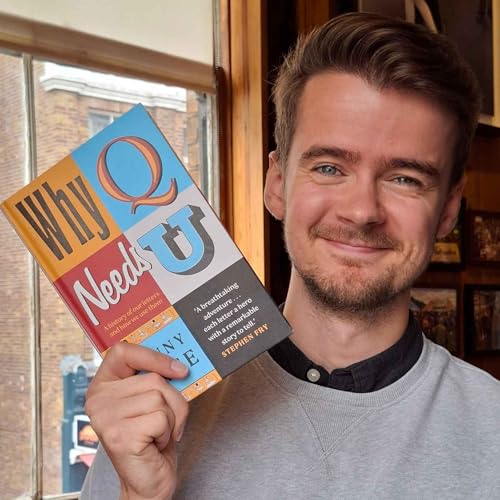
    Danny Bate joins us to talk about the history of the English alphabet, letter by letter. From the ancient Egyptian origins of A to the comeback of K, Danny talks about how writing systems travelled across civilisations and shaped modern English. We discuss silent letters, spelling quirks, phonics, Scrabble and standup comedy. Drawing on his work as a linguist, Bate explains how sound, history, and habit come together in the way we read and write today. His latest book "Why Q Needs U" was shortlisted among the best books of 2025 by The Economist and is a brilliant read.


    Danny also runs his own podcast. Check it out on https://dannybate.com/podcast


    Picture credit: http://dannybate.com/

    Hosted on Acast. See acast.com/privacy for more information.

    Show More Show Less
    52 mins
  • Marc Dunkelman on Why Nothing Works
    Dec 7 2025

    Marc J. Dunkelman is a political scientist and author of Why Nothing Works: Who Killed Progress and How to Bring It Back. Drawing on examples from infrastructure, public policy and everyday bureaucracy, Marc explains why institutions that once delivered big projects now struggle to get even simple things done. He brings to fore the cultural shifts since the 1970s, America’s “vitocracy” and why good ideas get stuck between competing interests. It's a clear, grounded look at how systems break and what it would take to fix them and is as relevant for those living outside the US.


    Picture credit: https://www.hachettebookgroup.com/

    Hosted on Acast. See acast.com/privacy for more information.

    Show More Show Less
    39 mins
  • Patrick McGee on Apple in China
    Sep 26 2025

    Patrick McGee, the Financial Times’ San Francisco correspondent, covers Apple and the U.S. technology industry. His book, Apple in China: The Capture of the World's Greatest Company is a brilliant read. In this podcast he explains how Apple became deeply tied to China’s factories, workers and politics and why that relationship still defines the company today. He also discusses the roles of Steve Jobs, Jony Ive, Tim Cook and others in shaping Apple’s culture while revealing how design, operations and manufacturing came together to create some of the most influential products of our time.


    Photograph by Cayce Clifford

    Hosted on Acast. See acast.com/privacy for more information.

    Show More Show Less
    49 mins
  • Stephen Witt on the cult of Nvidia and its charismatic founder, Jensen Huang
    Jun 14 2025

    Few people have had more access to Jensen Huang, Nvidia’s charismatic founder, than Stephen Witt. In his book The Thinking Machine: Jensen Huang, Nvidia, and the World’s Most Coveted Microchip, Witt traces the company’s three-decade journey under the leadership of a man he describes as sometimes “neurotic”, a founder who, despite being at the top of his game, constantly fears going out of business.


    And yet, his team remains fiercely loyal. He rarely fires those who face his ire. So how does he lead a company in an industry where every few years the technology is upended and replaced by something entirely new? And how does he stay grounded while working relentless hours? Stephen spoke to hundreds of people to find the answers, many of which he shares in his book and in this podcast.


    Image source: https://stephenwitt.info/

    Hosted on Acast. See acast.com/privacy for more information.

    Show More Show Less
    50 mins
  • Richard Overy on why humans go to war
    Jun 6 2025
    Why do humans go to war? Is peace ever truly possible? In this podcast historian of the Second World War and expert on totalitarian regimes and military conflict joins us to talk about his latest book, "Why War?". Drawing on decades of research, Prof Overy talks about organized violence from prehistoric times to modern state conflicts. He explains how war has evolved and what drives it and how leaders can use provocative language to brainwash their people before invading another country. What we can learn from nations, including India, that have managed to avert a full-scale war despite decades of conflicts with their neighbouring countries? Despite all the grim violence around us in Gaza and Ukraine, Prof Overy remains hopeful and says that fears of a third world war may be overblown.

    Hosted on Acast. See acast.com/privacy for more information.

    Show More Show Less
    39 mins