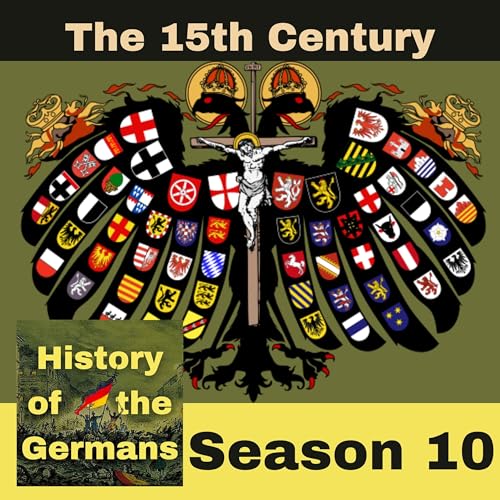
The Empire in the 15th Century cover art

The Empire in the 15th Century

The Empire in the 15th Century

By: Dirk Hoffmann-Becking
Listen for free

About this listen

This is the time when the empire reaches its most challenging phase. This is not the difficult second album, this is more Tina Turner in 1982 when her cover of shame, shame, shame reached #47 in the Netherlands charts. This is where we see the beginnings of actual states and state bureaucracies developing in Germany. But these states were extremely fragile, likely to be overrun by enemies, divided amongst multiple sons or incorporated into larger entties. War was almost constant, as were dramas of love and pride. Despite all this strife and feuding, this is also a time of great innovation. Gutenberg came up with the printing press, a technology that would undermine the authority of the Catholic church, fan the flames which led to the Reformation, create the communications infrastructure needed for the rise of modern science and even – if Neil Postman is to be believed – lead to the invention of childhood as an extended, protected phase in the lives of young people. Like the internet and social media, the printing press demanded new types of content: maps, encyclopedias, fiction, political pamphlets and engravings, opening the world up to the world.Copyright 2025 Dirk Hoffmann-Becking Art World
Episodes
  • How Holland was Lost to the Holy Roman Empire (Part 1 - the Politics)
    Dec 19 2025

    Today begins a two part series about how the Low countries modern day Belgium, Netherlands and Luxemburg shifted out of the Holy Empire. These lands, with the exception of Flanders, had been part of the empire for hundreds of years, ever since Henry the Fowler acquired Lothringia for east Francia in 925 – not by conquest but through diplomacy – as was his way.

    There are two ways to tell the story of the split away from the empire, one is about the dynastic machinations, the marriages, poisonings and inability to produce male heirs, the other one is about economics and the rising power of the cities.

    This, the first episode will look at the dynastic story, the pot luck and cunning plans that laid the groundworks for the entity that became known as the Low Countries to emerge, whilst the next one will look at the economic realities that thwarted the ambitions of one of the most remarkable women in late medieval history, Jacqueline of Bavaria, countess of Holland, Seeland and Hainault, and why that was ultimately a good thing, not for her and not for the empire, but for the people who lived in these lands.

    he music for the show is Flute Sonata in E-flat major, H.545 by Carl Phillip Emmanuel Bach (or some claim it as BWV 1031 Johann Sebastian Bach) performed and arranged by Michel Rondeau under Common Creative Licence 3.0.

    As always:

    Homepage with maps, photos, transcripts and blog: www.historyofthegermans.com

    If you wish to support the show go to: Support • History of the Germans Podcast

    Facebook: @HOTGPod

    Threads: @history_of_the_germans_podcast

    Bluesky: @hotgpod.bsky.social

    Instagram: history_of_the_germans

    Twitter: @germanshistory

    To make it easier for you to share the podcast, I have created separate playlists for some of the seasons that are set up as individual podcasts. they have the exact same episodes as in the History of the Germans, but they may be a helpful device for those who want to concentrate on only one season.

    So far I have:

    The Ottonians

    Salian Emperors and Investiture Controversy

    Fredrick Barbarossa and Early Hohenstaufen

    Frederick II Stupor Mundi

    Saxony and Eastward Expansion

    The Hanseatic League

    The Teutonic Knights

    Show More Show Less
    43 mins
  • The Landshuter Hochzeit – Love and War in Bavaria (Part 2)
    Dec 12 2025

    On November 14th and 15th 1475 one of the grandest events in the history of the Holy Roman Empire took place, the Landshuter Hochzeit, the nuptials of Georg, the Rich, son of Ludwig, the Rich and grandson of Heinrich, the Rich, all of them dukes of Bayern-Landshut, and Hedwig, the daughter of king Kasimir IV of Poland and Lithuania.

    The event attracted 10,000 guests, amongst them the Counts Palatine on the Rhine, the Dukes of Württemberg, the archduke Maximilian of Austria and the emperor Friedrich III himself. It lasted several days during which the eminent invitees as well as the citizens of Landshut ate, drank, danced and watched an endless row of tournaments, plays and musical performances.

    The fame of these festivities reverberated through the ages, so that in the 19th century the burghers of the town decided to stage the event again, initially annually and nowadays every 4 years. The reenactment involves over 2,000 participants, and culminates in a procession through the city, complete with bridal carriage, musicians and Landsknechte, all in splendid historical costumes.

    Which leaves us with more questions than answers. How come the most powerful ruler of central Europe, Kasimir King of Poland and Grand Duke of Lithuania married one of his precious daughters to the son of the ruler of half a duchy, hundreds of miles from his capital; secondly, how such a duke became so rich he could afford to stage an event that counted amongst the grandest weddings of this already very ostentatious century; and lastly, why Landshut is today a gorgeous, but only medium sized country town, and by no means the beating heart of Bavarian commerce, culture and politics.

    That is what we are going to explore in this episode.


    Show More Show Less
    44 mins
  • Agnes Bernauer - Love and War in Bavaria – (Part 1)
    Dec 5 2025

    When I first recorded this episode, my nose was so bunged up, I could barely speak. So I cloned my voice and produced a whole episode using an Ai generated version of me. That was a cool experiment, but ultimately, a canned voice is not the same thing.

    Fortunately, I am now fully recovered, and I have now re-recorded the same episode again, and this time the names of towns and cities will bear a bit more resemblance to what they are actually called.

    he music for the show is Flute Sonata in E-flat major, H.545 by Carl Phillip Emmanuel Bach (or some claim it as BWV 1031 Johann Sebastian Bach) performed and arranged by Michel Rondeau under Common Creative Licence 3.0.

    As always:

    Homepage with maps, photos, transcripts and blog: www.historyofthegermans.com

    If you wish to support the show go to: Support • History of the Germans Podcast

    Facebook: @HOTGPod

    Threads: @history_of_the_germans_podcast

    Bluesky: @hotgpod.bsky.social

    Instagram: history_of_the_germans

    Twitter: @germanshistory

    To make it easier for you to share the podcast, I have created separate playlists for some of the seasons that are set up as individual podcasts. they have the exact same episodes as in the History of the Germans, but they may be a helpful device for those who want to concentrate on only one season.

    So far I have:

    The Ottonians

    Salian Emperors and Investiture Controversy

    Fredrick Barbarossa and Early Hohenstaufen

    Frederick II Stupor Mundi

    Saxony and Eastward Expansion

    The Hanseatic League

    The Teutonic Knights

    The Holy Roman Empire 1250-1356

    The Reformation before the Reformation

    Show More Show Less
    31 mins
No reviews yet
In the spirit of reconciliation, Audible acknowledges the Traditional Custodians of country throughout Australia and their connections to land, sea and community. We pay our respect to their elders past and present and extend that respect to all Aboriginal and Torres Strait Islander peoples today.