Episodes

  • 107. Bullets Before Cannonballs & The 20-Mile March
    Mar 16 2026
    Today on The Cutting Onions Podcast, Myles and I discuss two principles from Jim Collins’ excellent book, Great By Choice, published in 2012. Jim has a new book coming out on April 7th titled What To Make of A Life, and we can’t wait to get our hands on it!In today’s conversation, we discussed firing bullets before cannonballs and the 20-mile march.
    Bullets Before Cannonballs:
    Imagine two ships trying to hit an enemy target.One captain loads the cannon immediately and fires a massive cannonball.Huge risk. Huge cost. Huge commitment.But the other captain takes a different approach.He fires a bullet first.A small test shot.Then another.And another. And when those bullets start hitting the target… Then he loads the cannon and fires the cannonball.Jim Collins defines a bullet like this:‘A bullet is a low-cost, low-risk, low-distraction experiment.’
    In the context of the restaurant/hospitality industry, it looks like running pilots (not systemwide rollouts without testing), and then gathering data and feedback. Those are bullets.
    Then they scaled it and fired the cannonball.The 20-mile march story Jim Collins touches on is fascinating. He tells the story of two explorers racing to the South Pole: ⁠Roald Amundsen⁠ and ⁠Robert Falcon Scott⁠.Amundsen approached the expedition with incredible discipline.
    • He committed to marching 20 miles every single day.
    • If the weather was beautiful, they marched 20 miles.
    • If the weather was brutal, they marched 20 miles.
    • No heroics. No overextending.

    Just disciplined progress.
    Scott’s team took the opposite approach.
    • When conditions were good, they pushed themselves to exhaustion.
    • When conditions were bad, they stopped.
    • And that lack of consistency ultimately cost them the race—and tragically, their lives.

    So what does this have to do with leadership?Great leaders combine two things:
    1. They fire bullets before cannonballs.
    2. And they march 20 miles every day.

    They test ideas before committing huge resources.And they build disciplined, consistent progress over time.That combination—experimentation and discipline—is what allows organizations to win over the long haul. Are you firing cannonballs before you know where the target is?Or are you firing bullets… learning… adjusting… and then committing your resources?And once you find the target…Are you marching 20 miles every single day?
    Because great leadership isn’t about heroic bursts of activity.
    It’s about disciplined progress and smart experimentation.
    Show More Show Less
    25 mins
  • Ep. 107 Bullets Before Cannonballs & The 20-Mile March
    Mar 16 2026
    Today on The Cutting Onions Podcast, Myles and I discuss two principles from Jim Collins’ excellent book, Great By Choice, published in 2012. Jim has a new book coming out on April 7th titled What To Make of A Life, and we can’t wait to get our hands on it! In today’s conversation, we discussed firing bullets before cannonballs and the 20-mile march.

    Bullets Before Cannonballs:
    Imagine two ships trying to hit an enemy target. One captain loads the cannon immediately and fires a massive cannonball. Huge risk. Huge cost. Huge commitment. But the other captain takes a different approach. He fires a bullet first. A small test shot. Then another. And another. And when those bullets start hitting the target… Then he loads the cannon and fires the cannonball. Jim Collins defines a bullet like this: ‘A bullet is a low-cost, low-risk, low-distraction experiment.’

    In the context of the restaurant/hospitality industry, it looks like running pilots (not systemwide rollouts without testing), and then gathering data and feedback. Those are bullets.

    Then they scaled it and fired the cannonball. The 20-mile march story Jim Collins touches on is fascinating.

    He tells the story of two explorers racing to the South Pole: Roald AmundsenandRobert Falcon Scott. Amundsen approached the expedition with incredible discipline.
    • He committed to marching 20 miles every single day.
    • If the weather was beautiful, they marched 20 miles.
    • If the weather was brutal, they marched 20 miles.
    • No heroics. No overextending.
    Just disciplined progress.
    Scott’s team took the opposite approach.
    • When conditions were good, they pushed themselves to exhaustion.
    • When conditions were bad, they stopped.
    • And that lack of consistency ultimately cost them the race—and tragically, their lives.
    So what does this have to do with leadership? Great leaders combine two things:
    1. They fire bullets before cannonballs.
    2. And they march 20 miles every day.
    They test ideas before committing huge resources. And they build disciplined, consistent progress over time.

    That combination—experimentation and discipline—is what allows organizations to win over the long haul.

    Are you firing cannonballs before you know where the target is?

    Or are you firing bullets… learning… adjusting… and then committing your resources? And once you find the target…

    Are you marching 20 miles every single day?

    Because great leadership isn’t about heroic bursts of activity.

    It’s about disciplined progress and smart experimentation.
    Show More Show Less
    25 mins
  • Ep. 106 The Power of Storytelling in Hospitality and in Life
    Mar 8 2026
    Welcome to The Cutting Onions Podcast. This is episode 106, and in today’s conversation, we're talking about the power of storytelling in hospitality and in life. Alongside my co-host, as always, Myles Gift, we’re really excited about this conversation. We believe storytelling has become a really important part of the work we do in the restaurant and hospitality industry, but you see its importance everywhere in every industry across every platform.

    This week, there has been a lot of energy around storytelling coming from some of the major burger brands out there and their new sandwiches, so that's part of this, but certainly not the full weight of it. This conversation is really on the power of storytelling and why it matters in hospitality.

    We talk about the three stories that every hospitality brand is telling:
    1. They're telling the story of the guest
    2. They're telling the story of their team.
    3. They're telling the story of their leadership.

    We’re very excited about this conversation. We hope you enjoy it as you immerse yourself in it and really think through the way that you're telling your story and the way that your brand is telling their story and using storytelling as a leadership tool.

    And finally, this last week, one of our childhood heroes, Harrison Ford, gave an acceptance speech at the Screen Actors Guild Awards that was a master class in why storytelling matters. We’ve posted about that a few times this week. If you haven’t seen it, we encourage you to watch it.

    This quote from Harrison Ford sums up the power of storytelling beautifully: "The stories we tell have a unique capacity to create moments of emotional connection."

    And isn’t that what we’re all here to do?

    We would love to hear from you on how you use storytelling in your brand to elevate your organization, your teams, and how you are impacting your communities.

    Thanks again today for joining us. We're really happy to have you here, and we'll see you on the other side.
    Show More Show Less
    43 mins
  • 106. The Power of Storytelling in Hospitality and in Life
    Mar 8 2026
    Welcome to The Cutting Onions Podcast. This is episode 106, and today’s conversation we're talking about the power of storytelling in hospitality and in life. Alongside my co-host, as always, Myles Gift, we’re really excited about this conversation. We believe storytelling has become a really important part of the work we do in the restaurant and hospitality industry, but you see its importance everywhere in every industry across every platform. This week, there has been a lot of energy around storytelling coming from some of the major burger brands out there and their new sandwiches so that's part of this, but certainly not the full weight of it. This conversation is really on the power of storytelling and why it matters in hospitality. We talk about the three stories that every hospitality brand is telling:
    1. They're telling the story of the guest
    2. They're telling the story of their team.
    3. They're telling the story of their leadership.
    We’re very excited about this conversation. We hope you enjoy it as you immerse yourself in it and really think through the way that you're telling your story and the way that your brand is telling their story and using storytelling as a leadership tool. And finally, this last week, one of our childhood heroes, Harrison Ford, gave an acceptance speech at the Screen Actors Guild Awards that was a master class in why storytelling matters. We’ve posted about that a few times this week. If you haven’t seen it, we encourage you to watch it. This quote from Harrison Ford sums it up beautifully: "The stories we tell have a unique capacity to create moments of emotional connection." And isn’t that what we're all here to do?Thanks again today for joining us. We're really happy to have you here, and we'll see you on the other side.
    Show More Show Less
    43 mins
  • 105. Bobby and Myles Discuss The 4 Leadership Needs of Every Follower
    Jan 23 2026
    Today on The Cutting Onions Podcast, Bobby and Myles talk about the Four Leadership Needs of every follower in every organization.

    Gallup recently studied people across 52 countries and found something powerful: No matter where you live, no matter the industry, the people you lead have four core leadership needs. Hope. Trust. Compassion. Stability.

    Of all four, hope is the most essential. Hope isn’t wishful thinking. Hope is a leader helping people see a better future and their place in it. Gallup’s data shows that when leaders inspire hope, thriving increases and suffering decreases. That’s not squishy leadership. That’s real impact.

    But hope alone isn’t enough. Trust means people believe your words and your actions align. Compassion means people feel seen, heard, and cared for, not managed. Stability means that even in uncertainty, your leadership provides clarity and psychological safety.

    Every day, our teams are asking four quiet questions:
    1. Can I believe in where we’re going?
    2. Can I trust you?
    3. Do you care about me?
    4. And am I safe here?
    Great leaders don’t guess at those answers. We hope you enjoy this episode!
    Show More Show Less
    43 mins
  • 105. Bobby and Myles Discuss The 4 Leadership Needs of Every Follower
    Jan 23 2026
    Today on The Cutting Onions Podcast, Bobby and Myles talk about the Four Leadership Needs of every follower in every organization. Gallup recently studied people across 52 countries and found something powerful: No matter where you live, no matter the industry, the people you lead have four core leadership needs.Hope. Trust. Compassion. Stability.Of all four, hope is the most essential. Hope isn’t wishful thinking. Hope is a leader helping people see a better future and their place in it.Gallup’s data shows that when leaders inspire hope, thriving increases and suffering decreases.That’s not squishy leadership. That’s real impact. But hope alone isn’t enough.Trust means people believe your words and your actions align. Compassion means people feel seen, heard, and cared for, not managed. Stability means that even in uncertainty, your leadership provides clarity and psychological safety. Every day, our teams are asking four quiet questions:- Can I believe in where we’re going?- Can I trust you?- Do you care about me?- And am I safe here?
    Great leaders don’t guess at those answers.
    We hope you enjoy this episode!
    Show More Show Less
    43 mins
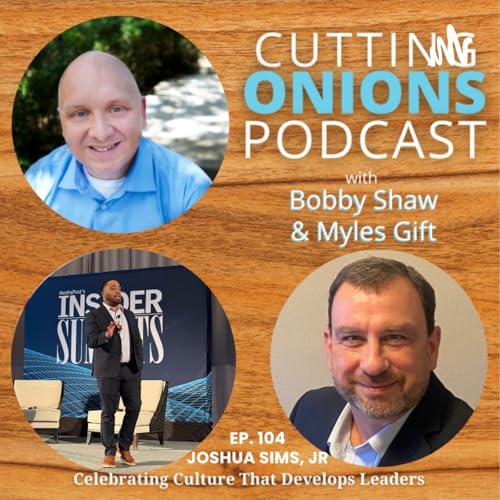
  • 104. Joshua Sims talks Entrepreneurship and the intersection of Marketing & Operations
    Jan 8 2026
    Today we are excited to host Joshua Sims Sr.on The Cutting Onions Podcast.

    Joshua is an entrepreneur and marketing executive, and the Founder of The Fossil Group, an omni-channel, digital, and data-forward marketing agency focused on driving digital sales for franchisees, emerging brands, and founders.

    His background includes serving as Head of Marketing at Big Chicken, Senior Manager of Media & Advertising (Digital) at Bojangles, and Co-Founder and Chief Marketing Officer of Family Life Brands.
    Joshua is also a restaurateur and has a new deli getting ready to open in North Carolina. As you’ll hear in this conversation, entrepreneurship runs in Joshua’s family, and it is in his DNA.

    He also resurrected his marketing agency as well because he saw a need to help small businesses and give them the tools to scale their organizations.

    Joshua has a unique way of connecting to Operations and building that bridge where Marketing and Operations work closely together to accomplish the KPI’s to drive the business.

    A graduate and former football athlete at North Carolina Central University. Joshua’s passion for HBCUs, sports, and culture led him to co-found The HBCUNightly Network, a media platform dedicated to elevating HBCU athletics and stories.

    His proudest accomplishment is being a devoted husband to his beautiful wife and a father to their four great children.

    We know you will enjoy this inspiring conversation with Joshua Sims! See you on the other side.
    Show More Show Less
    47 mins
  • 104. Joshua Sims talks Entrepreneurship and the intersection of Marketing & Operations
    Jan 8 2026
    Today we are excited to host Joshua Sims Sr.on The Cutting Onions Podcast.
    Joshua is an entrepreneur and marketing executive, and the Founder of The Fossil Group, an omni-channel, digital, and data-forward marketing agency focused on driving digital sales for franchisees, emerging brands, and founders.
    His background includes serving as Head of Marketing at Big Chicken, Senior Manager of Media & Advertising (Digital) at Bojangles, and Co-Founder and Chief Marketing Officer of Family Life Brands.
    Joshua is also a restaurateur and has a new deli getting ready to open in North Carolina. As you’ll hear in this conversation, entrepreneurship runs in Joshua’s family, and it is in his DNA.
    He also resurrected his marketing agency as well because he saw a need to help small businesses and give them the tools to scale their organizations.
    Joshua has a unique way of connecting to Operations and building that bridge where Marketing and Operations work closely together to accomplish the KPI’s to drive the business.
    A graduate and former football athlete at North Carolina Central University. Joshua’s passion for HBCUs, sports, and culture led him to co-found The HBCUNightly Network, a media platform dedicated to elevating HBCU athletics and stories.
    His proudest accomplishment is being a devoted husband to his beautiful wife and a father to their four great children.
    We know you will enjoy this inspiring conversation with Joshua Sims! See you on the other side.
    Show More Show Less
    47 mins