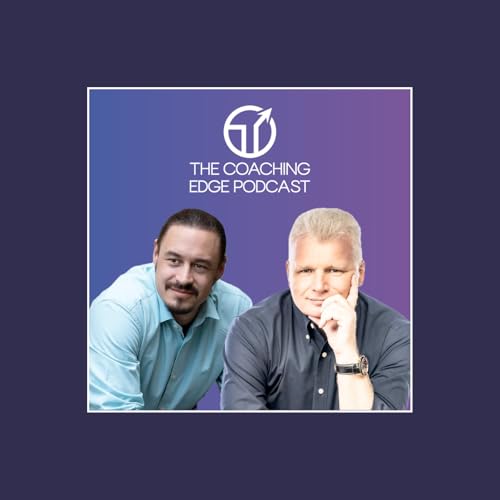
The Coaching Edge Podcast cover art

The Coaching Edge Podcast

The Coaching Edge Podcast

By: Dr. Steve Jeffs and Erwin de Grave
Listen for free

About this listen

A Podcast About Coaching, Business and other Interesting Stuff.

Copyright 2024 Dr. Steve Jeffs and Erwin de Grave
Economics Management Management & Leadership Personal Development Personal Success
Episodes
  • When Data Isn't Enough: Anita Kishore on Leading with Both Head and Heart
    Dec 17 2025

    In this episode of The Coaching Edge Podcast, Erwin de Grave and Dr. Steve Jeffs sit down with Dr. Anita Kishore, an executive coach for analytically minded leaders. With a background spanning a PhD in chemistry, pharma, consulting, and global health, Anita shares how she moved from hard science into the deeply human world of coaching — and why those worlds are far more connected than many leaders think.


    Anita explores what happens when brilliant, data-driven executives hit the limits of analysis. She explains why most decisions are, at their core, emotional, and how ignoring emotion doesn’t make us more analytical — it just makes our decision-making incomplete. She describes her work with “overthinkers” and analytical executives who want to become more inspirational leaders by integrating intellect and emotion, leading with both head and heart.


    The conversation dives into practical tools for leaders:

    • How to notice what you’re feeling in high-stake meetings without losing focus.
    • Using a simple “inner narration” technique in your notes to stay grounded and present.
    • Expanding your emotional vocabulary beyond the three “corporate-approved” feelings of happy, disappointed, and frustrated.
    • Helping teams feel safe to express emotions without everyone rushing in to “fix” or rescue.


    Anita also talks about decision-making when the data is incomplete, the realities of risk for senior leaders, and why emotional information is still data. Looking ahead, she shares her thoughts on AI’s role in leadership and coaching, and her hope for workplaces that combine psychological safety with real intellectual rigor.


    If you work with technical, scientific, or highly analytical leaders — or you are one — this episode offers a grounded, practical roadmap for becoming both more effective and more human as a leader.


    Watch the full episode here: https://thecoachingedgepodcast.com/when-data-isnt-enough-anita-kishore-on-leading-with-both-head-and-heart/

    Show More Show Less
    37 mins
  • Five-Minute Journaling: How Kay Adams Turns Writing into Everyday Therapy
    Dec 10 2025

    In this episode of The Coaching Edge Podcast, hosts Erwin de Grave and Dr. Steve Jeffs sit down with Kay Adams, a psychotherapist, journal therapist, and founder of the Center for Journal Therapy. From her early days as a lifelong journaler and journalism major to discovering, almost by accident, that journaling could become her life’s work, Kay shares the story of a 40-year career at the intersection of writing, psychology, and healing.


    Kay explains how a simple request from friends to “teach a journaling workshop” led her to codify 21 different journaling techniques, and later to develop the Journal Ladder—a structured hierarchy of writing methods designed to support safety, pacing, and containment, especially for people with trauma. She describes working in psychiatric hospitals with women diagnosed with what is now called dissociative identity disorder, and how she realized that unstructured free writing could unintentionally retraumatize them. Her answer was to design more guided approaches using tools like sentence stems (“Right now I feel…”, “Today the most important thing is…”) to help clients self-regulate on the page.

    The conversation also explores who tends to be drawn to journaling, and how gender patterns show up differently. While many women privately process their emotions in journals and hesitate to share their writing, Kay noticed that men often prefer to talk first—and, once they do write, they’re surprisingly eager to read their work aloud. Underneath these differences, she emphasizes, we’re all dealing with the same human struggles; journaling just gives each person a way to externalize and clarify what’s going on inside.


    One of the most practical ideas in this episode is the power of the five-minute sprint: writing fast for just five minutes about a realization, conflict, or problem. For busy coaches, leaders, and entrepreneurs, Kay frames this as a simple act of self-permission—five minutes of presence with yourself. Paired with a short reflection write (“As I read this, I notice…”), it becomes a powerful tool for insight, action planning, and tracking growth over time.


    Kay also touches on AI as an ally rather than a threat to journaling. She suggests using AI to generate writing prompts—“Give me 10 (or 30) journal prompts about the conflict I’m having with my team leader”—as a way to expand perspective and deepen self-exploration. For professionals who support others—coaches, therapists, and facilitators—she points to the Therapeutic Writing Institute, a three-year training program she designed for those who want to build a practice around expressive and therapeutic writing.


    If you’ve ever thought, “I don’t have time to journal” or “I don’t know what to write,” this episode offers both reassurance and a toolkit. Journaling doesn’t have to be elaborate or perfect; it can simply be five minutes, a few prompts, and the willingness to meet yourself on the page.


    Watch the full episode here: https://thecoachingedgepodcast.com/five-minute-journaling-how-kay-adams-turns-writing-into-everyday-therapy/

    Show More Show Less
    50 mins
  • Inside the Rise of Internal Coaching: How Rusty Tugman Built a Coaching Culture from the Inside Out
    Dec 3 2025

    In this episode of The Coaching Edge Podcast, co-hosts Dr. Steve Jeffs and Erwin de Grave sit down with Rusty Tugman, leadership trainer, coach, and creator of the first internal coaching program in the history of Oklahoma state government. After 30 years in full-time ministry, Rusty transitioned into the role of leadership trainer and coach at the Oklahoma Department of Human Services (OKDHS), a 6,000+ employee government agency serving some of the state’s most vulnerable citizens. What started as coaching a single employee organically grew—through word of mouth—into a robust internal coaching program offering executive, leadership, conflict, group, and team coaching.


    Rusty explains the unique challenges and opportunities of internal coaching versus external coaching. As an internal coach, he is “one of us” inside the system, dealing with real power dynamics, conflicts of interest, and the reality that some clients technically have the authority to fire him. Yet that same embedded position gives him something external coaches rarely have: day-to-day visibility of behavior change, team dynamics, and cultural shifts in real time. He also shares how critical it is to position internal coaching away from discipline and “fixing” people, and instead as a positive, future-focused resource designed to unlock potential and support growth.


    A major part of the conversation centers on how Rusty built and scaled an internal coaching program. He walks through four key pillars he used to design it:

    1. Clear purpose – What problem does coaching solve, what value does it bring, and how does it support organizational goals?
    2. Standards and structures – Using ICF competencies and ethics as quality anchors while allowing individual coaching style.
    3. Measurement and impact – Demonstrating value, especially ROI and outcomes such as performance, engagement, and culture.
    4. Delivery and consistency – Actually delivering results so coaching becomes a budget-worthy, permanent part of the business.


    Unexpectedly, one of the strongest outcomes of the program has been employee well-being. Rusty shares that the most common feedback from coachees is not only about better performance, but about feeling supported, having a safe place to talk, and being able to process the emotional load of the work. For leaders—especially senior leaders—coaching becomes a rare space to think out loud, explore ideas without everything being taken as a directive, and confront their own self-doubt.


    Rusty and the hosts also explore how internal coaches can coexist and partner with external coaches, aiming for alignment and consistency rather than competition. Ultimately, Rusty’s vision is a true coaching culture at OKDHS, where coach-like leadership, thought partnership, and human-centered support are embedded throughout the organization—not just reserved for the top of the org chart.


    Watch the full episode here: https://thecoachingedgepodcast.com/inside-the-rise-of-internal-coaching-how-rusty-tugman-built-a-coaching-culture-from-the-inside-out/

    Show More Show Less
    41 mins
No reviews yet
In the spirit of reconciliation, Audible acknowledges the Traditional Custodians of country throughout Australia and their connections to land, sea and community. We pay our respect to their elders past and present and extend that respect to all Aboriginal and Torres Strait Islander peoples today.