• Mexico: How the Mexican Revolution Assassinated Currency
    Mar 22 2026

    An overview of the events and actions of the key players of the Mexican revolution that created the issuance of a vast quantity and variety of currency of that era and how the armies and the people had to adjust.

    Show More Show Less
    51 mins
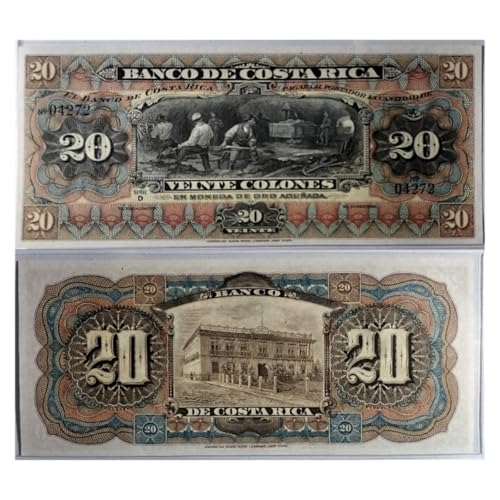
  • Costa Rica: Banco de Costa Rica 20 Colones Series D (1901)
    Feb 17 2026

    The turn of the 20th century marked a definitive inflection point for the Republic of Costa Rica, a period characterized by the ascendancy of the "Liberal State" and the aggressive modernization of its economic infrastructure. The banknote we are looking at—the Banco de Costa Rica 20 Colones, Series D, dated 1901 encapsulates the nation’s aspirations toward industrial progress, financial stability, and architectural grandeur.

    The specific specimen under analysis, identified by Serial Number 04272, belongs to a series of banknotes produced by the American Bank Note Company (ABNC) of New York. By deconstructing its physical composition, iconographic narratives, and institutional origins, we reveal the broader economic tapestry of the "Generation of Olympus" (Generación del Olimpo)—the liberal elite that governed Costa Rica and sought to integrate its coffee-based economy into the gold-standard global markets of Europe and North America.1

    This report asserts that the Series D 20 Colones note was designed to function as a "monument in paper." At a time when the Costa Rican Colón (introduced in 1896) was solidifying its value against gold, the Banco de Costa Rica—the nation's premier financial institution—commissioned a currency that visually equated the extraction of mineral wealth (the obverse mining scene) with the solidity of banking institutions (the reverse architectural portrait). The survival of Serial 04272 as a high-grade remainder allows for a pristine view into the engraving mastery of the late Victorian era, offering numismatists and historians alike a tangible link to the zenith of private bank issuance in Central America.

    Show More Show Less
    25 mins
  • Costa Rica: Banco de Costa Rica 20 Colones Series C (1906) Banknote
    Feb 16 2026

    A review of the history of the bank, the iconongraphy on the banknote, the Series C, and the market and technical specs. Did you know there was an American who wanted to establish English speaking colonies and slave states in Latin America and who was celebrated in the U.S>? Listen and find out where he fits in to the story.

    Show More Show Less
    30 mins
  • Costa Rica: PMG 65 EPQ Banco National De Costa Rica 5 Colones 1937-1938 (Pick 198a)
    Feb 15 2026

    The study of Latin American currency provides a unique lens through which to view the economic and political evolution of the region. We are looking at the Costa Rica 5 Colones note of 1937-1938, cataloged in the Standard Catalog of World Paper Money as Pick 198a. This banknote is not merely a medium of exchange; it is a transitional artifact that bridges two distinct eras of Costa Rican banking history: the period of the Banco Internacional de Costa Rica and the subsequent establishment of the Banco Nacional de Costa Rica.

    This report focuses on a specific, high-grade specimen of this issue: a 5 Colones note graded PMG 65 EPQ (Gem Uncirculated), identified as a "Top Pop" (Top Population) rarity. The existence of such a pristine example is a statistical anomaly given the tropical climate of Costa Rica and the heavy circulation these low-denomination notes typically endured. The note is characterized by its provisional nature—a revalidation of an earlier issue via a typographic overprint—and its striking obverse vignette, familiarly known to collectors as the "Banana Train."

    The visual narrative of the note, depicting the loading of bananas onto a railway car, encapsulates the "Green Gold" era of Costa Rica, dominated by the United Fruit Company and the Atlantic Railroad. This report will dissect the historical context, technical specifications, security features, and market dynamics surrounding this numismatic treasure, providing a definitive reference for the advanced collector.

    Show More Show Less
    30 mins
  • Mexico: Mexican Currency History from Cacao to Polymer
    Feb 11 2026

    Great overview to start with Mexican currency, from pre-Hispanic, to colonial to pre-revolution to revolution to independence to the latest issues, the Series G

    Show More Show Less
    31 mins
  • Mexico: El Estado de Chihuahua 10 Pesos Series: Dos Caritas 10 Pesos Banknote (1915)
    Mar 20 2026

    This extensive research report presents a definitive numismatic and historical analysis of the 10 Pesos banknote issued by El Estado de Chihuahua in 1915, identified in the Standard Catalog of World Paper Money as Pick Number S535a. Belonging to the celebrated "Dos Caritas" (Two Faces) series, this artifact is not merely a piece of currency but a primary document of the Mexican Revolution. It encapsulates the political legitimacy asserted by the División del Norte under General Francisco "Pancho" Villa, featuring the dual portraits of the martyred President Francisco I. Madero and the assassinated Chihuahuan Governor Abraham González.

    The report establishes that the specific specimen presented—a Series N note issued in January 1915—represents a critical juncture in the revolutionary war economy. It was produced during a period of intense inflation and military mobilization, authorized by the Military Decree of February 10, 1914. The analysis confirms the note's attribution as Pick S535a based on the absence of a printed date on the reverse and the presence of the distinct red "RUI-M" control mark, a feature of significant philatelic interest representing regional revalidation.

    Through a rigorous examination of numismatic data, this report details the technical specifications of the note, including its lithographic production, likely by U.S.-based firms such as the Norris Peters Co. or Maverick-Clarke, and the specific security features employed to combat the rampant counterfeiting of the era. The report further provides a granular market analysis, synthesizing data from PMG population reports and realized auction prices to offer a current valuation model. It concludes that while the "Dos Caritas" series was printed in vast quantities to fund the war effort, high-grade examples (EPQ) are increasingly scarce, with the "RUI-M" variety commanding specific attention from advanced collectors.

    Show More Show Less
    32 mins
  • Mexico: El Estado de Chihuahua 50 Centavos Series Dos Caritas Banknote (1915)
    Mar 20 2026

    The subject of this analysis is a regional Mexican banknote issued during the tumultuous period of the Mexican Revolution. Based on a methodical examination of the attached images and cross-referencing with numismatic databases, the specimen is definitively identified as the 1914 State of Chihuahua 50 Centavos note, cataloged under the Pick reference system as P-S527 and documented in the Numista registry as N# 248661.

    This specific fractional currency belongs to a broader familial grouping of revolutionary fiat money colloquially known among numismatists as the "Dos Caritas" (Two Faces) series.1 Authorized by the military decree of February 10, 1914, under the hegemony of General Francisco "Pancho" Villa's División del Norte (Division of the North), this currency was deployed as an emergency measure to stabilize a regional economy crippled by civil war, infrastructural collapse, and the hoarding of hard silver specie.3

    The following report provides a systematic evaluation of the historical and economic environment that necessitated this issue, the biographical context of the issuing authorities and signatories, the convoluted cross-border production logistics involving American commercial lithographers, and the extensive counterfeiting operations that targeted these notes. Furthermore, it delivers a direct visual analysis of the provided specimen, isolating its specific control letters, revalidation overstamps, security features, and estimated market valuation based on contemporary grading censuses.

    Show More Show Less
    27 mins
  • Mexico: Banco de Mexico 1000 Pesos Series AA (1974)
    Mar 19 2026

    This podcast analyzes the 1974 Banco de México 1000 Pesos banknote (Pick 52, Series BYT). It serves as a numismatic document that captures Mexico's economic transition from the stable "Mexican Miracle" era to a period of escalating inflationary pressure. The banknote, one of the final high-denomination notes printed by the American Bank Note Company (ABNC) for Mexico, features the Aztec emperor Cuauhtémoc on the obverse as a symbol of indigenous sovereignty and anti-imperialism, and the Mayan Temple of Kukulcan (El Castillo) at Chichén Itzá on the reverse, unifying Mexico's cultural history. Issued just before the severe economic crises of the late 1970s and 1980s, the note's high-grade preservation makes it a scarce and valuable relic of a vanished monetary system, as its purchasing power was later annihilated by hyperinflation and the note was demonetized in the 1993 Nuevo Peso reform.

    Show More Show Less
    43 mins