Tell it like it is cover art

Tell it like it is

Tell it like it is

By: Manisha Kadagathur
Listen for free

About this listen

Explore the concepts of purpose, performance, and reward through the lens of the guests with Manisha Kadagathur, management consultant and entrepreneur. Each week, I will bring you stories of their journeys and fill in the missing lines in ways we can all use to do more and feel better in our lives. Read full interview transcripts at: https://www.tellitlikeitispodcast.com/blog and catch trailers to future episodes. Follow us on Spotify: https://open.spotify.com/show/0NGjwaJZPWjuMjkKOldnCZManisha Kadagathur Economics
Episodes
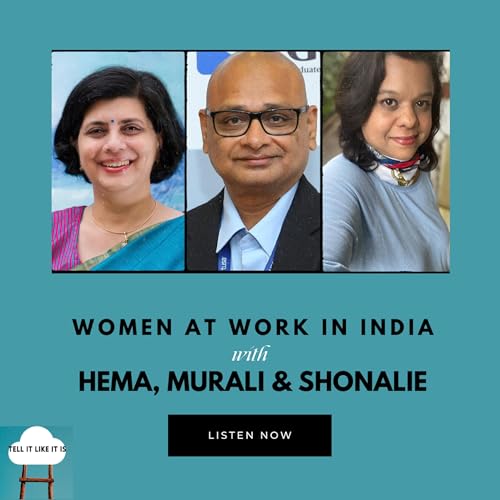
  • Women at work in India
    Feb 16 2021

    Today’s episode is the third in our series on women’s participation in the workforce in India. Every year, class XII grades show girls outperforming boys in science subjects. A McKinsey study, shows that in India women make up 43% of those graduating but only 25% of those in entry level jobs. That is a huge drop. There are many explanations including marriage, childbirth, care for elders, being the trailing spouse, safety, and all of this compounds as you go higher in the career ladder. The burden of childcare and elder care almost entirely falls on women. The effect shows on the labor participation rate. At an effective 11% participation in manufacturing and services, we trail many mature and emerging countries.

    For some time now, I’ve brought you individual stories of guests with outsized abilities and wisdom. So, in a break from tradition, today, I bring you a panel discussion with 3 leaders, who have the unique distinction of being able to shape the participation of women at work in India and with a different perspective and background. Joining me are Hema Hattangady, former CEO of Conzerv, an Indian family-owned enterprise acquired by Schneider Electric, who sits on the board of multiple companies and an alumnus of IIM Calcutta, Dr. Murali Padmanabhan, Senior VP for Global Talent & OD at Virtusa, leadership coach and a PhD in Applied Mathematics from the University of Hyderabad and Shonalie Gupta, Senior Director Organization Development at Indegene, diversity and inclusion coach and an alumnus of XLRI, Jamshedpur.

    In this episode, we discuss awareness of India’s dismal female participation, societal stereotypes, and challenges. But that is not all. We go further and give you practical, tested, tips and ideas on how to have the conversation around increasing female labor participation, beginning with small changes at an individual level to large scale organization impact. To cap it off, each of the panelists include their wish list of how they see corporate India 20 years from now. Go on, grab a cuppa joe, a note pad and tune in.

    Read a transcript of this interview at: https://www.tellitlikeitispodcast.com/post/s5-e4-bonus-women-at-work-in-india-tell-it-like-it-is

    Recommended reading:

    • The future of women at work by McKinsey Global Institute
    • Skills development of women through vocational training by Nikita Diwakar & Tauffiqu Ahamad: https://www.researchgate.net/publication/290691361_Skills_development_of_women_through_vocational_training
    • Women in the workplace by Lean In & McKinsey: https://womenintheworkplace.com/
    Show More Show Less
    58 mins
  • Bring back the midwife
    Feb 4 2021

    One of the reasons women drop out of the workforce is childbirth. Troubling as that is, even today, many women lose their lives during pregnancy and childbirth. A key indicator of maternal mortality is the Maternal Mortality Ratio (MMR). Recently, the Government of India published MMR for 2016-18 which stood at 113. To put this into context, the target 3.1 of Sustainable Development Goals (SDG) set by United Nations aims at reducing the global maternal mortality ratio to less than 70 per 100,000 live births. So, what can be done? Countries like Canada, Sri Lanka and the UK have combated MMR by introducing trained midwives into the process, vital to the care and delivery of low-risk pregnant women. It is important to mention here that about 75% of all pregnant women fall in the low-risk category and it is the 25% cases that are complicated and require an obstetrician’s attention. With over 25 million children born every year in India, and only 86,000 professionally trained midwives, there is a huge gap.

    This episode focuses on maternal mortality and helping women enjoy motherhood without the inherent risks of childbirth through a simple, effective, and forgotten method. My guest is Dr. Evita Fernandez, Chairperson-Fernandez Foundation, and a Fellow of the Royal College of Obstetricians and Gynecologists. She is the recipient of The Lifetime Achievement in Healthcare Award by FICCI, Hyderabad, besides other awards. In 2017, the Government of Telangana felicitated her for rendering exemplary services in the Field of Medicine. In 2011, she introduced a Professional Midwifery Education and Training Programme, committed to creating a national cadre of professional midwives. I caught up with her to understand how midwifery could be the solution to helping millions of women enjoy childbirth and have agency over their own bodies.

    Contact Fernandez Foundation: https://www.fernandez.foundation/

    Read a transcript of this interview at: https://www.tellitlikeitispodcast.com/post/s5-e3-bring-back-the-midwife-tell-it-like-it-is

    Recommended reading:

    1. Woman centred care: Has the definition been morphing of late? Elizabeth Rigg & Hannah Grace Dahlen

    2. WHO: The case for midwifery

    Show More Show Less
    37 mins
  • Voice for Girls
    Jan 21 2021

    India ranks pretty low in female labor participation. In 2019, female labor participation stood at a meagre 27% in comparison to China’s female labor participation at 60%. In India, over 60% of those who are employed are in agriculture, resulting effectively, in 11% female labor participation in services and manufacturing. It is well understood that if we are to go grow as a nation, then we need more women at the workplace. Prima facie, this should be easy, given our female to male ratio. Per the United Nations, women make up 48.04% of the population. However, in reality, getting women to participate in the formal workforce is far from easy. Especially since a large section of women are ill equipped with the basic skills and do not possess a high school degree. Why is that? This is so because a large number of girls simply drop out of school when they hit puberty, acerbated by unique socio-cultural stereotypes.

    My guest today is Anusha Bharadwaj, Executive Director of Voice4Girls, a social enterprise working with marginalized adolescent girls in rural Telangana and Andhra with a vision to educate and empower girls against violence and inequality. In our free-wheeling conversation, we touch upon many topics and taboos that are entrenched in our society, gender inequality, stereotypes, violence, early marriage and how keeping adolescent girls in school through high school might just be the way to increasing their participation in the workforce of the future.

    Contact Voice4Girls

    Read a transcript of this interview at: https://www.tellitlikeitispodcast.com/post/s5-e2-tell-it-like-it-is-voice-for-girls

    Show More Show Less
    36 mins
No reviews yet
In the spirit of reconciliation, Audible acknowledges the Traditional Custodians of country throughout Australia and their connections to land, sea and community. We pay our respect to their elders past and present and extend that respect to all Aboriginal and Torres Strait Islander peoples today.