Episodes

  • Detecting Structural Defects From a Photo w/ Ralph Noronha
    Mar 10 2026

    “What if detecting critical structural defects was as easy as uploading a photo?”


    Most structural inspections still rely on manual site visits, ladders, and visual checks, leaving room for missed defects, costly delays, and safety risks. In this episode I sit down with Ralph Noronha, founder of Defectech, to explore how AI, drones, and 3D modeling are transforming the way engineers detect and manage structural defects. Ralph shares the story behind building a bootstrap startup that turns ordinary images into actionable insights, enabling faster, safer, and more scalable inspections without sacrificing accuracy.


    From the technical challenges of training bespoke machine learning models to the human side of entrepreneurship, Ralph explains how Defectech balances risk, innovation, and real-world impact. Whether you’re an engineer, asset owner, or tech enthusiast, this conversation reveals how modern tools are redefining inspection workflows, making defect detection as easy as uploading a photo, and why the future of structural intelligence is about combining technology with practical expertise.


    🔑 Key Takeaways:

    - Traditional inspections miss defects; AI and drones make detection faster, safer, and more complete.

    - Photos become actionable 3D models, turning raw data into precise insight.

    - Bespoke machine learning models require meticulous data, annotation, and hyperparameter tuning.

    - Effective adoption depends on human judgment, trust, and workflow design not just technology.

    - Founders succeed by leveraging strengths, iterating fast, and learning from failure under tight resources.


    ⏱ Timestamps:

    00:00 - Engineering Meets Innovation

    04:53 - From Banking To Startup

    08:56 - Founder Mindset and Motivation

    12:23 - AI-Powered Defect Detection

    17:53 - Building and Training AI Models

    22:05 - Using Defectech In Practice

    26:48 - Recognition, Adoption, And Future Insights

    31:27 - Asset Storytelling And Predictive Insights

    35:22 - Customer Focus And Common Defects

    40:53 - AI Impact And Closing Thoughts


    🔗 Guest: Ralph Noronha

    Co-Founder of Defectech

    Website: https://www.defectech.com.au/

    LinkedIn (Company): https://au.linkedin.com/company/defectech

    LinkedIn (Ralph Noronha): https://au.linkedin.com/in/ralnor


    🎧 Host & Links

    LinkedIn: https://www.linkedin.com/in/owenrkeenan

    Spotify: https://open.spotify.com/show/7vcBFpl87NcqpLf0seIRaW

    YouTube: https://www.youtube.com/channel/UCE9Ax8jAJl2x0QQp3cO8vrw

    VoiceInspect.ai (AI for inspections): https://www.voiceinspect.ai


    👉 Subscribe to the Structural Intelligence Podcast on YouTube and Spotify to stay updated on new episodes.

    #Engineering #Technology #Innovation

    Show More Show Less
    44 mins
  • Stop Relying on “Representative” Inspections, Here’s Why w/ Derek Feebrey
    Feb 18 2026

    “What if the biggest risk to our infrastructure isn’t corrosion, cracking, or ageing, but the assumptions we still make?”


    Most asset inspections rely on “representative sampling”, checking a handful of areas and extrapolating the rest. But in complex, ageing buildings, that approach can quietly hide defects, increase risk, and lead to expensive surprises later.

    In this episode of the Structural Intelligence Podcast, host Owen Keenan sits down with Derek Feebrey, Co-Founder and CEO of Trendspek, to explore why sampling often falls short, and what a better future looks like, one built on complete, auditable data.

    From aviation-inspired precision to millimetre-accurate 3D digital records, Derek explains how the industry is shifting from static PDF reports to living models of the built environment, and why the biggest barrier is not technology, it’s trust, process, and change management.

    If you work in engineering, asset management, facilities, or infrastructure, this episode will challenge the way you think about inspections, evidence, and decision-making.


    🔑 Key Takeaways:

    • Why “representative” inspections can miss critical risks
    • How complete data reduces assumptions and improves decisions
    • Why 3D modelling is changing how we plan remediation and budgets
    • The role of engineers, contractors, and owners in better collaboration
    • Why adoption is more about people and process than technology


    ⏱ Timestamps:00:00 - Why Sampling Fails06:02 - From Photos to 3D Insight09:01 - Digital Inspections from Data13:42 - Agnostic Data Capture17:31 - The Limits of Representative Inspections22:40 - Remediation and Cost Certainty26:32 - Optimizing Asset Management30:19 - Working Together Virtually35:29 - Digitizing Data and Building Smarter Insights38:26 - AI-Powered Infrastructure


    🔗 Guest: Derek Feebrey

    Co-Founder & CEO TrendspekWebsite: https://trendspek.com/LinkedIn (Company): https://linkedin.com/company/trendspekLinkedIn (Derek Feebrey): https://linkedin.com/in/derek-feebrey


    🎧 Host & Links

    LinkedIn: https://linkedin.com/in/owenrkeenanSpotify: https://open.spotify.com/show/7vcBFpl87NcqpLf0seIRaWYouTube: https://www.youtube.com/@Structural-Intelligence

    VoiceInspect.ai (AI for inspections): https://www.voiceinspect.ai


    👉 Subscribe to the Structural Intelligence Podcast on YouTube and Spotify to stay updated on new episodes.

    Show More Show Less
    53 mins
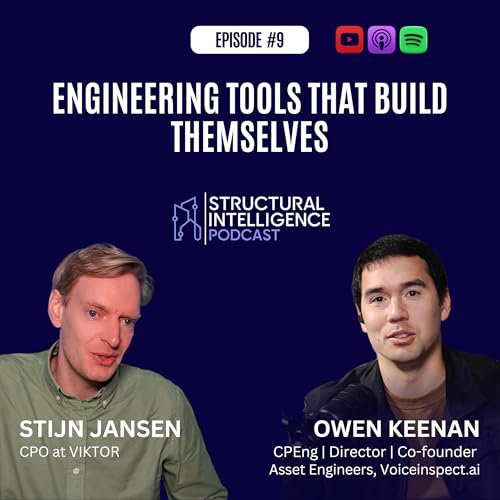
  • S1E9 - Engineering Tools that Build Themselves (w/Stijn Jansen)
    Dec 9 2025

    “When engineers start trusting AI, what exactly are they trusting?”


    In this episode of The Structural Intelligence Podcast, host Owen Keenan sits down with Stijn Jansen, co-founder of VIKTOR, to explore what happens when engineers begin building tools that build themselves. From aerospace engineering to software automation, Stijn explains how VIKTOR enables engineers to replace brittle spreadsheets with custom applications that integrate BIM models, simulation software, and now, AI-generated code.


    Together, they unpack one of today’s core tensions in engineering: how do we reconcile the reliability of deterministic systems with the flexibility of AI-driven workflows? If machines now help author our tools, where does responsibility live?


    🔑 Key Takeaways:

    • Why engineers struggle to trust AI and how deterministic code restores confidence
    • How AI can generate tools, without becoming the tool itself
    • What it really means to “automate the boring and engineer the awesome”
    • Why Python is becoming the new engineering literacy
    • How hybrid workflows blend human judgment with machine speed
    • Why engineers must evolve from tool users into workflow architects


    ⏱ Timestamps

    00:00 – When does automation become too unpredictable to trust?

    02:15 – From aerospace engineer to code-curious

    05:11 – What is VIKTOR and why build your own tools?

    08:52 – Why engineers default to Excel under pressure

    13:52 – “Automate the boring, engineer the awesome”

    24:38 – Case study – automating the Fehmarnbelt Tunnel design

    29:31 – Trusting AI vs trusting deterministic tools

    35:59 – Unit tests and verification for engineering apps

    41:16 – Connecting BIM, FEA and reports into one workflow

    51:10 – When AI agents start acting like colleagues

    56:18 – Where engineers should start with automation

    59:43 – Outro


    🔗 Guest:

    Stijn Jansen CPO of VIKTOR

    Website: ⁠https://www.viktor.ai/⁠

    LinkedIn (Company): ⁠https://linkedin.com/company/viktor-ai⁠

    LinkedIn (Stijn Jansen): ⁠https://www.linkedin.com/in/stijn-jansen-viktor⁠

    VIKTOR Free account: ⁠https://www.viktor.ai/start-now⁠


    🎧 Host & Links

    LinkedIn: ⁠https://linkedin.com/in/owenrkeenan⁠

    Spotify: ⁠https://open.spotify.com/show/7vcBFpl87NcqpLf0seIRaW

    VoiceInspect.ai (AI for inspections): ⁠https://www.voiceinspect.ai⁠


    👉 Subscribe to the Structural Intelligence Podcast on YouTube and Spotify to stay updated on new episodes.

    Show More Show Less
    1 hr and 2 mins
  • S1E8 - Between Innovation & Impact: We build systems, but do we always understand the consequences?
    Nov 6 2025

    “If we only solve the technical problem without understanding the human problem, we limit ourselves as engineering leaders.”


    Is engineering moving fast enough to keep up with technology, or are we limiting ourselves by thinking too narrowly? In this episode, Owen Keenan sits down with Raj Aseervatham, President of Engineers Australia, to explore how engineers are uniquely positioned at the intersection of innovation, society, and the environment. Drawing on decades of experience across mining, energy, and infrastructure, Raj explains why technical excellence alone isn’t enough, and how engineers must balance human impact, economic value, and environmental responsibility in every decision.

    From managing complex projects on-site to shaping national engineering strategy, Raj shares insights on leadership, curiosity, and the mindset shifts required for the next generation of engineers. Together, they discuss how fast-moving technologies like AI and material science aren’t just tools, they’re opportunities to expand what’s possible, to solve human-centred problems at scale, and to envision a future where engineering creates positive, lasting impact.


    🔑 Key Takeaways:

    - Engineering impacts go beyond technical fixes; it affects people, the economy, and the environment.

    - Good engineers balance human needs, technical solutions, and long-term value.

    - AI is a powerful tool for exploring options and optimising solutions, not a replacement.

    - Leadership in engineering means looking beyond narrow scopes and thinking systemically.

    - Investing in finance, economics, and the broader context strengthens technical expertise.


    ⏱ Timestamps:

    00:00:00 - Balancing innovation with worldwide consequences.

    00:01:47 - Raj’s Journey From Africa to Australia.

    00:02:44 - Mining, consulting, energy, and transition to non-executive leadership.

    00:05:01 - Early career experience broadening perspective.

    00:07:32 - The unintended consequences of engineering.

    00:09:06 - Engineering’s central role in solving complex problems.

    00:13:37 - The three pillars of solving problems.

    00:17:26 - Raj's thoughts on AI as a tool to solve problems.

    00:22:48 - Advice for mid-career engineers

    00:31:34 - Engineers Australia's hopes


    🔗 Guest:

    Raj Aseervatham

    President of Engineers Australia

    Website: https://www.engineersaustralia.org.au/

    LinkedIn (Company): https://au.linkedin.com/company/engineers-australia

    LinkedIn (Raj Aseervatham): https://au.linkedin.com/in/raj-aseervatham


    🎧 Host & Links

    LinkedIn: Owen Keenan

    YouTube: @Structural-Intelligence

    VoiceInspect.ai (AI for inspections): www.voiceinspect.ai


    👉 Subscribe to the Structural Intelligence Podcast on YouTube and Spotify to stay updated on new episodes.

    Show More Show Less
    41 mins
  • S1E7 – AI Agents and Rethinking Construction Tech Adoption with Ethan Ow (Wenti Labs)
    Oct 13 2025

    “What if construction isn’t tech-averse just misread?”Is construction really slow to adopt technology, or have we been building the wrong tools? In this episode of The Structural Intelligence Podcast, Owen Keenan sits down with Ethan Ow, Co-Founder & CEO of Wenti Labs, to challenge the myth of resistance in the field. Ethan shares how his team is embedding AI directly into the tools site teams already use: automating safety checks, reporting, and documentation straight from WhatsApp.From his early days managing projects on site to building AI agents that act like digital interns, Ethan explains how technology can adapt to construction workflows instead of forcing teams to adapt to tech. Together, they unpack the mindset shift needed for the industry to finally make AI fit-for-purpose.🔑 Key Takeaways:- Why construction’s problem isn’t tech aversion it’s tool misalignment- How Wenti Labs turns WhatsApp chats into structured project data- How AI agents can automate safety tracking, documentation, and reporting- Why treating AI like an “intern,” not a replacement, drives better adoption- Why starting small is the key to innovation that actually sticks on site- Lessons from building AI tools that adapt to construction not the other way around⏱ Timestamps:00:00:00 – Rethinking Construction Tech Adoption00:02:07 – Ethan’s Early Journey00:06:23 – Real-Time Data in Construction00:10:10 – Designing AI for the Chaos of Construction00:16:39 – How Wenti Labs Works on Site00:25:50 – Closing the Communication Gap on Site00:30:54 – Turning WhatsApp Chats into Structured Data00:33:20 – Automating Concrete Tracking and Documentation00:35:03 – Treating AI Like an Intern, Not a Replacement00:43:30 – The Mindset Shift Construction Needs🔗 Guest: Ethan OwCo-Founder & CEO, Wenti LabsWebsite: https://www.wentilabs.com/LinkedIn (Company): https://sg.linkedin.com/company/wentilabsLinkedIn (Ethan Ow): https://sg.linkedin.com/in/ethanow🎧 Host & LinksLinkedIn: Owen KeenanSpotify: Structural Intelligence PodcastYouTube: @Structural-IntelligenceVoiceInspect.ai (AI for inspections): www.voiceinspect.ai👉 Subscribe to the Structural Intelligence Podcast on YouTube and Spotify to stay updated on new episodes.

    Show More Show Less
    47 mins
  • S1E6 - Inside Civils.ai: Explore Stevan Lukic’s Leap from Engineer to Tech Founder long before the AI hype
    Sep 4 2025

    How does a civil engineer go from designing tunnels to building an AI startup?


    In this episode of The Structural Intelligence Podcast, Owen Keenan interviews Stevan Lukic, founder and CEO of Civils.ai a startup transforming how engineering teams use AI to extract data from construction documents. Before ChatGPT, before the hype, Stevan was already teaching himself to code and building automation tools for geotechnical logs, CAD drawings, and pre-construction workflows.


    They explore the mindset shift from consultant to founder, the real challenges of launching a construction tech startup, and why the future of engineering is built on data, not just drawings.


    Timestamps:
    00:00:00 – Before the AI hype: Stevan's vision for engineering00:02:00 – From tunnels to tech founder: Stevan's journey00:06:00 – Lessons from engineering vs startup culture00:09:40 – Teaching himself to code and founding Civils.ai00:15:00 – The startup journey: accelerators, funding, and product fit00:19:50 – What Civils.ai does solving problems trapped in PDFs00:26:00 – Extracting data from drawings the holy grail of construction AI00:29:00 – Civils.ai vs ChatGPT why specialized tools matter00:33:00 – Barriers to AI adoption in engineering00:42:00 – The future of engineers in the AI era


    👉 Subscribe to the Structural Intelligence Podcast on YouTube and Spotify to stay updated on new episodes.


    Host & Links

    • LinkedIn: Owen Keenan

    • Spotify: Structural Intelligence Podcast

    • YouTube: @Structural-Intelligence

    • VoiceInspect.ai: www.voiceinspect.ai

    Show More Show Less
    49 mins
  • S1E5 – No Dev, No Problem: How a Civil Engineer Coded His Own Automation Tool for Stormwater Modelling using AI (w/ Sebastian Masset)
    Aug 8 2025

    What happens when a civil engineer decides to stop waiting for better tools and builds one himself? In this episode, Owen Keenan talks with Sebastian Masset, the creator of HECFlow, a Python-based automation tool for stormwater modelling in HEC-HMS.


    They explore how Sebastian transitioned from spreadsheets to scripting, what role AI played in the process, and how any engineer can start bridging the gap between domain expertise and software.


    Timestamps:

    00:00 Introduction to Engineering Tools

    00:11 Meet Sebastian Masset: Civil Engineer and Innovator

    02:21 Sebastian's Journey into Engineering

    05:01 Challenges in Stormwater Management

    07:27 The Rational Method and Modern Solutions

    09:30 Sebastian's Software Journey

    14:49 Building the Automation Tool

    17:24 Technical Deep Dive into HECFlow

    21:42 Experimenting with File Structures

    22:13 Using AI as a Co-Pilot

    23:32 Building and Automating HECFlow

    25:50 Challenges and Learnings in Coding

    32:16 The Future of AI in Engineering

    39:13 Advice for Engineers on Building Tools

    42:11 Conclusion and Final Thoughts


    👉 Subscribe to the Structural Intelligence Podcast on Spotify and YouTube to stay updated on new episodes.

    Show More Show Less
    45 mins
  • S1E4 - Engineering Reality - The Power of Simulation & Digital Prototyping (w/ Derek Cloete)
    Jul 14 2025

    Engineering Reality - The Power of Simulation & Digital Prototyping
    with Derik Cloete, Senior Engineering Solutions Manager at LEAP Australia

    What if simulation wasn’t just about reducing prototypes, but about expanding how we think as engineers?

    In this episode of The Structural Intelligence Podcast, Owen Keenan is joined by Derik Cloete to explore the creative and technical frontier of simulation. From digital twins to fluid-structure interaction, from CFD and FEA to the flow of blood through a virtual heart, this is a conversation about how physics, curiosity, and compute are changing the way we model, design, and decide.

    You’ll hear how Derik and his team at LEAP Australia use multiphysics tools to support sectors from mining and defence to biomedical and optics, and how simulation is helping engineers ask better questions before anything gets built.

    🔍 Topics include:

    • Why systems thinking is central to modern engineering

    • How simulation enables virtual testing at scale

    • The role of tools like CFD, DEM, and digital mission engineering

    • The shift from gut-feel to data-driven design intuition

    • What it means to “prototype reality”

    📍 Chapters
    00:00 Introduction to the Podcast and Guest
    00:57 Derek Cloete's Early Career and Passion for Engineering
    03:28 Transition to a Soft Technical Role
    04:23 Role at LEAP Australia and Customer Interactions
    05:47 Exploring Simulation Technologies
    06:32 Diving into Physics and Simulation Applications
    10:48 Three-Letter Acronyms in Engineering
    11:24 Finite Element Analysis (FEA) and Computational Fluid Dynamics (CFD)
    14:04 Discrete Element Modeling (DEM) and Digital Mission Engineering (DME)
    18:28 Electromagnetics and Real-World Applications
    21:30 Simulation Technology Development and Industry Applications
    23:07 Empirical Standards in Engineering
    23:46 The Role of Communication in Engineering
    24:03 Engineering Morality and Standards
    26:07 Exploring Simulation in Engineering
    28:50 Practical Applications of Simulation
    34:21 Parameter Studies and Design Optimization
    39:15 The Future of Simulation and AI
    39:47 Building a Community of Engineers
    45:16 Final Thoughts and Summary

    🎧 Follow the podcast to get new episodes as they drop
    👤 Connect with Derik Cloete: https://www.linkedin.com/in/derikcloete/
    🏢 Learn more about LEAP Australia: https://www.leapaust.com.au

    #simulation #digitalengineering #FEA #CFD #designoptimisation #engineeringmindset #virtualtesting #prototyping #systemsengineering #multiphysics

    Show More Show Less
    49 mins