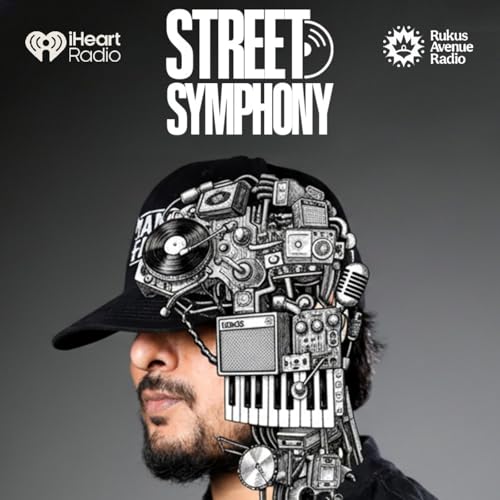
Street Symphony cover art

Street Symphony

Street Symphony

By: Jam Fam
Listen for free

About this listen

Step into the heartbeat of Hip Hop. Street Symphony takes you on a complete musical journey—uncovering the culture’s rich history, the origin stories of legendary artists, and the struggles that shaped their success. Each episode blends education with rhythm, spotlighting both underground gems and mainstream voices, while celebrating Hip Hop’s true significance. This isn’t just a show—it’s the sound of a culture that changed the world.

Where Hip Hop speaks, and the streets listen.

© RUKUS AVENUE RADIO 2025
Music
Episodes
  • Jaal: The Engineering of Trap
    Feb 2 2026
    From the streets of Atlanta emerged a sound that would eventually dominate global charts. In Jaal, we step inside the technical architecture of Trap music—not just its vibe, but the precise engineering that gives the genre its hypnotic power.

    This episode breaks down the science behind the legendary 808 kick drum, where producers digitally manipulate sine oscillators and apply techniques like soft clipping to create deep, sustained sub-bass frequencies. The result is a bassline so powerful it can shake massive sound systems while still being audible on small speakers and earbuds.

    We also explore the rhythmic signature that defines Trap: the rapid, stuttering hi-hat triplets. Through modern production tools like Digital Audio Workstation (DAWs), producers program complex patterns that feel almost mechanical—sharp, unpredictable, and intentionally “inhuman.”

    Visionary producers such as Metro Boomin and Southside used these digital tools to push rhythm and bass to new extremes, crafting a sonic web where every hi-hat tick, bass drop, and silence is precisely engineered for tension and impact.

    Jaal reveals that Trap isn’t just a genre—it’s a carefully designed system of rhythm, bass, and atmosphere. A sound built with technology, shaped by Atlanta’s streets, and now pulsing through speakers across the entire world.
    Show More Show Less
    54 mins
  • Digital Kranti: The Blog Era (2007–2012)
    Jan 26 2026
    As the internet reshaped the music world, Hip Hop entered a new revolution—Digital Kranti. Between 2007 and 2012, power quietly shifted away from major labels and into the hands of the fans, bloggers, and independent artists who understood the language of the internet.

    This episode explores how fan-driven platforms like 2DopeBoyz, NahRight, and DatPiff became the new gatekeepers of the culture. Instead of radio stations and label executives deciding what the world would hear, blogs and digital communities began amplifying raw talent directly to listeners.

    Through this shift, a new generation of artists emerged—Drake, J. Cole, and Kendrick Lamar—who built loyal fanbases by releasing free mixtapes online, bypassing traditional industry barriers.

    One of the defining moments of the era came in 2010 when Wiz Khalifa dropped Kush & Orange Juice and distributed it freely through Twitter. The release became a cultural phenomenon, proving that an artist with internet savvy, authenticity, and direct fan engagement could shape their own destiny without waiting for industry approval.

    Digital Kranti marks the moment when Hip Hop fully embraced the digital age—when mixtapes became movements, blogs became stages, and artists learned that the most powerful connection wasn’t through labels… but directly with the people.
    Show More Show Less
    1 hr
  • Sarvavyapi: Hip Hop Without Borders
    Jan 19 2026
    Hip Hop was born in the Bronx, but its spirit was never meant to stay confined to one place. In Sarvavyapi, we explore how the culture crossed oceans, languages, and borders to become a universal voice for the unheard.

    This episode travels to France, where groups like IAM and Suprême NTM transformed rap into a powerful tool of social critique. In the marginalized banlieues surrounding cities like Paris, Hip Hop became a platform to speak about inequality, discrimination, and life on the edges of society.
    The journey then moves east to Japan, where pioneers such as Hiroshi Fujiwara helped shape a uniquely Japanese interpretation of the culture. Despite the Japanese language lacking the stress accents that traditional rap relies on, artists creatively adapted rhythm, cadence, and flow—proving that Hip Hop’s essence is not limited by linguistic rules.

    Sarvavyapi reveals how Hip Hop’s original purpose—as a voice for the marginalized and a mirror to society—resonated with communities far beyond America. What began as a local expression of struggle evolved into a global language of resistance, creativity, and identity.

    👉 From the Bronx to the banlieues to Tokyo’s streets—
    Hip Hop proved one truth: real culture knows no borders.
    Show More Show Less
    53 mins
No reviews yet
In the spirit of reconciliation, Audible acknowledges the Traditional Custodians of country throughout Australia and their connections to land, sea and community. We pay our respect to their elders past and present and extend that respect to all Aboriginal and Torres Strait Islander peoples today.