Series 24 - The Tax Intelligence Advantage: When Compliance Data Becomes Strategic Signal cover art

Series 24 - The Tax Intelligence Advantage: When Compliance Data Becomes Strategic Signal

Series 24 - The Tax Intelligence Advantage: When Compliance Data Becomes Strategic Signal

By: Ryigit
Listen for free

Summary

Every large enterprise runs an indirect tax compliance function. Most treat it as a cost centre. A few have discovered that the transaction-level data it generates — richer, more granular, and more current than any other data set in the enterprise — is also the most powerful strategic intelligence source the organisation has and is not using. Hosted by Rıdvan Yiğit | Founder & CEO, RTC Suite rtcsuite.com · ridvan.yigit@rtcsuite.com · linkedin.com/in/yigitridvanRyigit Economics
Episodes
  • Series 24 - The Deep Dive: Tax Compliance Is the New Strategic Weapon
    Apr 15 2026

    Tax compliance is the new strategic weapon not because tax has become more strategically important — it has always been strategically important — but because the infrastructure that real-time compliance mandates require is also, incidentally, the most powerful commercial intelligence infrastructure the enterprise has ever been required to build. The deep dive this episode delivers builds the complete picture of what it looks like when an organisation treats its indirect tax compliance system as a strategic intelligence platform: the data architecture, the analytical framework, the organisational model, and the specific strategic questions that indirect tax data is uniquely positioned to answer.

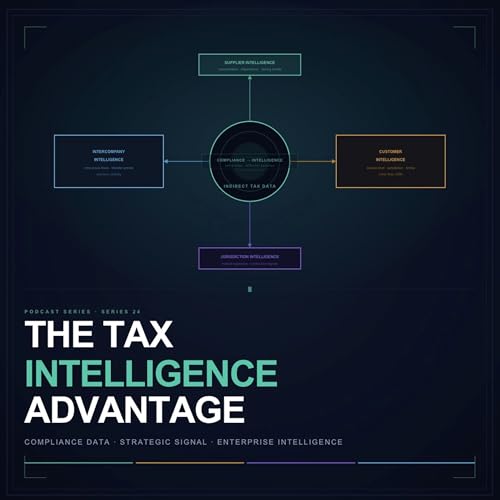
    We begin with the data inventory — the specific intelligence that indirect tax transaction data contains that no other enterprise data source provides in the same form. Supplier intelligence: the complete transaction history with every supplier, updated continuously, revealing concentration, dependency, pricing trends, and supply chain resilience signals before they appear in procurement reports. Customer intelligence: the invoice-level view of every customer relationship, in every jurisdiction, with timing and volume data that the commercial team's CRM does not capture with the same granularity or currency. Jurisdiction intelligence: the real-time map of where commercial activity is occurring, in what volumes, under what supply arrangements — the earliest available signal of market expansion, contraction, or structural change. Intercompany intelligence: the complete picture of intra-group flows, pricing, and timing that transfer pricing analysis requires but rarely has access to in real time.

    We then build the strategic intelligence layer on top of the compliance infrastructure: the data model extensions that make compliance data readable for commercial purposes without compromising its regulatory integrity, the reporting architecture that serves both the tax return and the CFO dashboard from the same underlying data, and the organisational model that positions the indirect tax function as a data source that finance, procurement, commercial, and strategy functions actively consume. We address the specific strategic use cases in detail: supply chain resilience monitoring using supplier transaction frequency as an early warning indicator, market expansion analysis using jurisdiction-level VAT transaction flows as a leading indicator of commercial opportunity, and competitor intelligence using public CTC data disclosures to model transaction volumes and market share. Finally, we address the governance model: how the indirect tax function manages the transition from cost centre to intelligence function, how it builds the internal credibility that strategic consumers require, and how the CFO sponsors and measures the strategic value the function delivers.

    Keywords: tax compliance strategic weapon, indirect tax strategic intelligence complete, VAT data strategic platform deep dive, tax compliance intelligence architecture, indirect tax data supply chain strategy, real-time VAT data commercial intelligence, indirect tax strategic weapon CFO, compliance data strategic layer, VAT data market intelligence architecture, indirect tax strategic use case, tax data supplier intelligence, real-time compliance strategic platform, indirect tax jurisdiction intelligence, tax compliance strategic value CFO, compliance infrastructure intelligence, indirect tax data governance strategic, VAT data customer intelligence, tax function strategic transformation, indirect tax intelligence framework complete


    About the Host

    Rıdvan Yiğit is the Founder & CEO of RTC Suite — the world's first Autonomous Compliance and Payment Intelligence platform, built natively on SAP BTP and operating across 80+ countries.


    Connect with Rıdvan:

    🔗 linkedin.com/in/yigitridvan✉

    ridvan.yigit@rtcsuite.com

    📞 +90 545 319 93 44


    Learn more about RTC Suite:

    🌐 rtcsuite.com

    Show More Show Less
    21 mins
  • Series 24 - The Debate: How Real-Time Tax Drives Business Strategy
    Apr 15 2026

    The proposition that indirect tax data can drive business strategy sounds more ambitious than it is — until you examine what the data actually contains. The debate this episode structures is not about whether the data is strategically relevant. It is about whether the indirect tax function is the right place to extract and communicate that relevance, and whether the investment required to make the tax data readable as strategic intelligence is justified by the output it generates.

    One side argues that the case is straightforward. Indirect tax data is already being collected, already being validated, already being structured for regulatory submission. The marginal cost of making it available to commercial and strategy functions — through a shared data layer, a CFO dashboard, a supply chain monitoring tool — is low relative to the strategic value it unlocks. Supplier concentration risk, market expansion signals, intercompany pricing anomalies, jurisdiction-level commercial trends: these are not insights that require a new data collection programme. They are already encoded in the compliance data the organisation is required to produce. Reading them is a data architecture decision, not a research investment.

    The other side argues that the gap between compliance data and strategic intelligence is wider than this framing suggests. Compliance data is structured for regulatory purposes — it answers regulatory questions precisely and business questions approximately. The supply type classifications that satisfy a VAT return do not map cleanly onto the commercial segmentation the strategy team uses. The jurisdiction codes that satisfy a SAF-T submission do not correspond to the market definitions the commercial team operates with. Making compliance data genuinely useful for strategic purposes requires transformation — of the data model, of the reporting layer, of the organisational interfaces between tax, finance, and strategy — that is neither cheap nor straightforward. The organisations that have done it well have invested materially. The ones that assumed it would be simple have produced dashboards that nobody uses.

    Keywords: real-time tax business strategy, indirect tax strategy debate, VAT data commercial strategy, tax data strategic use, real-time tax intelligence business, indirect tax data commercial value, tax compliance strategy debate, VAT data supply chain, real-time tax data CFO strategy, indirect tax strategic debate, compliance data business intelligence, tax data strategy investment, VAT data market intelligence, indirect tax commercial insight, real-time compliance business value


    About the Host

    Rıdvan Yiğit is the Founder & CEO of RTC Suite — the world's first Autonomous Compliance and Payment Intelligence platform, built natively on SAP BTP and operating across 80+ countries.


    Connect with Rıdvan:

    🔗 linkedin.com/in/yigitridvan✉

    ridvan.yigit@rtcsuite.com

    📞 +90 545 319 93 44


    Learn more about RTC Suite:

    🌐 rtcsuite.com

    Show More Show Less
    22 mins
  • Series 24 - The Critique: Winning the Strategic Indirect Tax Mandate
    Apr 15 2026

    The indirect tax function is being handed a mandate it did not ask for and is not fully prepared to deliver: become a source of strategic intelligence for the enterprise. The mandate is arriving through two channels simultaneously. From above, CFOs and strategy functions are recognising that the transaction data flowing through indirect tax is more current and more granular than anything the management information system provides. From outside, regulators are requiring real-time reporting infrastructure that, once built, makes the strategic use of that data technically trivial. The indirect tax function is sitting at the intersection of these two pressures — and most tax functions are responding to the compliance requirement without noticing the strategic opportunity it creates.

    This episode is a critique of that response. The organisations that will win the strategic indirect tax mandate are not the ones that build the best compliance system and then ask whether it has other uses. They are the ones that build the compliance system knowing it is also a strategic intelligence platform — that design the data model to answer commercial questions as well as regulatory ones, that build the reporting layer to serve the CFO dashboard as well as the tax return, and that position the tax function as a data source rather than a cost function before anyone else in the organisation thinks to ask.

    The critique is structural: the indirect tax function has a narrow window in which to claim this mandate. The compliance infrastructure is being built now. Once it is built for compliance purposes only, retrofitting it for strategic intelligence requires a second build — and by the time the second build is funded, another function will have claimed the role of real-time commercial intelligence provider using data from a different source. The tax function that wins is the one that designs for both purposes from the start.

    Keywords: indirect tax strategic mandate, tax function strategic intelligence, VAT compliance strategic platform, indirect tax CFO intelligence, real-time tax data mandate, tax function strategy, indirect tax data commercial, compliance infrastructure strategic, tax data business intelligence, indirect tax mandate winning, real-time compliance strategic, tax function position strategy, VAT data strategic opportunity, indirect tax design strategic, compliance data intelligence platform


    About the Host

    Rıdvan Yiğit is the Founder & CEO of RTC Suite — the world's first Autonomous Compliance and Payment Intelligence platform, built natively on SAP BTP and operating across 80+ countries.


    Connect with Rıdvan:

    🔗 linkedin.com/in/yigitridvan✉

    ridvan.yigit@rtcsuite.com

    📞 +90 545 319 93 44


    Learn more about RTC Suite:

    🌐 rtcsuite.com

    Show More Show Less
    12 mins
adbl_web_anon_alc_button_suppression_c
No reviews yet
In the spirit of reconciliation, Audible acknowledges the Traditional Custodians of country throughout Australia and their connections to land, sea and community. We pay our respect to their elders past and present and extend that respect to all Aboriginal and Torres Strait Islander peoples today.