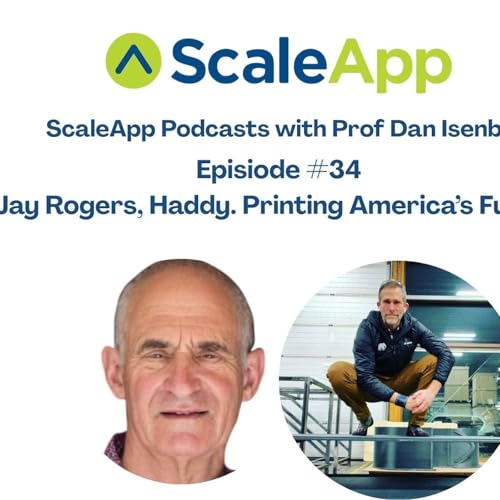
ScaleApp Podcasts with Prof Dan Isenberg cover art

ScaleApp Podcasts with Prof Dan Isenberg

ScaleApp Podcasts with Prof Dan Isenberg

By: Professor Daniel Isenberg
Listen for free

About this listen

ScaleApp is chock full of content and interviews with successful scalers that will help you grow your company better. DO NOT LISTEN IF YOU ARE A STARTUP: ScaleApp is for growing ventures, not starting them. (But if you are a startup with serious growth aspirations, ScaleApp IS for you).

© 2026 ScaleApp Podcasts with Prof Dan Isenberg
Economics Leadership Management & Leadership
Episodes
  • Episode #34 — 3D Printing America's Manufacturing Future — Jay Rogers, CEO/Co-founder, Haddy.life
    Mar 7 2026

    Jay Rogers is a serial entrepreneur who doesn't just learn from failure — he codifies it. His previous venture, Local Motors, 3D printed autonomous vehicles and deployed 150 of them across 29 cities and three continents. The technology worked. The pricing worked. They raised $100 mm or so in capital. Regulation slowed everything down and they never learned how to sell.

    The company failed as an investment, but the genetics survived.

    Between Local Motors and Haddy, Jay sat down and wrote out his critical lessons: stay out of highly regulated industries, make products with few components you can build entirely under one roof, and — here's the subtle one — choose assets that are financeable. He wanted a robot he could pay for with an SBA loan, not venture equity. That distinction between capital-intensive and equity-intensive is one of the sharpest insights in this conversation (disclosure: I am an investor in Haddy).

    What emerged is Haddy — a 3D printing "world builder" running a robotic micro factory in downtown St. Petersburg, Florida. Furniture, boats, molds, lighting, architectural elements, defense products. Jay went from Princeton to manufacturing in China to banking to dropping out of Stanford to join the Marines for seven years — and every chapter shows up in how he leads Haddy today, including a Marine-bred commitment to vulnerability that might surprise you.

    Favorite Quotes

    – "We've orphaned an enormous amount of tribal knowledge — how to mine, how to forge, how to do tool and die. America has lost a lot of making capability. That's what Haddy is here to address."

    – "Double, double, double to me is sluggish."

    – "It's a capital-intensive business, but don't hear that it's an equity-intensive business. Those things are often confused. We're a capital-efficient, capital-intensive business — and that's a deliberate choice."

    – "With Local Motors, I went out with a technology and built ahead of the market — and we were early. With Haddy, I got an order from a furniture company before I raised a dollar for the business."

    – "Vulnerability is being willing to get curious. Are you willing to shut up and listen? That vulnerability is worth its weight in gold."

    Key Themes

    Reshoring manufacturing through robotic micro factories

    • Haddy is rebuilding the "tribal knowledge" America lost over two decades of offshoring, using 3D printing and robots instead of scarce skilled labor
    • Failure as a design document — Extract lessons from failure and hardcode them into a new business model, from avoiding regulated industries to choosing financeable assets
    • Capital-efficient, not equity-intensive — a deliberate distinction that shapes everything from equipment choices to fundraising strategy, using SBA loans and debt rather than dilutive venture capital
    • Customer before capital — Jay secured a furniture order before raising a single dollar, reversing the Local Motors approach of building ahead of the market
    • Vulnerability as leadership — learned in the Marines, refined in business, Jay argues that shutting up, listening, and admitting mistakes creates stronger teams and better customer relationships
    Show More Show Less
    37 mins
  • Episode #33 - Kevin Kilty/Hubpay - From "too early yesterday" to "$100 mm tomorrow"
    Feb 13 2026

    In Episode 33 of ScaleApp Podcasts, Kevin Kilty and I unpack the messy, honest reality of building a cross-border payments platform from the UAE — one of the world’s fastest-growing trading hubs. HubPay is now approaching $10 million ARR (already at a $10mm run rate), profitable, with 58 people across Dubai and London, and a Series B in motion.

    Kevin launched HubPay in 2019 with a clear vision: a one-stop-shop for businesses to move money globally — fast, cheap, and simple. The problem? The infrastructure wasn’t ready. Bank APIs, virtual IBANs, regulatory tech — none of it was there yet. HubPay spent two years grinding through $1–2 million ARR while the market caught up. As Kevin says: “50 fintechs came before Revolut with pretty much the same plan. They were just too early.” HubPay nearly was too.

    But Kevin held on, pivoted from retail remittances to corporate cross-border payments, and when the critical infrastructure came online in late 2024, growth exploded. Now profitable at $10 million ARR (expected Q2), the Series B isn’t for survival — it’s for expansion into the UK, Europe, and Saudi Arabia. Kevin sees $100 million ARR in two to three years. (Disclosure: I am an LP in Emkan https://www.emkan.vc a VC investor in HubPay.)

    Favorite Quotes

    “Timing is everything. We had the right thesis, just the wrong year. Revolut wasn’t the first with the plan — 50 fintechs came before with pretty much the same idea.”

    “Execution is key. The idea is not quantum computing. But the plumbing behind it? That’s where you earn your stars. The customer demands are relatively simple.

    “At first people were getting burned out. You don’t mind working hard. But you get burnt out when you’re working hard and it’s simply not working.”

    “We are a team, not a family. Your family is with you no matter what. You don’t do a good job, your family’s there. Your team is certainly not — you must execute.”

    “Three pieces of advice to my younger self: Make the leap earlier. Community is everything. And when you raise money, be way more disciplined in how you spend it.”

    Key Themes

    – Timing is the silent killer: HubPay had the right thesis but launched before the infrastructure existed. Surviving “too early” without burning through capital became the defining test.

    – Simple value proposition, brutal execution: Customers want speed, global reach, and fair pricing. Delivering that across borders, regulators, and banks is where the real work lives.

    – Team, not family: Kevin runs a flat, execution-driven culture — 15+ languages in the Dubai office, mutual respect, but no room for passengers.

    – Financial discipline unlocks optionality: Profitability at $10M ARR on a shoestring means Series B is entirely for growth — UK/European licenses, Saudi expansion, and AI-driven product innovation.


    Show More Show Less
    31 mins
  • Episode #32 - Sam Smith, SuperScalers and £50 million finnCap
    Jan 28 2026

    In Episode 32 of ScaleApp Podcasts, Sam Smith and I unpack her 24-year scale journey: building FinnCap from an in-house corporate finance desk into an IPO-listed £50 million revenue financial services firm, staying profitable throughout.

    At 24 – “I literally had no clue what I was doing” after painstakingly building to £3 million revenue, a step change along with a management buyout created real ownership, a clear vision, and the freedom to scale.

    After leaving FinCap, Sam built Superscalers to address a stark gap in the UK’s scale ecosystem. Using data to track outcomes, Superscalers connects and equips underrepresented founders already past £1M revenue to push through the next doublings — and to create more businesses that break through to £50M and beyond.

    Favorite Quotes

    • “It was literally a desk, a phone, and me.”
    • “We built from there to over 50 million revenue and IPO listing.”
    • “Those patterns are the doubling principle.”
    • “It doesn’t come with 0.2 of a person.”
    • “Who started here is not going to be who ends here.”
    • “Assume everyone becomes an alumni.”
    • “I’ve not worried about competitors, I worry about customers!"

    Key Themes

    Why ownership, vision, and incentives mattered — and how the MBO unlocked the next chapter of scale.

    The ‘doubling principle’: Why growth compounds in leaps (1→2→4→8→16) and why teams/capability can’t be built in tiny increments.

    Culture through constant change: Hiring for growth mindset — and accepting that different stages require different people and skill sets.

    Exits as alumni, not endings: A practical approach to protecting culture by treating departures as ongoing relationships.

    Show More Show Less
    39 mins
No reviews yet
In the spirit of reconciliation, Audible acknowledges the Traditional Custodians of country throughout Australia and their connections to land, sea and community. We pay our respect to their elders past and present and extend that respect to all Aboriginal and Torres Strait Islander peoples today.