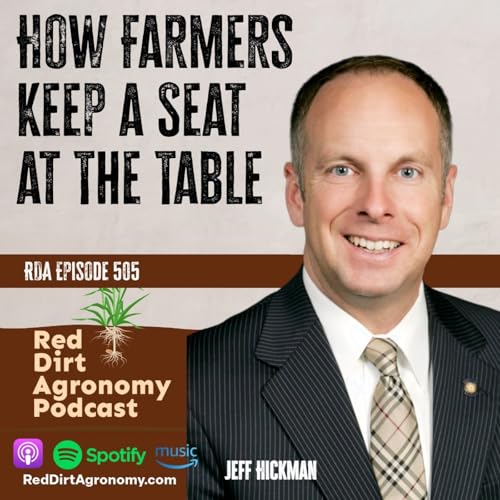
• How Farmers Keep A Seat At The Table - RDA 505
    Feb 10 2026

    Recorded live from the Oklahoma Wheat Commission booth at the 2026 KNID AgriFest in Enid, the crew sits down with Jeff Hickman—farmer, longtime ag association leader, Oklahoma higher-education regent, and former Oklahoma House Speaker—for a grounded conversation on where agriculture is headed and why local involvement still matters.

    Jeff breaks down how ag organizations stay viable in an era of consolidation, why multiple commodity groups working together amplify agriculture’s voice, and how public policy and regulation increasingly shape day-to-day farm decisions. The discussion also hits consumer trust, social media misinformation (and how AI can muddy the waters), and why agriculture has to keep educating an audience that forgets fast.

    They close with what Jeff sees coming next—trade uncertainty, the need for a dependable farm policy, and the importance of building relationships with candidates before they’re elected. Practical, candid, and very Oklahoma.

    Ten Takeaways

    1. Ag organizations are stronger together—shared support can keep smaller groups viable and influential.
    2. Regulation is often the real battlefield, sometimes more than legislation.
    3. Fewer rural/ag lawmakers means ag has to work harder to be understood in policy rooms.
    4. Producer involvement doesn’t have to be huge—membership alone helps fund representation and benefits.
    5. Markets can disappear even after great yields, driving tough planting decisions (sorghum example).
    6. Wheat is in a strategy moment: “What’s our thing?” like corn has ethanol—new uses/value streams matter.
    7. Consumer curiosity is a double-edged sword—interest is good, misinformation is rampant.
    8. AI can accelerate fake “credible” ag narratives, raising the stakes for trusted education.
    9. Rural issues resonate when you connect the dots (health care access, metro revenue, statewide economy).
    10. Election years are relationship years—don’t wait until after someone wins to introduce agriculture.

    Detailed Timestamped Rundown

    00:00–01:44 — Episode open, setting: Oklahoma Wheat Commission booth at KNID AgriFest (Enid); introductions.
    01:45–03:35 — Jeff Hickman joins; “many hats” across OK ag organizations and higher ed.
    03:36–04:44 — Why shared management/back-office support keeps smaller ag groups viable and strengthens ag’s voice.
    04:45–06:53 — Policy reality: more dependence on public policy + regulations; increased focus on agencies/administration.
    07:03–08:52 — Jeff’s background: journalism/OU roles, media work, farm roots; “planting and harvest were my vacations.”
    09:12–12:44 — Political pendulum swings; how DC trends show up in statehouses; fewer rural/ag-connected legislators.
    12:45–15:54 — Consumer interest: good and hard; difficulty finding truth; misinformation and AI concerns; supply chain lessons.
    15:55–18:29 — Global factors hitting ag (tariffs, shipping routes, even piracy) through a real-world retail/cotton example.
    18:30–20:55 — Benefits/challenges of representing many groups; why having a strong government affairs team matters.
    21:14–23:59 — What growers are facing: crop choice risk, markets disappearing, wheat’s future “what’s our thing?”; value of membership (and CFAP example).
    24:00–27:33 — How to get more producers involved in leadership/politics; timing, family/team approach, candidate mentorship.
    28:13–32:50 — Translating rural needs for urban lawmakers (rural hospitals example); rural dollars fueling metro projects.33:26–36:31 — Next 6–9 months: trade unresolved, farm bill/farm policy stability, election-year urgency—build relationships now.
    36:32–38:11 — Wrap-up, thanks, and where to find resources.

    RedDirtAgronomy.com

    Show More Show Less
    38 mins
  • Nitrogen Know-How From A Teen Agronomist - RDA 504
    Feb 3 2026
    In this episode of the Red Dirt Agronomy Podcast, we’re joined by 16-year-old Brayden Arnall, who recently won the National FFA Agriscience Award. This episode isn’t just about a student project—it’s a story of curiosity turned passion, and a father-son bet that led to a national title. Brayden walks us through his award-winning research on nitrogen stabilizers, tillage practices, and ammonia volatilization, breaking down complex science in an engaging and relatable way. Co-hosts Dr. Brian Arnall and Dave Deken, along with guest host Dr. Paul Weckler, offer commentary on the broader impact of youth agricultural programs like FFA and 4-H in Oklahoma and beyond.Listeners will hear about Brayden's methodology, the surprising results from his controlled barn experiments, and how these findings could influence farming practices. Plus, he gives a sneak peek into his next project on winter wheat growth and irrigation. Whether you're a researcher, educator, student, or just someone who appreciates the next generation of ag leaders, this episode is packed with inspiration, science, and Oklahoma charm.Top 10 Key TakeawaysBraden Arnall won the National FFA Agriscience Fair with a project on nitrogen stabilizers and tillage.His experiment showed that no-till plots had more ammonia volatilization losses than tilled ones.Anvol was the most effective nitrogen stabilizer in reducing nitrogen loss.Braden began his agriscience journey in middle school, building on skills from 4-H.His project used controlled PVC-tube environments and ammonia detection tools.He’s now researching irrigation impacts on winter wheat and nitrogen use.Youth participation in agriscience is strong in Oklahoma, especially Stillwater.Braden’s early exposure to research is guiding his career toward agronomy.The family’s tradition of “5-minute science” helped Braden understand college-level concepts early.The episode emphasizes the value of mentorship and community in ag education.Major Discussion Timestamps00:00–00:02 – Episode setup: the “father-son bet,” Brayden’s national win, and where to find info.00:01–00:02 – Plug: upcoming recording at the Central Oklahoma Cattle Conference (Feb. 13).00:02–00:04 – On location at KNID AgriFest (Enid); Oklahoma Wheat Commission booth + the cinnamon roll/bread scene.00:04–00:07 – Brian explains the “promise” and Brayden’s path: early success, then winning nationals + spotlight presentation.00:07–00:10 – Dr. Paul Weckler joins; why Agriscience matters for STEM ag careers; what Agriscience competition is.00:10–00:11 – 4-H speaking background and why it gave Brayden confidence in FFA.00:11–00:16 – The research: nitrogen stabilizers, tilled vs no-till, ammonia volatilization + nitrate leachate; how the measurements were taken.00:16–00:18 – Age check (Brayden is 16) + “five-minute science” mentoring and learning the nitrogen cycle.00:18–00:21 – Agriscience momentum in Stillwater; youth research examples; workforce need in ag engineering/ag systems tech.00:21–00:25 – Brayden’s new project: rainfed vs irrigated winter wheat response with stabilizers; real-world Oklahoma weather challenges.00:25–00:27 – Undergrad research opportunities + how early research can feed future grad students.00:27–00:29 – Media moment: Brayden featured on “Is This a Great State or What?”00:28–00:31 – What’s next: chapter officer run, public speaking, possible land judging; speech topic See & Spray.00:30–00:32 – Dr. Weckler’s perspective: computer vision roots and how today’s tech builds on earlier work.00:30–00:32 – Staying active in both 4-H and FFA; what each teaches.00:32–00:33 – Wrap + thanks + where to connect. RedDirtAgronomy.com
    Show More Show Less
    33 mins
  • Hands in the Dirt, Minds on the Future - RDA 503
    Jan 27 2026

    In this heartfelt and energizing episode of Red Dirt Agronomy, the team sits down with Dr. Kent Martin at the 2026 KNID AgriFest in Enid.
    Kent, now a full-time faculty member at Northwestern Oklahoma State University, shares how he's bringing real-world agronomy into the classroom.
    From digging soil pits to counting plant populations, his classes give students practical, hands-on experiences that prepare them to think critically and act confidently in their agricultural careers.
    His teaching philosophy—bridging theory and application—stems from his years of experience as a farmer, consultant, and Extension professional.

    The conversation also dives into leadership development, highlighting the importance of rural voices in community and national arenas.
    Kent shares stories from his time on the Sorghum Commission and US Grains Council, emphasizing that sometimes the most impactful insights come from simply telling your story.
    Whether you're a seasoned producer or just starting out, this episode offers powerful reminders about the importance of mentorship, service, and authenticity in agriculture.
    It’s a tribute to the value of showing up—on campus, in the field, or at the Capitol.

    10 Takeaways

    1. Dr. Kent Martin now teaches agronomy full-time at Northwestern Oklahoma State University in Alva.
    2. His teaching style is rooted in hands-on, field-based learning to bridge theory with practice.
    3. Martin emphasizes the value of students seeing and experiencing agronomy firsthand.
    4. The podcast highlights the similarity between Extension and teaching in terms of impact and approach.
    5. Leadership is not just about being in front—it includes being a supportive, informed voice behind the scenes.
    6. Participation in national sorghum and grain organizations can lead to unexpected influence.
    7. Farmers should consider stepping into advocacy roles—your story matters.
    8. Teaching is a long game—seeing students “get it” is a powerful reward.
    9. Mentorship and passing on leadership are recurring themes across all guests.
    10. The Red Dirt Agronomy team encourages rural leaders to take time off the farm for personal and community growth.

    Timestamps

    0:22 – Introduction to KNID AgriFest 2026 and Dr. Kent Martin
    2:18 – Dr. Martin’s new role at Northwestern Oklahoma State University
    6:16 – Field-based learning and teaching agronomy by doing
    10:07 – From Kansas State Extension to Oklahoma classrooms
    13:02 – Comparing Extension work with academic teaching
    20:31 – Serving on sorghum and grain boards nationally
    24:03 – Recognizing and nurturing future leaders
    33:45 – Stories of mentoring students into leadership
    42:11 – Encouraging rural voices in policy and community service
    46:42 – Why authenticity matters in agricultural leadership
    47:30 – Final reflections and call to support rural communities

    RedDirtAgronomy.com

    Show More Show Less
    48 mins
  • Oklahoma Wheat: Research, Markets, & Rural Life - RDA 502
    Jan 20 2026
    Episode 502 takes you straight to the Oklahoma Wheat Commission booth at the AgriFest in Enid—where the smell of fresh bread and cinnamon rolls is basically a tractor beam for farmers. Dave Deken and Dr. Brian Arnall sit down with Kay County wheat producer Tom Cannon, now a new Oklahoma Wheat Commission board member, to pull back the curtain on what “checkoff dollars” actually do. Tom shares the producer-side view of how funds support wheat research (better varieties, better quality, better management), expand export demand (he notes about half of Oklahoma wheat is headed overseas), and build ag literacy through hands-on education.The conversation hits home on why wheat still matters in modern rotations—especially after drought and wind reminded everyone what bare ground can do. From no-till residue and moisture protection to the “wheat + cotton” tag-team, Tom makes the case that wheat is the foundational crop that holds systems (and small towns) together. And just for fun: you’ll also hear about the “drone posse” concept—proof that Oklahoma agriculture is equal parts tradition, grit, and innovation.Top 10 takeawaysOklahoma winter wheat is a cornerstone crop economically and agronomically—and it still moves the needle statewide.Checkoff dollars are meant to act like a “marketing + research engine” for producers who are busy producing.Export market development is a major lever because a huge share of wheat demand is outside the local elevator.Producer education about checkoffs matters—refund requests signal a communication gap (Tom estimates ~6–8% refunded).Wheat’s residue is “soil armor” in Oklahoma—helping reduce erosion, slow evaporation, and improve water capture.No-till isn’t a set-it-and-forget-it system; it rewards deeper management—and wheat often anchors that system.Wheat and cotton can complement each other well in rotation, especially when you manage residue and planting windows.Research isn’t just yield—quality traits (protein management, fiber work) protect demand and create new value opportunities.Wheat success ripples through rural economies: equipment, parts, groceries, schools—everyone feels good crop years.Leadership in ag often starts the same way: somebody asks you to step up… and you decide to say yes.Timestamped Rundown00:00–00:01 — Dave opens Episode 502; Oklahoma wheat scale and value context; tees up the topic.00:01–01:52 — Intro of Brian Arnall Ph.D.; episode recorded at the Oklahoma Wheat Commission booth at KNID AgriFest (Jan. 10, 2026).02:05–04:07 — On-location banter: the bread/cinnamon roll operation, on-site oven, “follow your nose” traffic pattern.04:10–05:23 — Call-back to Tom’s earlier appearance (mental health); stigma fading; “it’s okay to talk.”05:47–07:52 — Tom’s path to the Wheat Commission board; why producer feedback matters; “their money” must be used wisely.07:52–11:59 — What the Commission does: promote wheat locally + worldwide; support OSU research; board debate + shared intent.12:01–13:35 — Export emphasis; Tom notes ~50% of production exported; “what would markets be without it?”13:35–16:52 — Research examples: nitrogen timing/protein, quality improvements, fiber-enriched wheat; surprise: refund requests (Tom estimates ~6–8%).17:07–17:55 — Why checkoffs exist: producers aren’t “marketing departments,” commissions fill that role.18:00–21:25 — Wheat acres + rotations; drought lessons; wheat residue and soil protection; no-till adoption in Kay County.21:25–24:45 — Cotton + wheat synergy; residue realities; why wheat after cotton works; harvest/header/residue discussion.24:46–26:29 — Logistics: drill “following the picker,” gin/trucking systems to clear fields fast for planting.26:29–28:49 — “Drone posse” business model; co-op fleet idea; custom work potential (moving north during fungicide season).28:53–30:06 — Public-facing work: baking events, wheat quality promotion, school coloring books/education.30:06–33:47 — Wheat’s ripple effect on rural towns (dealerships, stores, services); extra cents per bushel matters locally; OSU’s role.34:17–35:58 — Upcoming advocacy: Wheat Day at the Capitol, Ag Day, DC visits; educating policymakers about food production.36:00–36:51 — Wrap-up and where to connect with the show. RedDirtAgronomy.com
    Show More Show Less
    37 mins
  • The Big Debate: Stress vs. Deficiency In Crops - RDA 501
    Jan 13 2026

    Recorded live at KNID AgriFest in Enid from the Oklahoma Wheat Commission booth, Episode 501 launches Season 5 with a fast-paced crop check and a whole lot of agronomy banter.
    Dave Deken sits down with Brian Arnall and Josh Lofton to talk January wheat realities: dry conditions, odd winter insect pressure, and early reports of wheat diseases showing up sooner than anyone wants.
    They also hit canola concerns—like that purple color—and what to inspect right now (new leaves and crown health) as everyone looks ahead to green-up.

    Next, it’s go-time thinking for topdress: why timing, weather, and surface conditions matter—especially when warm days, wind, and dew can increase nitrogen losses.
    Then the conversation turns into a practical deep dive on plant physiology and decision-making: primordia (the “cells in waiting”), how early-season stress can differ from true deficiency, and why chasing genetic potential without respecting environmental limits can hurt ROI.
    If you like your agronomy with real-world nuance (and a little friendly arguing), this one’s for you!

    Top 10 takeaways

    1. January crop scouting can be misleading—weather swings can make fields look great or “go backwards” fast.
    2. Warm winter + dry stretch = unusual pest pressure, including armyworms in wheat.
    3. Early disease reports (tan spot, rust, powdery mildew) mean don’t assume “it’s too early.”
    4. For canola right now, focus on new leaves and crown—that’s your “are we okay today?” check.
    5. Green-up moisture is the hinge point for both wheat tillering and canola recovery.
    6. Topdress timing is a system problem (acres, co-op schedules) and a weather-loss problem (dew + warm + wind).
    7. If conditions are right to lose N (dry soil + dew/humidity + wind), waiting can be the most profitable move.
    8. A lot of management is about what’s happening inside the plant—primordia/cell division—before you ever see it.
    9. Stress can be useful; deficiency is where you start giving away yield potential—context (stage/goal) matters.
    10. The “right” program depends on your risk profile: protecting max yield vs protecting ROI on inputs.

    Detailed timestamped rundown

    00:00–01:15 — Welcome to Episode 501 + Season 5 vibes; shoutout to AgriFest and the Wheat Commission cinnamon-roll traffic.
    01:16–01:55 — Introductions: Dave Deken with Dr. Brian Arnall and Dr. Josh Lofton; “we were arguing in our office earlier…”
    01:46–02:10 — Recorded Jan 9, 2026 at the Oklahoma Wheat Commission booth during AgriFest in Enid.
    02:10–03:05 — Cinnamon roll banter + meeting listeners at the booth.
    03:07–04:20 — Crop update headline: it’s January, it hasn’t rained, it feels like June; armyworms in wheat; disease confirmations in SW OK.
    05:01–06:20 — Canola check: purple color mystery; focus on new leaves + crown health “right now.”
    06:35–08:10 — “Magic windows” talk: green-up moisture is critical for canola and wheat tillering.
    09:03–10:30 — Rooting + grazing: planting timing affects anchoring; some fields pull easier under cattle.
    10:45–12:55 — Topdress season starts early for many; best efficiency late Jan–March; avoid warm/windy/dewy days that can increase N loss (they cite “blow off 15–25%”).
    13:00–16:55 — What if winter doesn’t get cold? Daylength and growth timing; discussion on how wide the N window really is.
    17:00–22:10 — OSU NPK blog topic: managing “primordia” (cells-in-prep), not just what you see aboveground.
    22:10–25:20 — Corn example: by V6 you’ve set rows/potential kernels; stress/deficiency can reduce grain number.
    28:50–41:10 — Main debate: stress vs deficiency, “leaf deficient but not the plant,” and Liebig’s Law barrel analogy.
    44:20–48:10 — Genetic vs environmental potential, realized yield; precision vs accuracy; risk aversion (yield loss vs input cost).
    49:40–50:17 — Wrap + resources at reddirtagronomy.com.

    RedDirtAgronomy.com

    Show More Show Less
    50 mins
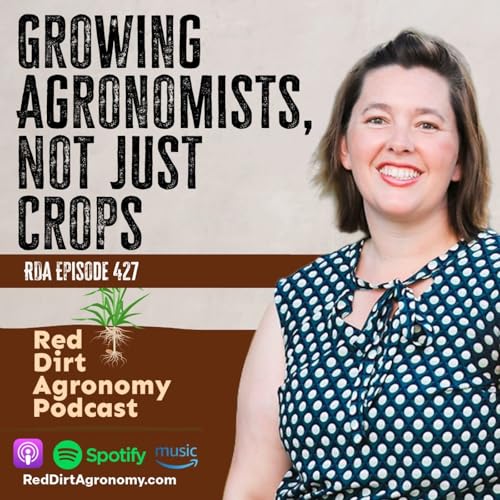
  • Growing Agronomists, Not Just Crops - RDA 427
    Nov 19 2025
    This episode of the Red Dirt Agronomy Podcast features Dr. Beatrix Haggard, an associate professor in Oklahoma State University’s Department of Plant and Soil Sciences, whose teaching mission is to make sure students know what plant they’re looking at—and how it works. Dr. Haggard walks us through her journey from FFA land judging in Texas to soil science at Tarleton State and LSU, to a regional soil fertility role in the Louisiana Delta, and finally to a teaching-heavy, tenure-track position at OSU. Along the way, she explains how those experiences shape how she teaches, from intro plant science to senior seminar, crop judging, and soil morphology.The crew also explores major shifts in today’s student body and how they change the way agronomy is taught. They discuss students working full-time jobs while in school, the rise of pre-vet and ag business majors, the growing number of non-traditional and out-of-state students (from California to New York and Indiana), and why judging teams and hands-on greenhouse work are powerful ways to build confidence and real-world skills. If you care about who will be scouting your fields, writing your recs, and leading your ag businesses in 10–20 years, this episode is a great look at how OSU is training that next generation.Top 10 takeawaysTeaching-focused, tenure-track agronomy roles are rare—and powerful.Dr. Haggard holds an 85% teaching appointment at a land-grant university, which she describes as a “unicorn” compared to more common research-heavy roles. That lets her invest deeply in core plant and soil courses that hundreds of students pass through every year.Intro plant science at OSU is huge and foundational.Plant 1213 serves ~600 students a year, mostly freshmen, and often becomes their first exposure to plant science, agronomy and OSU’s ag culture. What happens in that class heavily influences which majors students choose—and whether they ever consider crops or soils.College is about “learning how to learn,” not just memorizing content.Dr. Haggard uses her own career—soil scientist turned crop teacher—to show students that the real value of college is learning how to tackle new subjects and roles. If she can go from soil formation to crop growth stages on the job, they can pivot in their careers too.Judging teams teach life skills: travel, teamwork and resilience.Beyond plant and seed ID, crops and soils judging expose students to long trips, new regions and tight-quarters team dynamics. For some, it’s their first time crossing the Mississippi River or even flying. Dr. Haggard jokes it’s a successful trip if everyone is still talking on the way home.Today’s students juggle far more than class.Many students work full time, commute home on weekends and carry heavy concurrent credit loads from high school. That changes how instructors design assignments and study expectations—“go to the library all weekend” doesn’t match many students’ realities anymore.OSU agronomy is no longer just rural Oklahoma farm kids.The department now attracts students from California, Oregon, Washington, Indiana, Missouri, Arkansas, Kentucky, New York and beyond, plus metro and suburban areas like Edmond and Oklahoma City. Many arrive with little or no farm background, which reshapes how faculty introduce basic equipment and practices.Ag majors are fluid—pre-vet and ag business are big destinations.Dr. Haggard sees many students start in animal science or pre-vet and then migrate to ag business, economics or plant/soil majors once they experience different classes and discover where their interests really lie. Flexibility in degree paths is key.Plain language and memory tricks matter in technical fields.Rather than keeping content “unattainable,” Dr. Haggard leans on layman’s terms and memorable phrases like “all cats manage kittens ammonium naturally” to help students retain complex ideas such as the lyotropic series in soil chemistry. Those small tools make a big difference for freshmen.Extension and classroom teaching are two sides of the same coin.Josh points out that he loves teaching the same agronomic concepts to two very different audiences: landowners and consultants on the extension side, and students in the classroom. The goals and depth differ, but both are about helping people apply agronomy in real life.Stable, passionate teachers anchor a department.Brian notes how important it is for a department to have long-term, high-quality teachers in core classes. With Dr. Haggard and Dr. Abbott, OSU Plant and Soil Sciences has a consistent foundation for teaching the “fundamentals” to every student who comes through the program. Segment Timestamps00:00–02:00 – Opening & introductions02:00–06:30 – What Dr. Haggard teaches at OSU06:30–11:30 – Her path into soils and agronomy11:30–15:30 – First “real” job & learning crops on the fly15:30–19:30 – Why she loves teaching19:30–24:30 – Building...
    Show More Show Less
    37 mins
  • Digging Deeper: Rethinking Irrigation In A New Era - RDA 426
    Nov 4 2025

    Water is life—especially in the Oklahoma Panhandle. In this episode, the Red Dirt Agronomy team welcomes Dr. Sumit Sharma, OSU Extension’s irrigation specialist, for a wide-ranging discussion on how producers can stretch every drop.
    From pre-watering to planting decisions, Sharma explains how irrigation science is helping producers navigate declining well capacities and unpredictable weather while maintaining strong yields.

    The conversation also explores cotton and corn management, growing degree days, and the future of sustainable production in Oklahoma’s High Plains.
    With insights on new technologies, the Master Irrigators program, and the resilience of prairie systems, this episode offers both practical advice and a hopeful look at how farmers can adapt without giving up on the land they love.

    10 Takeaways

    1. Efficient irrigation is key to sustaining Oklahoma Panhandle agriculture as wells decline.
    2. Cotton can thrive with as little as 14 inches of irrigation when managed correctly.
    3. Elevation impacts growing degree days, influencing which crops succeed.
    4. Pre-watering is vital for establishing crops and managing weeds in sandy soils.
    5. Short-maturity cotton varieties may improve harvest success before early freezes.
    6. Data and technology (like soil moisture sensors) are transforming irrigation decisions.
    7. Regenerative ag and cover crops are helping improve soil health under limited irrigation.
    8. Pasture restoration is a long-term solution for lands losing water capacity.
    9. The Master Irrigators Program offers farmers education, audits, and financial incentives to conserve water.
    10. The Panhandle’s resilience—both ecological and cultural—shows that adaptation is possible even in drought-prone areas.

    Timestamped Rundown

    00:00–01:00 – Dave Deken opens Episode 426; sets up discussion on irrigation and underground water.
    01:00–03:00 – Introductions: Dr. Brian Arnall, Dr. Josh Lofton, Dr. Raedan Sharry; light humor about breakfast and fieldwork.
    03:30–05:00 – Dr. Sharma joins; recap of his background and move from the Panhandle to Stillwater.
    05:00–07:00 – Overview of ongoing research: growing corn with limited water, regenerative agriculture, and cotton-water studies.
    07:00–10:00 – Explanation of growing degree days (GDDs) and how elevation affects crop heat units in Oklahoma.
    10:00–13:00 – Cotton challenges in high elevation areas; water use comparisons between cotton and corn.
    13:00–17:00 – Discussion on cotton irrigation timing—why early stress can help root growth.
    17:00–21:00 – Cotton varieties (Phytogen 205 vs. 411); balancing short vs. long maturity crops.
    21:00–25:00 – GDD model reliability questioned; differences between Panhandle and southern climates.
    25:00–29:00 – Deep dive on “pre-watering” in the Panhandle: how much, why, and when.
    29:00–32:00 – Millet research and unexpected challenges (birds, pigweed, herbicide limits).
    32:00–35:00 – Discussion on drought, soil loss, and reestablishing pasture for sustainability.
    35:00–39:00 – Dr. Sharma details the Master Irrigators Program: training, incentives, and upcoming sessions in Altus.
    39:00–40:30 – Closing remarks and links to RedDirtAgronomy.com.

    RedDirtAgronomy.com

    Show More Show Less
    41 mins
  • Wheat Pasture, Feedlots, and the Future Herd - RDA 425
    Oct 20 2025

    The cattle industry is riding high on prices—but running low on cows.
    In this episode of the Red Dirt Agronomy Podcast, Dr. Derrell Peel, OSU Extension Livestock Marketing Specialist, joins the team to unpack how drought, market cycles, and global trade have shaped today’s record-setting beef economy.
    Peel explains why herd numbers have fallen to their lowest level in 70 years, and why it could take until the end of the decade to rebuild.

    From wheat pasture leases to feedlot margins, the discussion dives deep into how grain, forage, and feed costs influence decisions on the ranch.
    The crew also explores producer strategies in a volatile market—from managing risk to making the call on heifer retention.
    Whether you’re a cow-calf producer, stocker operator, or just watching the beef prices at the grocery store, this episode brings timely insight into the complex world of cattle markets.

    Top 10 Takeaways

    1. U.S. beef cow herd is at a 70-year low—the tightest supply in generations.
    2. Cattle prices are at record highs, and analysts expect peaks through 2027.
    3. Drought forced widespread liquidation, reducing herds beyond intended levels.
    4. Herd rebuilding will be slow—likely taking the rest of the decade.
    5. Feedlots benefit from cheap corn, extending feed periods to offset low supplies.
    6. Beef demand remains strong, even with expensive retail prices and alternatives available.
    7. Ground beef drives the U.S. beef market, making up nearly half of consumption.
    8. Imports of lean beef add value to U.S. cattle by balancing fat and lean ratios.
    9. Market volatility is a growing risk, making risk management crucial for producers.
    10. New producers should proceed cautiously, leasing land or starting small before buying high-priced cattle.

    Timestamps

    00:00–04:00 – Opening and crop updates from Dr. Josh Lofton: best summer in years, but grain markets are low.
    04:00–10:00 – Wheat planting delays, moisture variability, and forage conditions across Oklahoma.
    10:00–12:00 – Crop quality nationwide and tie-in to cattle feed and grain prices.
    12:00–14:00 – Introduction of Dr. Derrell Peel, OSU Livestock Marketing Specialist.
    14:00–17:00 – Record-high cattle prices amid record-low inventories.
    17:00–20:00 – Feedlots thriving on cheap corn; stocker margins tightening.
    20:00–24:00 – Drought’s impact on herd liquidation; slow path to rebuilding.
    24:00–28:00 – Consumer beef demand remains strong despite high prices.
    28:00–32:00 – Myths about government assistance for herd rebuilding.
    32:00–37:00 – Drought cycles, herd age, and long-term herd quality.
    37:00–42:00 – Political factors, trade issues, and market volatility.
    42:00–47:00 – Ground beef’s crucial role and the importance of imports.
    47:00–51:00 – Restaurant beef prices and consumer demand resilience.
    51:00–53:00 – Practical advice for new landowners and market timing.

    RedDirtAgronomy.com

    Show More Show Less
    53 mins