Episodes

  • Is social media addictive or are we asking the wrong question?
    Mar 2 2026

    Are our kids truly addicted to their phones… or are we looking at something more nuanced?

    In this episode of Protect Our Kids, Kristi Bush dives into one of the biggest questions parents and professionals are asking right now—especially as social media companies face growing scrutiny:

    👉 Is this addiction… or binge-style behavior?

    Kristi breaks down:
    • What science actually says about “addiction” vs. “problematic use”
    • Why many kids fall into a gray space—not fully addicted, but not fully in control
    • How social media design (algorithms, rewards, notifications) impacts behavior
    • Why focusing only on screen time is missing the bigger picture
    • What parents should really be paying attention to
    • Practical ways to create boundaries that actually work

    This is not a fear-based conversation. It’s a clarity-based one.

    Because the real question isn’t just:
    “Is my child addicted?”

    It’s:
    What role is this playing in my child’s life—and how do I lead them through it?


    www.knbcommunications.com

    Show More Show Less
    31 mins
  • The Hidden Crisis: Teens and Social Media
    Feb 23 2026

    In this episode, Kristi Bush discusses the identity crisis faced by teens in the age of social media. She explores how social media fractures self-concept, the impact of parasocial relationships with influencers, and the dangers of performance-based identity. Kristi emphasizes the importance of authenticity in identity development and provides strategies for parents to support their teens in navigating these challenges. The conversation highlights the need for deeper discussions about identity and self-worth in a digital world.


    Takeaways

    • Social media can fracture a teen's self-concept.
    • Teens often present multiple versions of themselves online.
    • Lower self-concept clarity leads to identity confusion.
    • Parasocial relationships with influencers can be harmful.
    • Teens feel pressured to present idealized versions of themselves.
    • Engagement metrics can distort a teen's sense of worth.
    • Authenticity is crucial for healthy identity development.
    • Parents should focus on identity development over screen time limits.
    • Encouraging offline experiences can help teens explore their identity.

    Open discussions about social media and authenticity are essential!


    www.knbcommunications.com

    Show More Show Less
    28 mins
  • “Roblox in 2026: What Changed, What Didn’t, and What Parents Need to Know”
    Feb 17 2026

    In this episode of Protect Our Kids, host Kristi Bush discusses the recent updates to Roblox, focusing on the new mandatory age verification for chatting, the ongoing safety concerns regarding inappropriate content and grooming, and the importance of parental involvement in monitoring children's online activities. Kristi emphasizes that while Roblox has implemented safety measures, active supervision and communication with children are essential to ensure their safety in the digital space.


    Takeaways


    Roblox has introduced mandatory age verification for chat features.

    Kids are finding ways to bypass age checks using parent selfies.

    There are serious global concerns about grooming on Roblox.

    Parental awareness and oversight are crucial for child safety.

    Roblox has built-in safety tools, but they require active parental involvement.

    Content filtering and reporting tools are available for parents.

    Parents should familiarize themselves with the app's settings and controls.

    Age-based protections are only effective if the child's age is accurate.

    Safety requires a combination of technology and parental supervision.

    Regular check-ins with children about their online experiences are essential.

    Show More Show Less
    16 mins
  • When the world feels unsafe...my most vulnerable and open conversation yet.
    Jan 26 2026

    This may be my most vulnerable and honest episode yet.

    I didn’t sit down intending to talk about the emotional climate of our world. But as a social worker, a mom, and someone who spends every day protecting kids — I couldn’t ignore what I was feeling anymore. The violence. The misinformation. The intensity. The instability.

    This isn’t a political episode. It’s a nervous system episode. A child development episode. A human episode.

    Our kids do not just absorb what’s on their screens. They absorb the emotional tone of the world around them. Their bodies are constantly asking: Am I safe? Are the adults okay? Can I trust what I’m seeing?

    In this episode, I share why this moment feels different to me, how cultural dysregulation shows up in kids, and why families matter more than ever as anchors of safety and regulation.

    If you’ve felt unsettled lately ...if your heart has felt heavy, protective, or quietly anxious ...this conversation is for you.


    www.knbcommunications.com

    Show More Show Less
    24 mins
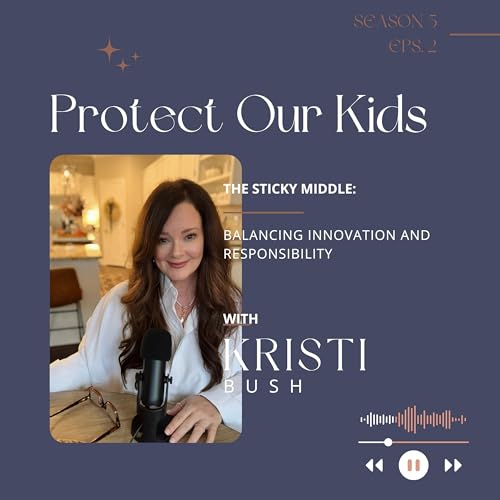
  • "The Sticky Middle: Balancing Innovation and Responsibility
    Jan 12 2026

    In this episode of Protect Our Kids, I do something a little different ...I use AI itself as a research tool and ask a big-picture question: How has the human race historically responded to new technology, and what does that mean for our kids right now?

    What came back was surprisingly clear and honestly, a little unsettling.

    Across history, when transformative technology enters society, we follow a familiar pattern: rapid adoption, cultural excitement, delayed safeguards, and vulnerable populations ... especially children ...being impacted first. Social media and AI are no exception, except for one critical difference: this technology is moving faster than anything we’ve ever seen before.

    We talk about:

    • Why our nervous systems struggle to keep up with rapid tech change

    • How society tends to regulate only after harm appears

    • What “unstewarded technology” really means for families

    • Why waiting for culture and policy to catch up may not be an option this time

    Most importantly, this episode is a call to stewardship — not fear. Technology itself isn’t the enemy, but leaving kids unprotected in the middle of massive innovation is not acceptable.

    If you’re a parent, educator, or professional who feels both hopeful and uneasy about where we’re headed, this conversation is for you. And I truly want to hear your thoughts ...because protecting kids in the digital age is not something any of us should be figuring out alone.


    www.knbcommunications.com

    Show More Show Less
    21 mins
  • The Sticky Middle: Balancing Innovation and Responsibility
    Jan 12 2026

    In this episode of Protect Our Kids, I do something a little different ...I use AI itself as a research tool and ask a big-picture question: How has the human race historically responded to new technology, and what does that mean for our kids right now?

    What came back was surprisingly clear and honestly, a little unsettling.

    Across history, when transformative technology enters society, we follow a familiar pattern: rapid adoption, cultural excitement, delayed safeguards, and vulnerable populations ... especially children ...being impacted first. Social media and AI are no exception, except for one critical difference: this technology is moving faster than anything we’ve ever seen before.

    We talk about:

    • Why our nervous systems struggle to keep up with rapid tech change

    • How society tends to regulate only after harm appears

    • What “unstewarded technology” really means for families

    • Why waiting for culture and policy to catch up may not be an option this time

    Most importantly, this episode is a call to stewardship ...not fear. Technology itself isn’t the enemy, but leaving kids unprotected in the middle of massive innovation is not acceptable.

    If you’re a parent, educator, or professional who feels both hopeful and uneasy about where we’re headed, this conversation is for you. And I truly want to hear your thoughts — because protecting kids in the digital age is not something any of us should be figuring out alone.


    www.knbcommunications.com


    Show More Show Less
    21 mins
  • The Biggest Challenge Parents Will Face Isn’t Screen Time…It’s Influence
    Jan 5 2026

    For years many professionals have been telling parents that screen time is the problem. How many hours? What apps? Which games? What age is too young? While those questions matter, they miss the larger shift already underway. It is one I have been talking about for over a decade. The greatest challenge parents will face in the coming years is not how much technology their children use…but who (or what) is shaping their thinking, emotions, and sense of self. Emphasis on what…


    www.knbcommunications.com

    Show More Show Less
    23 mins
  • Reflecting on 2025...Challenges & Triumphs: Stewardship...A new approach for 2026
    Dec 29 2025

    In this reflective episode, Kristi Bush discusses the challenges and wins of 2025, emphasizing the importance of intentionality and self-care. She introduces the concept of 'stewardship' as her guiding principle for 2026, encouraging listeners to consider how they care for their health, families, and communities. The conversation highlights the need for present, grounded adults in the lives of children and the significance of embracing imperfections in parenting and personal growth.

    Takeaways

    • This year was both absolutely amazing and incredibly challenging.
    • Choosing a word for the year helps focus intentions.
    • Healing is not linear; it involves ups and downs.
    • Intentional work sharpens impact rather than shrinking it.
    • We need present parents, not perfect ones.
    • Stewarding health means not pushing beyond limits.
    • Consider what you are entrusted with and how to steward it.
    • Stewardship encourages moving from reaction to responsibility.
    • Reflecting on the past year can reveal personal growth.

    www.knbcommunications.com

    Show More Show Less
    15 mins