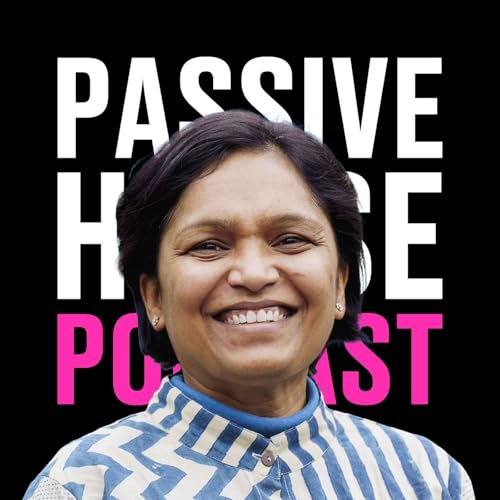
Passive House Podcast cover art

Passive House Podcast

Passive House Podcast

By: Matthew Cutler-Welsh Zack Semke Mary James and Ilka Cassidy
Listen for free

About this listen

Interviews with the leaders, practitioners, and change-makers in the global Passive House movement. A production of Passive House Accelerator.

© 2025 Passive House Accelerator
Science Social Sciences
Episodes
  • 279: Beyond Aesthetics: Kia Weatherspoon on Design Equity
    Mar 10 2026

    In this episode of The Passive House Podcast, Mary James chats with Kia Weatherspoon, founder of Determined by Design. Weatherspoon describes how experiences visiting her brother in prison and creating privacy during Air Force deployments shaped her belief that spaces must be felt, not just seen. She explains her mission-driven focus on affordable housing and a design process rooted in ancestry, legacy, and identity, translating community narratives into specific material and layout decisions. The discussion emphasizes bringing interiors into the integrated design team early, pushing for healthier materials amid cost and pricing-transparency challenges, and streamlining specifications to maintain budgets. The hosts reflect on how interior environments affect wellbeing and project outcomes.

    https://www.determinedbydesign.com/portfolio/station-u-o/

    https://passivehouseaccelerator.com/articles/leading-with-humanity-passive-interior-design

    Show More Show Less
    42 mins
  • 278: Exploring Insulation and Overheating Risks with Tavis Creswell-Wells
    Mar 3 2026

    In this episode of The Passive House Podcast, host Matthew Cutler interviews New Zealand building scientist and sustainability specialist Tavis Creswell-Wells of Ecolution about overheating risk, building performance, and lessons from working in the UK. Tavis describes his path from architecture to building science, early research with BRANZ on the Building Energy End Use Study, and later experience in London with large energy modeling and rating systems including BREEAM, WELL, and Part L. He argues New Zealand’s H1 code overemphasizes insulation and lacks requirements to address overheating, while Part L includes lighting, hot water, mechanical systems, and checks at design and completion. The conversation covers glazing, shading, natural ventilation limitations, PHPP overheating constraints, and using TM59 for zoned overheating analysis, and previews the Reimagine Buildings Multifamily online conference.

    https://ecolutionsbs.com/ecolution


    Thank you for listening to the Passive House Podcast! To learn more about Passive House and to stay abreast of our latest programming, visit passivehouseaccelerator.com. And please join us at one of our Passive House Accelerator LIVE! zoom gatherings on Wednesdays.

    Show More Show Less
    48 mins
  • 277: Transforming Multifamily Housing: Lessons from Cycle Architecture + Planning
    Feb 25 2026

    In this episode of The Passive House Podcast, Jay Fox speaks with Tony Daniels and Caitlin Matusewicz of Cycle Architecture + Planning about their backgrounds in high-performance design and the firm’s focus on scalable multifamily deep energy retrofits, resilience, and Passive House. The conversation covers why retrofits are harder than new construction and how Cycle aims to scale by starting with repeatable retrofit solutions. They discuss panelized overcladding and modular mechanical strategies, NYSERDA’s role via incentives and innovation programs, and broader barriers such as contracting and insurance models that enforce siloing.

    https://www.c-ap.net/

    Thank you for listening to the Passive House Podcast! To learn more about Passive House and to stay abreast of our latest programming, visit passivehouseaccelerator.com. And please join us at one of our Passive House Accelerator LIVE! zoom gatherings on Wednesdays.


    Show More Show Less
    1 hr and 10 mins
No reviews yet
In the spirit of reconciliation, Audible acknowledges the Traditional Custodians of country throughout Australia and their connections to land, sea and community. We pay our respect to their elders past and present and extend that respect to all Aboriginal and Torres Strait Islander peoples today.