

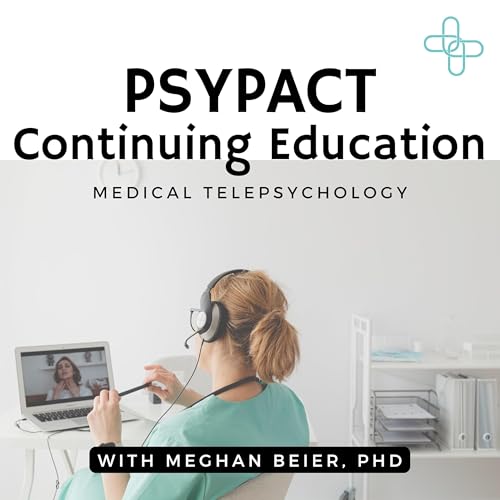
20. UPDATED - PSYPACT - Research, History, Interjurisdictional Practice, & Billing Considerations
Failed to add items
Sorry, we are unable to add the item because your shopping cart is already at capacity.
Add to basket failed.
Please try again later
Add to Wish List failed.
Please try again later
Remove from Wish List failed.
Please try again later
Follow podcast failed
Unfollow podcast failed

20. UPDATED - PSYPACT - Research, History, Interjurisdictional Practice, & Billing Considerations
-
Narrated by:
-
By:
About this listen
CONTINUING EDUCATION
If you are a psychologist or social worker and want CE credits for listening this episode, click on this link.
To find out more about all our CE courses click here.
PODCAST SUMMARY
As of August 2025, 43 States have enacted PSYPACT legislation. After COVID-19, the participation of states and professionals in PSYPACT grew considerably and continues to expand across the country. The ability to use telepsychology to practice across state lines and expand practice has brought many benefits for patients and providers. However, there are distinct and vital competencies, ethics, and standards that must be addressed, implemented, and maintained. This is particularly true for telepsychology practices (including virtual neuropsychological assessments) with neurologic, medical, and disability populations. Although this technology can break down transportation and geographic barriers, some individuals may require additional assistance to properly utilize telepsychology services. Is telehealth really as effective as in-person care? Dr. Meghan Beier talks with Dr. Mary Wells and Dr. Anna Agranovich about what the research shows, the challenges clinicians face, and how shifting insurance rules impact telepsychology. From practical tips to policy updates, this episode unpacks what every therapist needs to know as telehealth becomes a lasting part of mental health care.
Our Experts:
- Mary Wells, PhD - Professor of Physical Medicine and Rehabilitation, Virginia Commonwealth University Health System
- Anna Agranovich, PhD - Assistant Professor of Physical Medicine and Rehabilitation at Johns Hopkins University School of Medicine
COST
- Listening, reading, or watching the course content is free.
- Pay only if you need the continuing education credits.
- This course costs $20 and provides 1 CE credit
- Chen JA, Chung WJ, Young SK, Tuttle MC, Collins MB, Darghouth SL, Longley R, Levy R, Razafsha M, Kerner JC, Wozniak J, Huffman JC. COVID-19 and telepsychiatry: Early outpatient experiences and implications for the future. Gen Hosp Psychiatry. 2020 Sep-Oct;66:89-95. https://pubmed.ncbi.nlm.nih.gov/32750604/
- Pierce BS, Perrin PB, Tyler CM, McKee GB, Watson JD. The COVID-19 telepsychology revolution: A national study of pandemic-based changes in U.S. mental health care delivery. Am Psychol. 2021 Jan;76(1):14-25. https://pubmed.ncbi.nlm.nih.gov/32816503/
- American Society of Clinical Hypnosis (ASCH) Ethics for Telemedicine and Distance Education. https://www.asch.net/aws/ASCH/asset_manager/get_file/614091?ver=1
Practice Guides:
- APA Guidelines for the Practice of Telepsychology - https://www.apa.org/about/policy/telepsychology-revisions
- Place of Service Codes for Professional Claims - https://www.apaservices.org/practice/medicare/medicare-payment/pos-codes
- 2024 Psychological and Neuropsychological Testing Billing and Coding...
No reviews yet
In the spirit of reconciliation, Audible acknowledges the Traditional Custodians of country throughout Australia and their connections to land, sea and community. We pay our respect to their elders past and present and extend that respect to all Aboriginal and Torres Strait Islander peoples today.