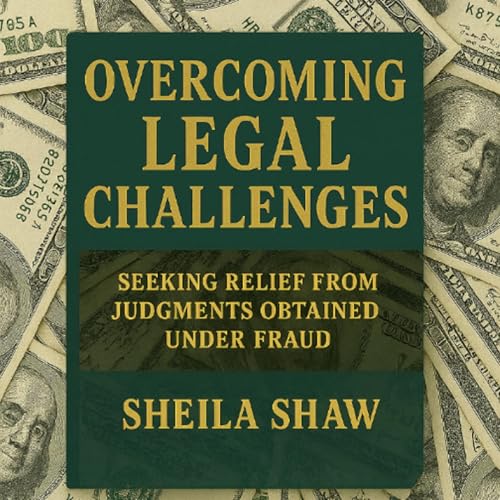
Overcoming Legal Challenges cover art

Overcoming Legal Challenges

Overcoming Legal Challenges

By: Sheila Shaw
Listen for free

About this listen

Legal Challenges associated with civil rights.Sheila Shaw True Crime
Episodes
  • State Created Danger Doctrine Holding Cities Accountable: Monell Liability and Failure to Train
    Feb 28 2026


    Civil Rights Doctrines & Legal Protections in §1983 Litigation This structured reference outlines key legal doctrines and case law relevant to §1983 litigation, police liability, and state-enabled harassment, including state-created danger, deliberate indifference, Monell liability, procedural and substantive due process, equal protection, privacy torts, and malicious prosecution. It provides Q&A on housing interference, fraudulent consent, financial privacy, tech abuse, and public-safety failures, making it ideal for civil-rights firms, litigation explainers, or legal training series. podcast link: https://cdn.notegpt.io/notegpt/web3in1/podcast/podcast_a0d1fe04-d839-46bb-a742-d357c9498c52-1772317714.mp3 1. Opening: How Police Inaction Can Turn Harassment Into a Civil-Rights Crisis 1.1. speaker1: Ever wondered what happens when the very people meant to protect us—like the police—actually make things worse by doing nothing, especially when harassment or stalking escalates? 1.2. speaker2: It's a disturbing reality, and it raises huge questions about public safety and constitutional rights. Today, we’re diving into how police inaction, misinformation, and systemic failures can open the door to serious civil-rights violations—and even turn private harassment into a federal case. 1.3. speaker1: You’ll learn how doctrines like state-created danger and deliberate indifference actually work in court, how cities can be held liable for failing to train officers properly, and why procedural safeguards are so essential. We’ll also break down issues around housing interference, tech-enabled stalking, and what makes these cases rise to the level of a § 1983 civil-rights lawsuit. 1.4. speaker2: We’ll look at: when police inaction becomes a constitutional issue, why fraudulent authority claims matter, how bias and discrimination get woven into these stories, and practical steps people can take if they’re facing harassment or housing interference. Ready to get into the details? Let’s start with the basics: state-created danger. 2. State-Created Danger and Deliberate Indifference Explained 2.1. speaker1: So, let's get into what the state-created danger doctrine actually is. Imagine a situation where someone is being stalked, and the police keep brushing off complaints. If officers know about escalating threats but do nothing, they can actually be liable for putting that person at greater risk. 2.2. speaker2: Exactly—and courts really lean on cases like Kneipp v. Tedder for this. The key point is foreseeability: if it’s obvious someone’s safety is in danger, and officials ignore it, that’s often when liability kicks in. This isn’t just about being inattentive; it’s about knowingly allowing harm to happen... When these failures pile up, they don’t just affect one person—they become a systemic issue, which takes us right to the next doctrine: Monell liability . That actually brings us to some practical steps: what should people do if they find themselves in these situations? 6. Closing Recap: Key Takeaways and Next Steps for Protecting Civil Rights 6.1. speaker1: So, let’s wrap up with the three big takeaways: First, police inaction or reliance on false authority can transform private harassment into a constitutional crisis. Second, cities and departments are responsible when bad practices or lack of training cause systemic risk. Third, procedural and equal protection safeguards are your frontline defense against things like housing interference and tech-enabled abuse. 6.2. speaker2: And here’s a concrete action step:

    Show More Show Less
    7 mins
  • Federal Civil Rights Q&A: Housing, Consent, and Privacy Protections
    Feb 28 2026


    Federal Civil Rights Q&A: Housing, Consent, and Privacy Protections This revised Q&A integrates Supreme Court case law and federal statutes on housing interference, fraudulent consent, digital and financial privacy, and hate crimes. It explains that only lawful occupants may grant home entry, past associations do not confer authority, and tech-enabled or bias-motivated harassment is federally prosecutable. Police complicity through acceptance of false claims can violate civil rights, and coordinated harassment may constitute a federal conspiracy. podcast link: https://cdn.notegpt.io/notegpt/web3in1/podcast/podcast_11c38c5f-ef44-4349-baf2-066e58cbc67e-1772304065.mp3 1. Podcast Opening: Home Entry, Privacy, and Civil Rights Under Federal Law 1.1. speaker1: Picture this: someone you used to know tries to enter your home, claiming an old friend said it’s fine. But is that even legal? And what if the police just go along with it? 1.2. speaker2: That scenario is way more common than people realize—and it’s not just about personal boundaries. We're talking real federal law, Supreme Court rulings, and what happens when civil rights get trampled in the process. 1.3. speaker1: Today, we’ll break down exactly what the law says about third-party consent, housing interference, and digital harassment—plus why ignoring these issues isn’t just risky for individuals, but dangerous for entire communities. 1.4. speaker2: Here’s our roadmap: first, we’ll clear up myths about who can give consent to enter a home; then, we’ll get into banking privacy, tech-enabled abuse, and the role of law enforcement. We’ll wrap up with how federal civil-rights laws deal with coordinated harassment. 2. Who Can Really Give Consent to Enter a Home? 2.1. speaker1: So let’s start with a big one—third-party consent. Can anyone other than the actual resident legally let someone in? 2.2. speaker2: Not a chance. Courts are crystal clear: only someone who lives there and currently has authority can give real consent. If you’re a former partner or friend who moved out, you’ve lost that right. 2.3. speaker1: That’s a huge deal, because people sometimes believe that a past relationship means open doors. But Supreme Court cases like Matlock and Randolph really draw the line, right? 2.4. speaker2: Exactly. In Randolph, the Court said consent must be current and explicit. Anything less—especially if it’s based on rumor or old gossip—just doesn’t count legally. If someone tries to use fake consent to get inside, it could even cross into civil-rights violation territory. 2.5. speaker1: Myths 3.1. speaker2: Let’s dig into the idea of implied consent. Some folks think that just because they used to visit, they can walk right in. But the law says otherwise. 3.2. speaker1: Right, for consent to be legal, it has to be voluntary and in the moment—not something you claim based on a previous connection. Courts have shut down those arguments, especially when ex-partners try to use them to justify entry. 3.3. speaker2: And when law enforcement relies on rumor or past association to allow someone inside, they’re actually putting people’s Fourth Amendment rights at risk. It’s a public-safety problem that goes way beyond one individual. 3.4. speaker1: Honestly, it’s kind of wild how quickly that leap from ‘I used to know them’ turns into a Fourth Amendment violation—especially if tech or intimidation gets involved. 4. Banking Privacy, Tech Harassment, and the Rise of Digital Intrusion 4.1. speaker2: Switching gears, let’s talk about privacy beyond just homes—like financial info and tech. Can someone use a past relationship to peek into your bank accounts or install spyware? 4.2. speaker1: No way. The Right to Financial Privacy Act and federal cybercrime laws make it clear: nobody gets access to your accounts or your devices unless you grant it...

    Show More Show Less
    5 mins
  • DUE PROCESS DOCTRINE
    Feb 28 2026


    Advanced §1983 Litigation: Stalking, False Reports & Cyber Intrusion This guide expands on due process doctrine and litigation strategies for §1983 claims involving stalking, false police reports, and cyber intrusion. It details how to document continuing constitutional violations, establish state action, use foreseeability and Monell liability, and frame law enforcement failures as deliberate indifference and equal protection breaches. The guide synthesizes key case law and evidentiary strategies for robust civil rights litigation. podcast link: https://cdn.notegpt.io/notegpt/web3in1/podcast/podcast_dd576a66-4002-4c76-86ea-4b717ad04e00-1772300741.mp3 1. Podcast Cold Open: When the System Fails to Protect 1.1. Man With Deep Voice: Picture this: someone’s stalking you, filing false reports, hacking your accounts—and every time you call the police, nothing happens. Not only are you ignored, but it feels like the system is standing right behind your stalker. 1.2. Upbeat Woman: That’s the nightmare a lot of families face, and it’s not just about bad luck or a few rogue officers. Today, we’re digging into how law, due process, and civil rights doctrines actually apply when law enforcement looks the other way—or worse, enables the abuse. 1.3. Man With Deep Voice: We’re breaking down what happens legally when police ignore stalking, false reports, or cyber intrusion, and why that’s not just wrong, but potentially unconstitutional. 1.4. Upbeat Woman: So here’s the plan for today: we’ll lay out how the courts see ongoing harassment as a continuing violation, unpack what makes law enforcement accountable for not stepping in, explore digital privacy as a constitutional right, and tie it all together with key strategies if you’re facing this yourself. 2. Recognizing a Continuing Constitutional Violation 2.1. Man With Deep Voice: Let’s start with something a lot of folks don’t realize: courts actually treat repeated stalking, threats, or harassment as one big, ongoing violation—not just isolated incidents. 2.2. Upbeat Woman: Exactly, and that’s huge because it means you can’t just be told, ‘Oh, that happened a year ago, it’s too late.’ If the harassment is still happening, it’s considered a continuing violation. Think of it like a faucet that never stops dripping—it’s the pattern that matters. 2.3. Man With Deep Voice: That’s straight out of cases like Cowell v. Palmer Township and O’Connor v. City of Newark. So if someone keeps stalking you, sending threats, or hacking your accounts—and the police keep ignoring your complaints—then the law sees this as one unbroken stream of misconduct. 2.4. Upbeat Woman: And that sets the stage for actually holding state actors accountable, especially if you’re going after them in a federal civil rights case. 3. How State Action Turns Private Harm Into a Civil Rights Violation 3.1. Man With Deep Voice: Here’s where it gets even more interesting: it’s not just about what the stalker does. It’s about what the state—meaning law enforcement—knows and does with that information. 3.2. Upbeat Woman: Right, because for a lawsuit under Section 1983, you have to connect the harm to some form of state action. That doesn’t mean the stalker has to work for the government. It means police knew about the threats, saw the false reports, or were told about the cyber intrusion—and did nothing. 3.3. Man With Deep Voice: Or worse, maybe they actually emboldened the stalker by ignoring your calls for help. That’s called ‘state-created danger,’ and courts look for a pattern of police inaction or even retaliation that makes things worse

    Show More Show Less
    5 mins
No reviews yet
In the spirit of reconciliation, Audible acknowledges the Traditional Custodians of country throughout Australia and their connections to land, sea and community. We pay our respect to their elders past and present and extend that respect to all Aboriginal and Torres Strait Islander peoples today.