Episodes

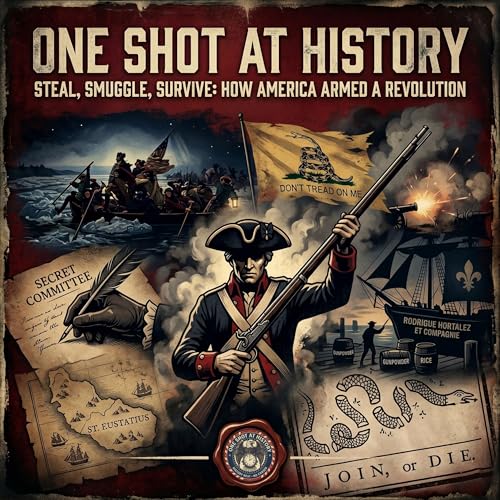
  • STEAL, SMUGGLE, SURVIVE: How America Armed a Revolution
    Apr 26 2026

    Forget everything you think you know about spies.James Bond had an Aston Martin and the full backing of British intelligence. Jason Bourne had black-ops conditioning and a talent for parkour. The American Founders had a printing press, some tobacco to barter with, and a desperate shortage of gunpowder.

    They still pulled it off.

    When George Washington took command of the Continental Army in 1775, his officers counted the gunpowder. Ninety barrels. For an army trying to fight the British Empire. One eyewitness recorded that Washington didn't utter a word for half an hour. Thirty minutes of silence from the man who would become the Father of this Nation. No orders. No strategy. Just math — and the math was catastrophic. Ninety barrels of gunpowder. Enough to start a fight. Not remotely enough to finish one. The most powerful army on earth was camped outside Boston, and George Washington's big plan was held together by roughly the same amount of gunpowder you'd find at a colonial Fourth of July party. Except it wasn't even July. And there was no United States yet.In this episode, we pull back the curtain on the hidden supply network that gave the Continental Army a fighting chance — a story that reads less like a history textbook and more like a screenplay Hollywood would reject for being too implausible:

    • A 25-year-old bookseller with zero military training who dragged sixty tons of cannon across the frozen Berkshires — because he’d read a book about it.

    • A French playwright-turned-arms-dealer who ran millions of livres worth of weapons through a fake Spanish trading company — while simultaneously writing The Barber of Seville.

    • A Connecticut merchant dispatched to France with no French, no credentials, and no cover story except “private merchant” — tasked with arming an army of 25,000 men.

    • A New York housewife who ran covert intelligence operations through her laundry line. (Yes, really.)

    • A tiny eight-square-mile Caribbean island that became the most important illegal arms hub in the Atlantic world.

    • And a rifle so accurate it psychologically broke the British officer class — who stopped wearing their own uniforms in public just to survive.

    Before a single shot was fired at Concord. Before the ink was dry on the Declaration of Independence. America’s Founders had already built one of history’s most sophisticated clandestine supply networks — part spy ring, part arms cartel, part diplomatic con job.


    Welcome to One Shot at History, with your host; Carl Reinemann


    Show More Show Less
    45 mins
  • Things the go Bump in the Natural State: Arkansas Folklore
    Apr 14 2026

    This week on One Shot at History, we're trading Wisconsin weather for Arkansas weirdness — and there is a lot of it.

    We start in Little Rock in 1920, where two police officers on a routine patrol stumble into a ditch, see lights floating into the treetops, and nearly get shot by three women who were ghost hunting on a new moon. It gets stranger from there.

    We visit the White River, home to Arkansas's own version of the Loch Ness Monster — a creature so embedded in local culture that the state legislature officially designated a stretch of river as the White River Monster Refuge in 1973. We head to Fouke, where a hairy, red-eyed creature attacked a family in 1971 and inspired a film that helped invent the found-footage horror genre. We drive the railroad tracks outside Gurdon, where a mysterious light has been bobbing in the darkness since the 1930s and no one — not scientists, not Unsolved Mysteries — has fully explained it.

    And we spend some real time with the Cherokee legend of the Yunwi Tsunsdi — the Little People — small, powerful spirit beings who guided lost travelers, kept sacred fire burning on the Trail of Tears, and, according to tradition, are still out there. This one isn't a ghost story. It's something older and more alive than that.

    One Shot at History takes a humorous look at the serious business of folklore — how stories travel, why they survive, and what they say about the people who keep telling them.

    From Wisconsin, headed south of the Mason- Dixon Line

    Show More Show Less
    28 mins
  • The 1882 Murder of Marshal William Gibson
    Apr 11 2026

    OLD COLD CASE

    Horicon City Marshal William Gibson — Civil War veteran, father of four, a man his community trusted with their safety — was shot once, point-blank, on the steps of his own jailhouse, in front of his ten-year-old son.

    The killer vanished into the dark Wisconsin night. Suspects were arrested across the state. Leads were chased down, and evidence was recovered. A reward climbed to two thousand dollars — the equivalent of sixty-five thousand dollars today.

    There were arrests that went nowhere. A killer who slipped through the net and disappeared without a name. And then — seventeen years after the murder — a dying man in a Minneapolis hospital confessed to killing eleven men. He named one of them - Marshal William Gibson of Horicon.

    This is a cold case more than a hundred and forty-four years old. And today, we’re going back in to pay tribute and honor the name of a fallen officer. We'll follow his timeline, from his arrival at the American House Hotel, to his day of heavy drinking, and his subsequent arrest by Marshal Gibson for public drunkenness.

    We'll hear from the witnesses who gave depositions at the official inquiry. The Detectives who were brought in for the manhunt. The town on edge.


    We'll learn about who William, or 'Bill', Gibson was as a man, an Irish immigrant with a dream and a duty.


    We'll remember Marshal Gibson and his sacrifice. His Memorials here in Wisconsin and in Washington D.C.


    This is the Old Cold Case, The Murder of Marshal William Gibson.


    Show More Show Less
    33 mins
  • Lost on Superior, Found in Time: The Tragedy of the C.F. Curtis and Her Barges
    Mar 30 2026

    On a bitter November day in 1914, the C.F. Curtis, the Selden E. Marvin, and the Annie M. Peterson headed out onto Lake Superior carrying lumber, freight, and a crew of working people bound for another routine run — and vanished into one of the lake’s worst storms.


    More than a century later, the wrecks were finally found again, turning a long-lost maritime disaster into a gripping story of ambition, endurance, tragedy, and the secrets Lake Superior kept hidden for generations. More than a century later, underwater archaeology and shipwreck research would finally locate the Curtis and the Marvin, revealing new details about one of the lake’s enduring mysteries and the human cost of the lumber trade.

    Show More Show Less
    24 mins
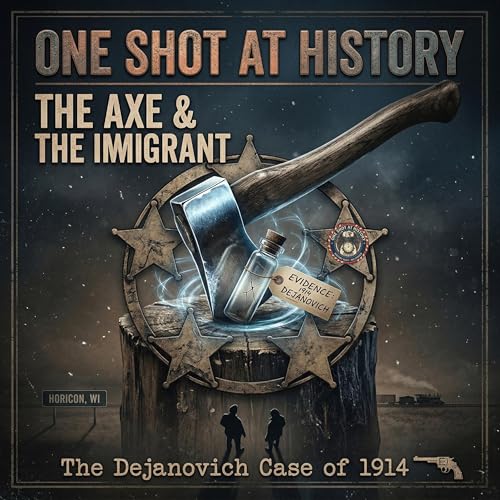
  • The Axe and the Immigrant: The Dejanovich Case of 1914
    Mar 27 2026

    Podcast Name: One Shot at History

    "The Axe and the Immigrant: The Dejanovich Case of 1914":It's July 1914 in Horicon, Wisconsin. A Croatian laborer named Joseph Dejanovich wakes up in the middle of the night to the blow of an axe — and somehow survives. His wife, nineteen-year-old Barbara, is arrested and charged with attempted murder. The evidence seems damning: a sharpened axe, a fired revolver, a bloodstained nightgown. But when the case reaches the courtroom, nothing is quite what it seems.

    In this episode, Carl Reinemann reconstructs one of Dodge County's most forgotten crimes — tracing the lives of two immigrants navigating a world that wasn't built for them, a courtroom that struggled to believe what it was seeing, and a verdict that raised more questions than it answered. And all of it unfolding in the same summer that Frank Lloyd Wright's Taliesin ran red — a few counties away, just weeks later.

    A story about domestic violence, immigrant life, gender, and justice in early twentieth-century Wisconsin. And about the silence that settles over the people history decides not to remember.


    One Shot at History digs into the forgotten corners of local history — the stories that lived briefly in newspaper columns and then quietly disappeared. Hosted by Carl Reinemann, each episode brings a single overlooked nugget of history, a case, crime, or community moment back to life with dramatic narration, rich historical context, and a reminder that real history happens to ordinary people. Because the past only happens once.


    Show More Show Less
    22 mins
  • The Unexplained Circles of Mayville Wisconsin
    Mar 26 2026

    A Different Kind of History — But One That Mattered

    This is a different kind of episode for me. I'm a history person. I like documents, primary sources and the things we can pin down. But history is also made of the moments that resist explaining — the things that happened that we still can't fully explain. The Mayville circles are part of Wisconsin's history, whether or not we ever know what caused them.


    https://iccra.org/reports/wisconsin_mayville_kekoskee_7_4_2003.htm

    Show More Show Less
    17 mins
  • The Skeleton in the Closet: Laura Ingalls Wilder and the Murder in the Big Woods
    Mar 25 2026

    Today on One Shot at History, we're pulling back the curtain on one of America's most beloved literary figures. Laura Ingalls Wilder — author of the Little House on the Prairie series — shaped the way generations of Americans imagined frontier life. The log cabins, the open prairie, the warmth of Pa and Ma, and the close-knit Ingalls family.

    But there's something Laura kept out of those books. Something her own parents whispered about rather than spoke aloud. A gunshot. A neighbor dead in the dark. A trial. A prison sentence.

    And a family secret she carried for decades.

    Show More Show Less
    17 mins