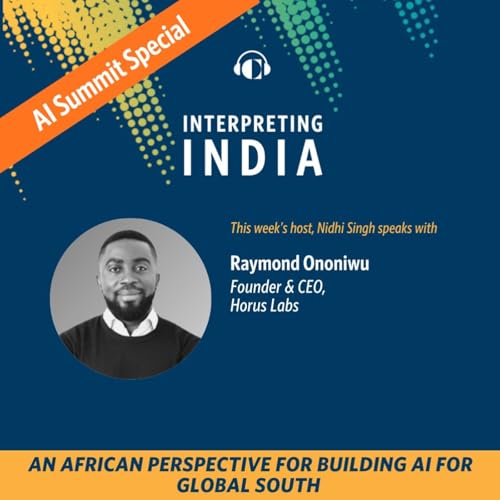
Interpreting India cover art

Interpreting India

Interpreting India

By: Carnegie India
Listen for free

Summary

In Season 5 of Interpreting India, we continue our exploration of the dynamic forces that will shape India's global standing. At Carnegie India, our diverse lineup of experts will host critical discussions at the intersection of technology, the economy, and international security. Join us as we navigate the complexities of geopolitical shifts and rapid technological advancements. This season promises insightful conversations and fresh perspectives on the challenges and opportunities that lie ahead.2024 Carnegie India Political Science Politics & Government
Episodes
  • An African Perspective for Building AI for Global South | AI Summit Special
    Apr 30 2026

    This episode is part of our special series on the India AI Impact Summit, examining the conversations, decisions, and debates that are shaping global AI governance.

    Raymond draws a distinction early in the conversation that shapes everything that follows: training and inference are not the same thing, and conflating them is leading a lot of countries to make expensive mistakes. Training, he says, is like building the engine. Inference is running the transport system every single day. Most countries do not need to build the engine. What they need is airports, roads, and reliable infrastructure that gets the technology into the hands of people. The global assumption that frontier model training is the only legitimate AI pathway is, in his view, one of the more consequential misreads of the moment.

    On the ground realities of building in Africa, Raymond is specific about where the bottlenecks actually are. It is not ambition. It is power reliability, cost of connectivity, access to capital, and the kind of financing frameworks that have not yet caught up with what AI infrastructure actually requires. He points to genuinely interesting anomalies, such as Ethiopia's extremely low cost of power sitting alongside very limited terrestrial fiber diversity, as a reminder that building in the Global South is not about replicating Silicon Valley at a discount. It is about finding combinations of constraints that can actually be made to work, and optimising for reliability, cost efficiency, and practical impact rather than scale and prestige.

    His advice to governments is to start with problems, not hardware. Prestigious projects with no clear use case, over-regulation before a single GPU cluster exists, and attempts to rebuild sovereign versions of large compute clusters are all, in his view, things to ignore. What countries should actually invest in is reliable and clean power, public interest compute access, data governance frameworks, sector specific pilots in health, agriculture, and education, and talent development that works by getting the technology into the hands of people rather than running structured boot camps. For Raymond, the success metric for Africa in five years should not be the size of anyone's model. It should be whether AI has meaningfully improved economic productivity and public service delivery across the continent.

    Episode Contributors

    Nidhi Singh is an associate fellow at Carnegie India. Her current research interests include data governance, artificial intelligence and emerging technologies. Her work focuses on the implications of information technology law and policy from a Global Majority and Asian perspective.

    Raymond Ononiwu is the founder of Horus Lab, a technology and infrastructure company building Africa’s next-generation digital backbone through modular, renewable-powered, AI-ready data centers. An engineer with more than 15 years of experience delivering products across Mixed Reality, Windows Analytics, and Teams Copilot, his work has powered platforms relied on by hundreds of millions globally.

    Every two weeks, Interpreting India brings you diverse voices from India and around the world to explore the critical questions shaping the nation's future. We delve into how technology, the economy, and foreign policy intertwine to influence India's relationship with the global stage.

    As a Carnegie India production, hosted by Carnegie scholars, Interpreting India, a Carnegie India production, provides insightful perspectives and cutting-edge by tackling the defining questions that chart India's course through the next decade.

    Stay tuned for thought-provoking discussions, expert insights, and a deeper understanding of India's place in the world.

    Don't forget to subscribe, share, and leave a review to join the conversation and be part of Interpreting India's journey.

    Show More Show Less
    48 mins
  • The India-EU Trade Deal: What It Delivers and What It Doesn't
    Apr 23 2026

    For most of the last decade, a trade deal between India and the EU seemed unlikely. The nudge came as the world changed around both. Nicolas points to three converging forces: the pressure of US tariffs under Trump, which gave both sides political incentive to show they had other partners; the shared interest in reducing dependence on China for critical supply chains; and India's loss of GSP preferential treatment in the EU from January this year, which created a very concrete economic urgency on the Indian side. Together, these forces did what years of diplomatic goodwill could not.

    The deal itself is ambitious by India's standards, covering tariff elimination on 96.6% of EU goods exports, significant reductions on cars, wine and spirits, and new services commitments across sectors that were previously off the table. But Nicolas is candid about the gaps. There is no chapter on government procurement, the sustainability provisions lack any real enforcement mechanism, and investment protection has been deferred to a separate negotiation. On the regulatory side, Indian exporters still face the carbon border adjustment mechanism on steel and aluminium, strict food safety standards that have already led to hundreds of rejected shipments, and product testing requirements that a tariff cut alone cannot resolve.

    On mobility, Nicolas notes that the framework for Indian professionals is genuinely more promising than what was on offer in the original negotiations, partly because the UK is no longer in the room and partly because Europe's labour market has shifted significantly. But immigration policy remains a national competence, and many EU governments are currently run by or in coalition with parties for whom restricting migration is a core political position. The gap between what Brussels signs and what Vienna or Rome implement could be quite wide, and managing expectations around this will be one of the more delicate parts of the implementation process ahead.

    Every two weeks, Interpreting India brings you diverse voices from India and around the world to explore the critical questions shaping the nation's future. We delve into how technology, the economy, and foreign policy intertwine to influence India's relationship with the global stage.

    As a Carnegie India production, hosted by Carnegie scholars, Interpreting India, a Carnegie India production, provides insightful perspectives and cutting-edge by tackling the defining questions that chart India's course through the next decade.

    Stay tuned for thought-provoking discussions, expert insights, and a deeper understanding of India's place in the world.

    Don't forget to subscribe, share, and leave a review to join the conversation and be part of Interpreting India's journey.

    Show More Show Less
    51 mins
  • From Bletchley Park to Delhi and What Comes Next | AI Summit Special
    Apr 16 2026

    This episode is part of our special series on the India AI Impact Summit 2026, examining the conversations, perspectives, and debates that are shaping global AI discourse.

    Tino has been in the room at all four AI summits, and his account of how the conversation has evolved is both candid and grounding. Bletchley Park, he says, was about putting AI on the agenda as a matter of global significance. Seoul was about bringing the private sector formally into that conversation. Paris marked a pivot towards economic opportunity, reflecting a growing recognition, particularly in Europe, that being seen only as a regulator was not a position anyone wanted to hold for long. And New Delhi brought something none of the previous summits had: scale, and a genuinely different set of questions. Half a million people attended, and the conversations happening on the floor of the convention center were about crop yields, public service delivery, and what the technology meant for jobs and families. That, Tino says, is not a dilution of the AI safety agenda. It is a necessary part of building one that the rest of the world can actually be part of.

    On the criticism that these summits produce declarations that no one enforces and voluntary commitments that companies quietly walk away from, Tino is pragmatic rather than defensive. He points to the eradication of smallpox, the reduction of nuclear weapons, and the Montreal Protocol as reminders that consequential international progress tends to look messy and incremental from the inside. The network of AI safety institutes that now exists across multiple countries, the UN panel on AI, and the fact that frontier labs are taking evaluation and testing seriously at all, are all, in his view, real if incomplete achievements. The harder question, particularly after the U.S. and UK declined to sign the Paris declaration, is whether the summit process can hold its shape as geopolitical competition intensifies and the appetite for multilateral consensus shrinks.

    For Geneva, Tino hopes the conversation moves inward, towards understanding how AI is actually changing organizations, families, and daily life at the micro level. He is also candid about risks he thinks are still not being taken seriously enough, particularly around loss of control, pointing to early evidence of models that scheme, misrepresent, and in controlled environments show signs of self-preservation. His overall posture is one of cautious optimism: he does not think the technology should slow down, but he does think the work of aligning it with what is genuinely good for people has barely begun.

    Chapters

    00:00 Introduction
    02:18 Introduction to AI Diplomacy
    04:07 The Bletchley Park Summit: Hope and Concerns
    10:24 Seoul Summit: Concrete Commitments and Challenges
    11:58 Paris Summit: Shifting Focus to Action
    16:04 Delhi Summit: The Global South Perspective
    21:30 Diverse Perspectives: Government, Private Sector, and Civil Society
    26:15 Critiques of Summit Effectiveness and Global Cooperation
    29:24 Assessing AI's Global Impact
    33:45 India's Role in AI Development
    39:07 Looking Ahead to the Geneva Summit
    43:09 Global Perspectives on AI
    47:25 The Future of AI Governance

    Every two weeks, Interpreting India brings you diverse voices from India and around the world to explore the critical questions shaping the nation's future. We delve into how technology, the economy, and foreign policy intertwine to influence India's relationship with the global stage.

    As a Carnegie India production, hosted by Carnegie scholars, Interpreting India, a Carnegie India production, provides insightful perspectives and cutting-edge by tackling the defining questions that chart India's course through the next decade.

    Stay tuned for thought-provoking discussions, expert insights, and a deeper understanding of India's place in the world.

    Don't forget to subscribe, share, and leave a review to join the conversation and be part of Interpreting India's journey.

    Show More Show Less
    55 mins
No reviews yet
In the spirit of reconciliation, Audible acknowledges the Traditional Custodians of country throughout Australia and their connections to land, sea and community. We pay our respect to their elders past and present and extend that respect to all Aboriginal and Torres Strait Islander peoples today.