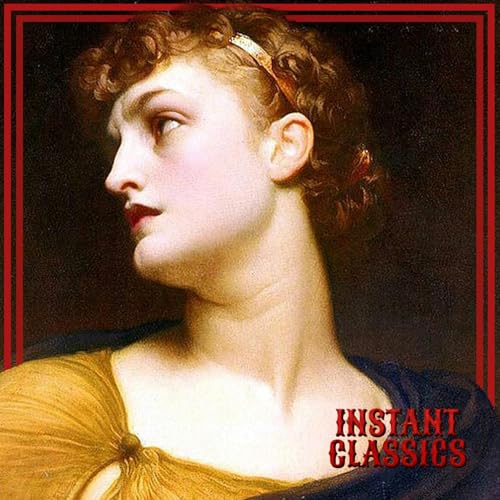
Instant Classics cover art

Instant Classics

Instant Classics

By: Vespucci
Listen for free

About this listen

Join world-renowned classicist Mary Beard and Guardian chief culture writer Charlotte Higgins for Instant Classics — the weekly podcast that proves ancient history is still relevant. Ancient stories, modern twists… and no degree in Classics required. Become a Member of the Instant Classics Book Club here: https://instantclassics.supportingcast.fm/ World
Episodes
  • Classic Chats: Tom Holland
    Feb 26 2026
    Mary and Charlotte talk to Tom Holland, co-host of the Rest is History. As well as being a podcasting megastar, Tom is a brilliant historian of Ancient Rome. His books include Rubicon: The Last Years of the Roman Republic, Pax: War and Peace in Rome’s Golden Age and his recent translation of Suetonius’ The Lives of the Caesars. In the first half of this episode, Tom talks about why Suetonius, with his interest in court gossip and trivia, is the historian for the current age. In the second half, he talks about his lifelong fascination with the Romans - from discovering the Asterix books as a boy, the poetry of Catullus as a teenager, and how writing a series of novels about vampires led him to write Rubicon. @instaclassicpod for Insta, TikTok and YouTube @insta_classics for X email: instantclassicspod@gmail.com Instant Classics handmade by Vespucci Producer: Jonty Claypole Video Editor: Jak Ford Theme music: Casey Gibson Learn more about your ad choices. Visit podcastchoices.com/adchoices
    Show More Show Less
    56 mins
  • Who's Afraid of Lupercalia?
    Feb 19 2026
    If you were to go back in time to 15 February in Ancient Rome, you might see marauding packs of naked men surging through the streets. If you were particularly unlucky one of them might whip you with a piece of goat skin. This was the Roman festival of Lupercalia. In this episode, Mary and Charlotte ask: what on earth was all this about? What did Lupercalia mean to the Romans? And what was the real purpose of any festival to the Romans? Despite its mind-boggling oddness, Lupercalia is better documented than many other Roman festivals. This is partly because the Romans themselves didn’t know really what it was about. Lupercalia was something that seemed to have always been celebrated, but opinions varied - then as now - as to what it meant. The wolfiness of lupercalia, and the suggestion the ritual began in the cave where Romulus and Remus were believed to have been suckled, implies it may have been a way for the Romans to connect with their murky origins - an example of the city performing its own past. But even this is contested. One thing is clear: despite the date, Lupercalia had nothing to do with modern Valentine’s Day - unless, of course, your idea of romance is running naked through the streets flailing a piece of animal skin… @instaclassicpod for Insta, TikTok and YouTube @insta_classics for X email: instantclassicspod@gmail.com Mary and Charlotte recommend some further reading: The Lupercalia is one of Roman religious festivals discussed in Mary’s book, with John North and Simon Price, Religions of Rome (Cambridge UP pb, 1998) volume 2 (with translation of the main ancient texts, including a section of Pope Gelasius’ pamphlet). Mary also discusses how to understand Roman festivals more widely in her chapter in C. Ando (ed.), Roman Religion, Edinburgh Readings in the Ancient World (Edinburgh UP, pb, 2003). Shakespeare’s Lupercalia is in his Julius Caesar Act 1, scene 2 Instant Classics handmade by Vespucci Producer: Jonty Claypole Video Editor: Jak Ford Theme music: Casey Gibson Learn more about your ad choices. Visit podcastchoices.com/adchoices
    Show More Show Less
    47 mins
  • Villain, Victim... Double Agent? The Many Lives of Helen of Troy pt 4
    Feb 12 2026
    Greece gave way to Rome and the Roman Empire too declined, but Helen of Troy survived. Forever young and relevant, she has been reimagined by generation after generation. In the last episode of this mini-series, Mary and Charlotte look at Helen’s enduring appeal in the modern age. They show how she appeared in the poetry of medieval bards, inspired playwright Christopher Marlowe to create one of the most famous lines in English literature (the face that launched a thousand ships) - and how Shakespeare, not wanting to be outdone by Marlowe, said her face launched ‘over’ a thousand ships. Mary describes some of her favourite 19th century paintings of Helen - and discusses the problem of how you paint a face that, by definition, is more beautiful than the face of any artist model. Charlotte talks about how that problem continues in cinema (with a side anecdote about asking Brad Pitt the wrong question at the launch of the film Troy). Finally, Charlotte and Mary compare some of their favourite Helens in modern literature, including Margaret Atwood’s Penelopiad (2005), Pat Barker’s The Silence of the Girls (2018) and Natalia Haynes’ A Thousand Ships (2019) @instaclassicpod for Insta, TikTok and YouTube @insta_classics for X email: instantclassicspod@gmail.com Paintings referred to: G Moreau, Helen at the Scaean Gates https://commons.wikimedia.org/wiki/File:Helene_a_la_porte_scee_-_gustave_moreau_-_2.jpg F. A Sandys, Helen of Troy https://www.liverpoolmuseums.org.uk/artifact/helen-of-troy (The original magazine illustration from which the painting is excerpted: https://collections.vam.ac.uk/item/O783702/illustration-to-helen-and-cassandra-print-sandys-frederick/ ) E de Morgan, Helen of Troy: https://www.demorgan.org.uk/collection/helen-of-troy/ Instant Classics handmade by Vespucci Producer: Jonty Claypole Video Editor: Jak Ford Theme music: Casey Gibson Learn more about your ad choices. Visit podcastchoices.com/adchoices
    Show More Show Less
    56 mins
No reviews yet
In the spirit of reconciliation, Audible acknowledges the Traditional Custodians of country throughout Australia and their connections to land, sea and community. We pay our respect to their elders past and present and extend that respect to all Aboriginal and Torres Strait Islander peoples today.