Episodes

  • Strengthening Global Talent Pipelines Through Microcredentials and Collaboration with Octavio Heredia of Arizona State University
    Dec 18 2025
    Access to world-class education is rapidly being redefined, and learners everywhere are demanding flexible, verifiable pathways that keep pace with innovation. In this episode, we’re joined by Octavio Heredia, Director, Global Outreach and Extended Education, Fulton Schools of Engineering at Arizona State University, to explore how stackable microcredentials, global partnerships and learning-employment records are shaping the future of engineering education. We discuss how ASU is meeting learners where they are, how industry and academia can co-create scalable solutions, and what it truly means to cultivate lifelong “master learners.” Key Takeaways: 00:00 Introduction. 02:27 Octavio reflects on witnessing ASU’s transformation over 23 years. 04:43 Microcredentials meet rapidly changing learner and industry needs. 10:25 A microcredential framework improved learner motivation and targeted skill growth. 15:00 Clearer microcredential messaging remains a work in progress. 20:07 Alignment, transparency, and collaboration make hard partnerships worthwhile. 24:33 Fast-changing, complex industries make alignment challenging. 30:01 Learning records aim to empower learners to tell their full skills story. 32:46 The goal to develop master learners equipped to grow and adapt. Resources Mentioned: Arizona State University | Website ASU Microcredential Programs Trusted Learner Network ASU Fulton Schools of Engineering Thanks for listening to “Engineering the Future Workforce.” If you enjoyed this episode, please leave a 5-star review. And be sure to subscribe so you never miss any insightful conversations. #EngineeringEducation #ElectricalEngineering #MechanicalEngineering
    Show More Show Less
    38 mins
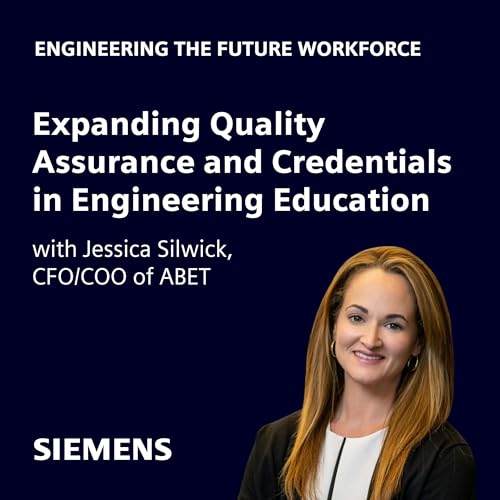
  • Expanding Quality Assurance and Credentials in Engineering Education with Jessica Silwick, CFO/COO of ABET
    Oct 14 2025
    Engineering education is evolving fast — and the way we assess skills, validate learning and prepare future talent must evolve with it. In this episode, we’re joined by Jessica Silwick, CFO and COO of ABET, to explore how academic assessment, peer feedback and credential recognition are reshaping pathways into STEM careers. Jessica shares how ABET is setting global standards for quality assurance, why assessment is central to a growth mindset and how microcredentials are changing the landscape of lifelong learning. Key Takeaways: 00:00 Introduction. 02:07 Jessica discovers her passion for STEM while working with engineers. 04:06 ABET builds quality assurance services and training for evolving STEM needs. 09:11 Siemens chosen as pilot partner for shared commitment to quality education. 14:15 Thoughtful assessment fosters self-reflection, growth and adaptability. 19:09 Continuous feedback and peer review drive innovation and improvement. 22:37 Self and peer assessment build accountability and support growth. 28:37 Microcredentials and essential skills build a growth mindset. 36:59 Credentials expand access to skills and unlock new career opportunities. Resources Mentioned: Jessica Silwick https://www.linkedin.com/in/jessica-silwick-cpa-mba-cae-46935035/ ABET⁠ | LinkedIn https://www.linkedin.com/company/abet-/ ABET | Website https://www.abet.org/ Siemens Digital Industries Software https://www.sw.siemens.com/en-US/ Washington Accord https://www.internationalengineeringalliance.org/accords/washington-accord Thanks for listening to “Engineering the Future Workforce.” If you enjoyed this episode, please leave a 5-star review. And be sure to subscribe so you never miss any insightful conversations. #EngineeringEducation #ElectricalEngineering #MechanicalEngineering
    Show More Show Less
    40 mins
  • Making Sustainability Core to Engineering Education with Suavi Yildirim of FAU Erlangen-Nürnberg
    Jun 18 2025
    Blending immersive technology with sustainable thinking can help future engineers tackle real-world challenges from day one. In this episode, we’re joined by Suavi Yildirim, Graduate Research Assistant of Institute FAPS/FAU Erlangen-Nürnberg, to explore how immersive engineering tools like VR, XR and digital twins are reshaping sustainable design education. We dive into Suavi’s journey leading the winning team in the Siemens and Sony Immersive Design Challenge and how cross-disciplinary collaboration, mentorship and microcredentials play a role in preparing the next generation of engineers. Key Takeaways: (02:38) Suavi embraced sustainability after learning about the UN development goals. (04:50) Suavi’s winning project tackles EV battery challenges and has a strong B2B use case. (09:47) Immersive tools make sustainable design learning intuitive and accessible. (15:21) Siemens microcredentials embed sustainability through real-world learning. (19:55) Without practical experience, students miss sustainability’s role in engineering. (23:27) What matters most is the journey of constant learning and improvement. (26:17) Stay curious, follow your passion and link your work to real impact. (27:53) Suavi values teamwork, open ideas and engineering with real impact. Resources Mentioned: Suavi Yildirim https://www.linkedin.com/in/suaviyildirim/ Institute FAPS/FAU Erlangen-Nürnberg https://www.linkedin.com/company/faps-fau/ Institute FAPS | Website https://faps.fau.de Siemens NX https://plm.sw.siemens.com/en-US/nx/ Coursera https://www.coursera.org/courseraplus?utm_medium=sem&utm_source=gg&utm_campaign=b2c_apac_x_coursera_ftcof_courseraplus_cx_dr_bau_gg_sem_bd-ex_s2_all_m_hyb_23-12_x&campaignid=20989858741&adgroupid=157016705446&device=c&keyword=coursera&matchtype=e&network=g&devicemodel=&creativeid=696907040395&assetgroupid=&targetid=kwd-36262515261&extensionid=&placement=&gad_source=1&gad_campaignid=20989858741&gbraid=0AAAAADdKX6afEsK2Z2-lUcMCcLkbcBx7C&gclid=Cj0KCQjwuvrBBhDcARIsAKRrkjdB96xeO_OAUkx9Jwqc-ZfqzUqAiGHZnySO1nZbzcvs-WFyqbwUPvAaAqM3EALw_wcB Thanks for listening to “Engineering the Future Workforce.” If you enjoyed this episode, please leave a 5-star review. And be sure to subscribe so you never miss any insightful conversations. #EngineeringEducation #ElectricalEngineering #MechanicalEngineering
    Show More Show Less
    29 mins
  • Rethinking Credentials: The Shift Toward Digital Skills-Based Education with Michael Readey of University of Colorado Boulder and Christy Bozic of Duke University
    Apr 23 2025
    Today’s students aren’t just looking for a degree; they’re looking for an edge in a fast-changing world. Employers, meanwhile, want skills they can see, not just credentials on paper. In this episode, we’re joined by Michael Readey, Professor, Engineering Management, at University of Colorado Boulder, and Christy Bozic, Executive Director, Master of Engineering Management Program, at Duke University. We explore how universities and employers can align more effectively to build a future-ready workforce, starting with skills, sustainability and stackable learning models. Key Takeaways: (02:40) Students must adapt to rapid industry change. (05:08) Academia struggles to match the pace of tech. (08:43) Partnerships close education-industry gaps. (13:17) Siemens embeds sustainability across roles. (18:38) Employers prioritize skill-based hiring. (20:43) Stackable learning supports career mobility. (26:26) Most learners are early-career professionals. (30:14) Peer diversity enriches learning. (45:17) Faculty exchanges strengthen relevance. (50:02) Skills-based education is key to the future of learning. Resources Mentioned: Michael Readey https://www.linkedin.com/in/michael-j-readey-16738112/ University of Colorado Boulder https://www.linkedin.com/school/cuboulder/ Christy Bozic https://www.linkedin.com/in/christybozicphd/ Duke University https://www.linkedin.com/school/duke-engineering/ Project Drawdown https://drawdown.org/ Coursera https://www.coursera.org/ ABET https://www.abet.org/ Thanks for listening to “Engineering the Future Workforce.” If you enjoyed this episode, please leave a 5-star review. And be sure to subscribe so you never miss any insightful conversations. #EngineeringEducation #ElectricalEngineering #MechanicalEngineering
    Show More Show Less
    52 mins
  • How Engineering Students Can Gain a Competitive Edge With Credentials with Sophie Overstreet and Hani Qaqish of Siemens Digital Industries Software
    Mar 18 2025
    In a competitive job market, continuous learning and industry-recognized credentials are more valuable than ever, and Sophie Overstreet, Learning Consultant, and Hani Qaqish, Advanced Technical Product Manager, both of Siemens Digital Industries Software, know this firsthand. In this episode, they share insights into the evolving landscape of learning, credentials and the role of AI in education and professional development. Key Takeaways: (08:53) University learning often lacks real-world scale and complexity. (09:33) Credentials help shape career paths and boost confidence. (13:52) Siemens’ ambassador program connects students with industry. (18:04) NASA’s L’SPACE Academy bridges education and industry. (21:00) Employers increasingly value industry-specific credentials. (23:21) Certifications set candidates apart in hiring and career growth. (24:11) Men apply with 60% of qualifications; women wait for 90-95%. (32:10) Microcredentials will play a bigger role in workforce development. (37:34) AI speeds up learning and customizes content. (42:54) Universities must rethink workforce training to meet industry demands. Resources Mentioned: Siemens Digital Industries Software NASA L’SPACE Academy Siemens Xcelerator Academy Thanks for listening to “Engineering the Future Workforce.” If you enjoyed this episode, please leave a 5-star review. And be sure to subscribe so you never miss any insightful conversations.  #EngineeringEducation #ElectricalEngineering #MechanicalEngineering
    Show More Show Less
    44 mins
  • Essential Skills for the Next Generation of Engineers with Jacqueline El-Sayed, CEO of SAE International
    Feb 11 2025
    Engineering education is undergoing a transformation. As technology advances and industries evolve, how do we ensure future engineers are equipped with the right skills? On this episode, we’re joined by Jacqueline El-Sayed, Chief Executive Officer of SAE International. With an extensive background spanning industry, academia and professional societies, she shares insights into the evolving landscape of engineering education, the role of professional organizations and the critical skills engineers need for the future. Key Takeaways: (02:11) Jacqueline’s experience in industry, academia and nonprofits. (05:44) Digital transformation is reshaping engineering and industry. (06:49) Global connectivity impacts student learning and identity. (09:33) Experiential learning bridges academia and industry. (16:19) Ethics and human judgment remain vital in AI advancements. (18:57) Funding initiatives expand opportunities for minority-serving institutions. (19:58) Postdoctoral fellowships develop future engineering leaders. (23:32) Credentialing ensures education meets industry standards. (31:38) AI personalizes and accelerates online learning. (34:31) Embracing confidence and ignoring self-doubt. Resources Mentioned: Jacqueline El-Sayed - https://www.linkedin.com/in/jacquelineelsayed/ SAE International | LinkedIn - https://www.linkedin.com/company/sae-international/ SAE International | Website - https://www.sae.org ASEE Workforce Summit - https://workforcesummit.asee.org ABET Accreditation - https://www.abet.org Thanks for listening to “Engineering the Future Workforce.” If you enjoyed this episode, please leave a 5-star review. And be sure to subscribe so you never miss any insightful conversations. Check out the blog recap: AI, ethics and the future of engineering education with Dr. Jacqueline El-Sayed - Siemens Software Podcast Network - https://blogs.sw.siemens.com/podcasts/engineering-the-future-workforce/ai-ethics-future-engineering-education/ To learn more about Siemens' Global Academic and Future Workforce Program, visit: https://sie.ag/PpYAT #EngineeringEducation #ElectricalEngineering #MechanicalEngineering
    Show More Show Less
    37 mins
  • Cultivating curiosity, initiative and lifelong learning
    Jan 15 2025
    What’s the key to thriving in a world of constant change? In our inaugural episode, Barbara Humpton, CEO of Siemens USA, reveals how lifelong learning and digital innovation are shaping the workforce of tomorrow. Barbara shares insights that inspire action and redefine success. Key Takeaways: (03:16) Curiosity and initiative are essential for lifelong success. (08:21) Early career peer reviews build teamwork and skills for success. (15:28) Digital twins optimize systems, boost sustainability and cut costs. (18:07) Digital tools empower both experienced professionals and new workers. (20:00) Bridging generational gaps creates innovation and collaboration. (24:19) Universities must embrace flexible, lifelong learning models. (31:14) Community colleges are critical for upskilling a diverse workforce. (33:55) Workforce transformation requires partnerships with industry leaders. (39:01) Lifelong learning tools like My Learning World enhance skill-building accessibility. (44:45) Enjoy the journey — learning is a continuous, fun process. Resources Mentioned: Barbara Humpton | LinkedIn: https://www.linkedin.com/in/barbara-humpton/ Siemens USA | LinkedIn: https://www.linkedin.com/company/siemens/ George Mason University: https://www.gmu.edu/ University of Colorado Boulder Sustainability Credential: https://www.colorado.edu/ Siemens My Learning World: https://mylearningworld.siemens.com/web/en/login NSF summary: Putting Skills First: A Framework for Action | World Economic Forum: https://www.weforum.org/publications/putting-skills-first-a-framework-for-action/ Thanks for listening to “Engineering the Future Workforce.” If you enjoyed this episode, please leave a 5-star review. And be sure to subscribe so you never miss any insightful conversations. #EngineeringEducation #ElectricalEngineering #MechanicalEngineering
    Show More Show Less
    47 mins
  • From Classroom to Racetrack: The National University of Singapore's Formula SAE Journey
    Nov 5 2024
    What if your classroom project involved designing a Formula 1-style car to compete in an international race? In this episode of Innovation in the Classroom, Shannon O'Donnell dives into the thrilling world of Formula SAE, where innovative engineering students push the boundaries of design, performance, and teamwork. Join me as I chat with Hong Wee Lim, the Project Supervisor for the National University of Singapore's (NUS) Formula SAE team. Every year, his team designs, builds, and races Formula 1-style cars, preparing to compete on the global stage at Michigan's Formula SAE (FSAE) student engineering competition. But behind the thrill of competition lies a relentless cycle of sleepless nights, technical failures, and fierce deadlines as these students face the daunting challenge of turning their designs into race-ready machines. Hong Wee offers a unique glimpse into how the NUS team transforms classroom theories into high-speed reality. From his journey as a mechanical engineer to managing a group of passionate students, Hong Wee Lim shares the highs and lows of leading a project that combines intense technical learning, innovative problem-solving, and the adrenaline rush of motorsports. In This Episode, You Will Learn: What is Formula SAE, and how do students compete internationally (10:00) How do students benefit after they graduate from participating in FSAE? (14:45) The roles of AI, machine learning, and additive manufacturing in FSAE (21:00) How students enhance their people and leadership skills (22:44) How students adopt an innovative mindset (25:15) The application of Siemens software in FSAE (38:10) Connect with Shannon O'Donnell Linkedin Hong Wee Lim Website LinkedIn As mentioned in the podcast NUS Formula SAE NUS Engineering Design and Innovation Centre
    Show More Show Less
    40 mins