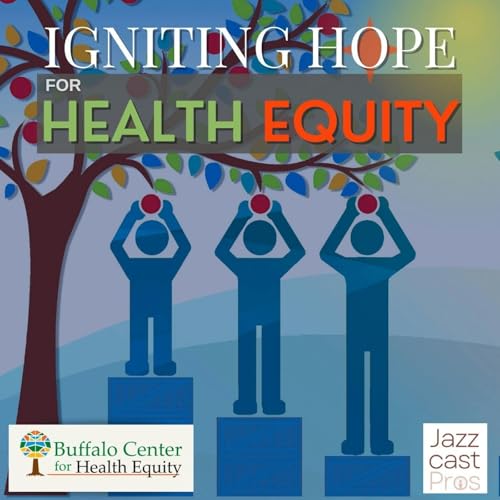
Igniting Hope for Health Equity cover art

Igniting Hope for Health Equity

Igniting Hope for Health Equity

By: Buffalo Center for Health Equity
Listen for free

About this listen

Exposing the social norms, policies and systems that contribute to health inequities in Black America. Our mission is to report the facts and offer solutions to eliminate race-based disparities and achieve health equity. The conversation is led by Pastor George F Nicholas the Senior pastor of Lincoln Memorial United Methodist Church and Chairman of the Buffalo Center for Health Equity.Copyright JazzCast Pros Philosophy Social Sciences
Episodes
  • Seneca Nation of Indians vs New York State
    Oct 13 2024
    Ep. 7 This Indigenous Peoples' Day, we are exploring an important perspective from the Seneca Nation on the ongoing struggles for justice and equitable treatment, issues deeply rooted in historical injustices. Pastor George sits down with Samantha Nephew to discuss Native American affairs in Western New York, including the recent dispute between New York State and the Seneca Nation over casino revenue sharing. Samantha is an active member of the Seneca Nation of Indians (Deer Clan) serving as an advocate for health equity in Western New York. Instagram @healthcareeducation Generational Trauma: Its Legacy and Impact The episode opens by addressing the generational trauma that deeply affects Indigenous communities. Samantha Nephew shares a powerful story of her great-grandmother, a Deer Clan member who was forced into a residential school. 🏫 She was punished for speaking her native language, underscoring how colonial systems sought to erase Indigenous identities. This trauma echoes through generations, showing up in mental health challenges and struggles to preserve culture. The importance of truth-telling for healing is emphasized throughout the episode, reminding us that confronting the past is crucial for moving toward reconciliation. 💬 🎰 Governance Disputes: The Seneca Nation vs. New York State The podcast also dives into the financial disputes between the Seneca Nation and New York State, specifically around the gaming compact that has fueled ongoing tension: The Issue: New York demanded revenue payments from the Seneca Nation’s casinos, which led to a financial freeze of the Seneca Nation’s bank accounts in early 2022. This action was seen by many as a modern form of colonial domination. 🏦 The Impact: The freeze disrupted the livelihoods of many Seneca Nation members and deepened mistrust. Pastor G from the podcast reflects, “No matter what you make out of that, it’ll never be a fair and equitable exchange for what was done to native people.” Learn more about your ad choices. Visit megaphone.fm/adchoices
    Show More Show Less
    44 mins
  • Rejecting Generational Trauma and Reimagining Black Neighborhoods for Economic Self-Sufficiency
    Feb 23 2024
    Ep. 32 Pastor George Nicholas and Dr. Henry Taylor discuss their plan to transform Buffalo's Black east side. This episode explores the concept of a neighborly community built on principles of solidarity, community governance, shared ownership, cooperative economics, and community wealth. We must own and control the land on which we are building our community." - Dr. Henry Lewis Taylor Dr. Henry Taylor is a University at Buffalo faculty expert on urban issues and social, racial and economic justice. He directs the Center for Urban Studies at UB. With an unwavering commitment to systemic transformation, Dr. Taylor elucidates the principles of creating a prosperous and equitable community framework. He ardently speaks on the imperative of governing at the neighborhood level, advocating for shared ownership, and establishing community wealth over individual wealth. This episode is a beacon for those seeking actionable insight into catalyzing positive change within Black communities. GET ACTIVE! Register for the Event: How to Change the Black Eastside Monday, Feb 26th 6pm at Jacobs School of Medicine, 955 Main Street, Buffalo, NY Read the Report Changing the Black East Side: Pilot Initiative Will Tackle Social Determinants of Health - Community Health Equity Research Institute - University at Buffalo End Gun Violence Event: Thursday, February 29 10am-1pm Erie County Medical Center Smith Auditorium 462 Grider St., Buffalo, NY Key Episode Takeaways: Shared Community Governance: Dr. Taylor emphasizes the significance of collective action and self-determination within neighborhoods through elected local bodies that represent community interests. Comprehensive Planning: Effective transformation necessitates identifying issues and systematically addressing them in unity, ensuring all community members are involved in decision-making. Ownership of Land: Securing control over the land on which communities are built is paramount to fortifying neighborhoods against exploitative market dynamics and gentrification. Economic Self-Sufficiency: The development of cooperative businesses and social enterprises enables communities to retain economic resources and foster community wealth. Health Equity and Infrastructure: The fixture of existing housing conditions is a pathway to addressing health disparities endemic within the black community on Buffalo's East Side. Chapters: 0:00:00 Intro: The challenges of liberating black communities. 0:00:43 Need for black communities to take action and read Dr. Henry Lewis Taylor's report. 0:03:28 Dr. Henry Lewis Taylor discusses the condition of black communities and paths to improvement. 0:04:28 Historical pattern of Black people living in undesirable neighborhoods 0:06:00 Dr. Taylor challenges the narrative that white people don't want to live next to black communities 0:08:20 Community built on solidarity, self-governance, and shared ownership. 0:14:53 Pastor George highlights the existence of homeowner associations in wealthy neighborhoods. 0:16:09 The American way perpetuates disparities and mass incarceration. 0:20:03 The importance of cooperative ownership and community wealth. 0:22:39 The focus on fixing existing rental housing and community control. 0:23:55 The impact of dilapidated housing on health and the need for comprehensive planning. 0:29:30 The undervaluation of land in Black communities and market dynamics. 0:33:58 Job training for community members is essential for neighborhood improvements. 0:36:17 Utilizing creative tools like payments in lieu of taxes to lower costs. 0:38:24 Median household income for black Americans is lower than other racialized groups. 0:39:00 Community conversation on February 26 to discuss the comprehensive plan. 0:41:16 Demonstrating proof of concept and seeking broad support for the plan. 0:43:29 Rejecting the notion that black people cannot control their own destiny. 0:46:16 Invitation to join the conversation at the Jacob School of Medicine. Learn more about your ad choices. Visit megaphone.fm/adchoices
    Show More Show Less
    49 mins
  • Gun Violence is the Output. Where does it begin?
    Feb 16 2024
    Ep. 31 Pastor George Nicholas and Sherman Webb-Middlebrooks discuss the issue of gun violence as a public health concern. They explore the historical roots of gun ownership in America, particularly its connection to the control of Black people, and the disproportionate impact of gun violence on Black youth. They also highlight the need for upcoming community events to address the culture of violence and trauma that perpetuates gun violence. "The presence of gun laws itself has not proven to be the kind of deterrent in order to keep ourselves safe. It's a cultural thing." - Pastor George Nicholas Resources: Buffalo Center for Health Equity Events: Men's Health Initiative Monday, February 19, March 4 and 18th. How to Change the Black Eastside (Featuring Dr. Henry Taylor) Monday, Feb 26th End Gun Violence Event: Thursday, February 29 10am-1pm Erie County Medical Center Smith Auditorium 462 Grider St., Buffalo, NY Book by Carol Anderson: The Second: Race and Guns in a Fatally Unequal America Key Takeaways: Gun violence is the leading cause of death for children and teenagers in America, with black youth being disproportionately affected. America has a unique gun culture, with more guns than people, and a significant portion of gun ownership is concentrated among white men. The historical context of gun ownership in America reveals a legacy of using firearms to control and oppress black people and indigenous communities. Framing gun violence as a public health issue allows for a deeper understanding of the root causes and the development of comprehensive solutions. Addressing the trauma and desensitization to violence is crucial in breaking the cycle of gun violence and creating safer communities. About the Speakers: Pastor George Nicholas is the host of the Igniting Hope podcast and the Executive Director of the Buffalo Center for Health Equity. He is dedicated to eliminating race-based health disparities and addressing the root causes of gun violence in communities. Sherman Webb-Middlebrooks is the Manager of the Men's Health Initiative at the Buffalo Center for Health Equity. He works closely with young people and men in the community, providing support groups and resources to promote personal and financial growth. Chapters: 0:00:00 Pastor George Nicholas introduces the topic of gun violence as a public health issue. 0:05:29 Sherman Webb-Middlebrooks promotes the upcoming men's health initiative event. 0:08:18 Analysis of the ineffectiveness of strict gun laws in preventing gun violence. 0:11:05 Revelation of firearms as the leading cause of death for children and teenagers in America. 0:13:06 There is gun violence everywhere in America. 0:14:58 Witnessing violence creates trauma, especially for young people. 0:15:37 The presence of firearms enables and empowers violence. 0:16:53 "The Second: Race and Guns in a Fatally Unequal America" by Carol Anderson. 0:17:21 The idea of black people having guns was not in the original documents. 0:18:46 The Negro Act of 1740 restricted the movements and access to firearms for enslaved people. 0:19:20 South Carolina issued monetary rewards for the scalp of an escaping slave. 0:20:10 50% of wealth holders in the 13 colonies owned guns in 1774. 0:21:37 Legislation and punishment were used to control enslaved people. 0:24:00 Massachusetts and New York banning enslaved Africans from possessing guns 0:25:11 The use of the militia to control African and indigenous populations 0:26:59 Comparison of the government's use of the National Guard during civil rights protests 0:30:46 The rise in black gun ownership and the narrative of self-defense 0:32:25 Disproportionate gun violence and deaths among black youth 0:34:46 Desensitization to violence and the influence of street culture 0:35:53 Gilbert Arenas and the consequences of impulsive actions 0:37:23 Creating a community where gun violence is not normalized 0:39:32 President Biden's office of Gun Violence Prevention Learn more about your ad choices. Visit megaphone.fm/adchoices
    Show More Show Less
    48 mins
No reviews yet
In the spirit of reconciliation, Audible acknowledges the Traditional Custodians of country throughout Australia and their connections to land, sea and community. We pay our respect to their elders past and present and extend that respect to all Aboriginal and Torres Strait Islander peoples today.