

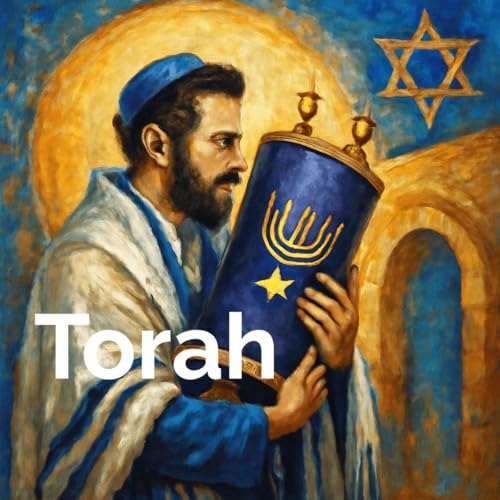
Terminology and Names.
Failed to add items
Sorry, we are unable to add the item because your shopping cart is already at capacity.
Add to basket failed.
Please try again later
Add to Wish List failed.
Please try again later
Remove from Wish List failed.
Please try again later
Follow podcast failed
Unfollow podcast failed

Terminology and Names.
-
Narrated by:
-
By:
Summary
Etymologies and Designations.
The Hebrew term Torah derives from the root (y-r-h or yara), a verb connoting "to instruct," "to teach," or "to guide," with metaphorical extensions from "to throw" or "to shoot" as in directing an arrow toward a target. This root emphasizes purposeful direction, aligning with the text's role as divine instruction for ethical and ritual conduct.
In Jewish tradition, the Torah designates the Pentateuch—the five books of Genesis, Exodus, Leviticus, Numbers, and Deuteronomy—also called the Chumash, from the Hebrew/Aramaic for "five," referring to its division into five scrolls or volumes. These books bear Hebrew names drawn from their opening words: Bereshit, "In the beginning", Genesis, Shemot, "Names", Exodus, Vayikra, "And He called", Leviticus, Bamidbar, "In the wilderness", Numbers, and Devarim, "Words", Deuteronomy.
The Greek designation Pentateuch (pentateukhos), meaning "five scrolls" or "five cases," emerged in the Hellenistic era, with its earliest attested use in a Greek epistle from the mid-second century CE, reflecting the physical format of separate scrolls in ancient Jewish and early Christian libraries. English translations often render it as the "Five Books of Moses," attributing authorship to Moses per traditional Jewish and biblical accounts, though this ascription pertains more to composition than nomenclature.
In non-Jewish contexts, particularly Christian and academic usage, "Torah" sometimes broadly denotes the entire Hebrew Bible or Jewish law (halakha), but this extension deviates from its primary Jewish sense limited to the written Pentateuch, distinct from the Oral Torah or later rabbinic interpretations. The Latin-derived "Law" (from Greek nomos) has historically emphasized legal aspects, occasionally leading to misinterpretations of the text's narrative and covenantal dimensions.
Scope in Jewish and Broader Contexts.
In Jewish tradition, the term Torah primarily denotes the Written Torah (Torah she-bi-khtav), comprising the five books attributed to Moses—Genesis, Exodus, Leviticus, Numbers, and Deuteronomy—which outline creation, patriarchal histories, the Exodus, wilderness wanderings, and core legal stipulations including the 613 commandments (mitzvot). the Torah, totaling approximately 79,000 Hebrew words, form the unadorned scriptural foundation, with ambiguities intentionally left unresolved to necessitate interpretive guidance.
The concept expands in Judaism to encompass the Oral Torah (Torah she-be-al peh), a parallel tradition of rabbinic exegesis, ethical teachings, and halakhic (legal) elaborations believed to have been revealed to Moses at Sinai alongside the Written Torah but transmitted verbally to prevent idolatry of the text and allow adaptive application. Codified post-70 CE destruction of the Second Temple, it includes the Mishnah (c. 200 CE), Gemara forming the Talmud (c. 500 CE for Babylonian, 400 CE for Jerusalem), and subsequent commentaries like Maimonides' Mishneh Torah (12th century), comprising interpretive layers that detail observance of the mitzvot—such as precise rituals for Sabbath or dietary laws—rendering the Oral Torah volumetrically far larger and distinctive to Judaism by excluding it from claims by other faiths on the Written Torah alone.
In Christianity, the Torah's scope aligns with the Pentateuch as the initial segment of the Old Testament, providing covenantal history and moral precepts preparatory to the New Testament, though its ritual laws are deemed typological or abrogated post-Christ, emphasizing ethical continuity over strict adherence. In Islam, the Tawrat signifies the original revelation to Moses for Israelite guidance, equated to the Pentateuch's content but regarded as partially corrupted (tahrif) through human alteration, with the Quran (revealed 610–632 CE) affirming its monotheistic essence while superseding it as the uncorrupted final scripture. Beyond Abrahamic religions, secular scholarship delimits the Torah to the Written Pentateuch as an ancient Semitic corpus, analyzed for its composite authorship, Bronze/Iron Age contexts, and influences on ethics and law, independent of revelatory claims.
This episode includes AI-generated content.
adbl_web_anon_alc_button_suppression_c
No reviews yet
In the spirit of reconciliation, Audible acknowledges the Traditional Custodians of country throughout Australia and their connections to land, sea and community. We pay our respect to their elders past and present and extend that respect to all Aboriginal and Torres Strait Islander peoples today.