

Book of Genesis.
Failed to add items
Sorry, we are unable to add the item because your shopping cart is already at capacity.
Add to basket failed.
Please try again later
Add to Wish List failed.
Please try again later
Remove from Wish List failed.
Please try again later
Follow podcast failed
Unfollow podcast failed

Book of Genesis.
-
Narrated by:
-
By:
Summary
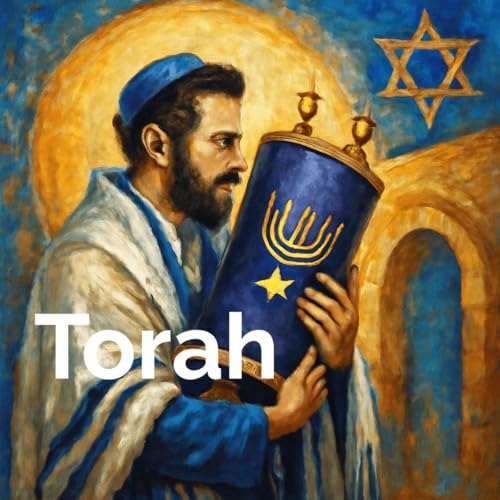
The Book of Genesis, titled Bereshit, "In the beginning", forms the opening segment of the Torah, spanning 50 chapters that recount the creation of the cosmos, the early development of human society, and the foundational lineage of the Israelites through the patriarchs. It establishes core theological motifs, including divine sovereignty over creation, the entry of sin into the world, recurring patterns of human failure met with God's covenantal interventions, and the election of a specific family line amid broader ancient Near Eastern contexts. The narrative employs genealogies (toledot) to segment history, tracing descent from Adam through Seth to Noah, and subsequently to Abraham, structuring the text as a unified account of origins rather than isolated myths.
Genesis divides into primeval history (chapters 1–11), which addresses universal origins and humanity's primal estrangement from God, and patriarchal history (chapters 12–50), which narrows to the promises extended to Abraham's descendants. Chapters 1–2 depict God forming the universe in six sequential acts—light, sky, land and seas, vegetation, celestial bodies, sea creatures and birds, land animals and humans—pronouncing each "good" and instituting the seventh day as rest, countering ancient cosmogonies like the Babylonian Enuma Elish by emphasizing orderly speech-act creation without conflict among deities. Subsequent accounts detail Adam and Eve's disobedience in Eden, introducing mortality and toil (Genesis 3); Cain's murder of Abel and the spread of violence (Genesis 4); escalating corruption prompting the Flood, where Noah preserves life via ark amid global deluge (Genesis 6–9, with precise ark dimensions of 300x50x30 cubits and provisions for paired animals); and the Babel dispersion due to unified rebellion against divine limits (Genesis 11). These episodes culminate in the Noahic covenant, prohibiting blood consumption and murder while promising no future total flood, evidenced by the rainbow sign.
The patriarchal section shifts to God's unilateral call of Abram from Ur (Genesis 12:1–3), initiating covenants promising progeny as numerous as stars, land possession, and global blessing, reiterated amid trials like famine in Egypt, Hagar's son Ishmael, and Sodom's destruction (Genesis 15–19). Isaac's birth to aged Sarah fulfills barrenness reversal (Genesis 21), followed by his near-sacrifice test (Genesis 22) and marriage to Rebekah (Genesis 24). Jacob supplants Esau via deception, flees, wrestles God for renaming as Israel, and sires twelve sons through Leah, Rachel, and concubines, including Joseph's dreams precipitating fraternal betrayal (Genesis 25–37). The finale details Joseph's enslavement, false accusation, and ascent to Egyptian vizier under Pharaoh, interpreting dreams of seven abundant then lean years, enabling grain storage that sustains his family during famine and relocates them to Goshen (Genesis 39–50). Joseph's orchestration averts starvation for Jacob's household of 70 souls, setting preconditions for later exodus events, with his dying charge to bury bones in Canaan underscoring enduring ties to promised land.
While primeval accounts lack direct extrabiblical corroboration and align more with theological etiology than verifiable annals, patriarchal narratives intersect with archaeological contexts like Middle Bronze Age nomadic patterns and Egyptian administrative practices, though specific figures like Abraham remain unattested in nonbiblical records. The text's internal coherence, such as consistent covenant motifs and genealogical spans totaling approximately 2,000 years from Adam to Joseph, supports its composition as intentional ancient historiography rather than late redaction, prioritizing causal sequences of promise, failure, and preservation.
Bereshit establishes the theological and historical framework upon which the rest of the Torah builds.
This episode includes AI-generated content.
adbl_web_anon_alc_button_suppression_c
No reviews yet
In the spirit of reconciliation, Audible acknowledges the Traditional Custodians of country throughout Australia and their connections to land, sea and community. We pay our respect to their elders past and present and extend that respect to all Aboriginal and Torres Strait Islander peoples today.