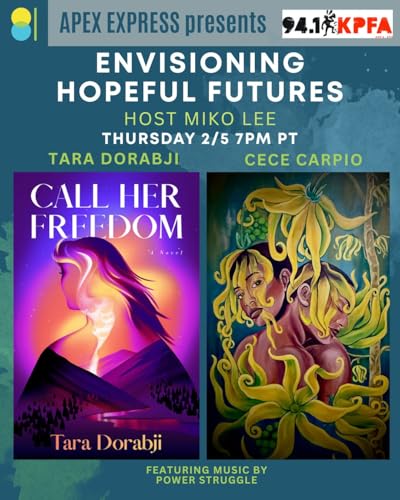
APEX Express – 2.5.26-Envisioning Hopeful Futures cover art

APEX Express – 2.5.26-Envisioning Hopeful Futures

APEX Express – 2.5.26-Envisioning Hopeful Futures

Listen for free

View show details

About this listen

A weekly magazine-style radio show featuring the voices and stories of Asians and Pacific Islanders from all corners of our community. The show is produced by a collective of media makers, deejays, and activists. Envisioning Hopeful Futures Host Miko Lee speaks with two Bay Area artists, activists, and social change makers: Tara Dorabji and Cece Carpio. Both of these powerful people have been kicking it up in the bay for a minute. They worked in arts administration as community organizers and as artist activists. LINKS TO OUR GUESTS WORK Tara Dorabji Author’s website New book Call Her Freedom Find more information about what is happening in Kashmir Stand With Kashmir Cece Carpio Tabi Tabi Po running at Somarts SHOW Transcript Opening Music: Apex Express Asian Pacific expression. Community and cultural coverage, music and calendar, new visions and voices, coming to you with an Asian Pacific Islander point of view. It’s time to get on board the Apex Express. Miko Lee: Good evening. I’m your host Miko Lee, and tonight I have the pleasure of speaking with two Bay Area local artists, activists, and social change makers, Tara Dorabji and Cece Carpio. Both of these powerful people have been kicking it up in the bay for a minute. They worked in arts administration as community organizers and as artist activists. I so love aligning with these multi hyphenated women whose works you can catch right now. First up, I talk with my longtime colleague, Tara Dorabji Tara is an award-winning writer whose first book Call Her Freedom just came out in paperback. And I just wanna give a little background that over a decade ago I met Tara at a workshop with the Great Marshall Gantz, and we were both asked to share our stories with the crowd. During a break, Tara came up to me and said, Hey, are you interested in joining our radio show, Apex Express? And that began my time with Apex and the broader Asian Americans for Civil Rights and Equality community. So if you hear a tinge of familiarity and warmth in the interview, that’s because it’s real and the book is so great. Please check it out and go to a local bookstore and listen next to my chat with Tara. Welcome Tara Dorabji to Apex Express. Tara Dorabji: Thank you so much for having me. It’s wonderful to be with you, Miko. Miko Lee: And you’re actually the person who pulled me into Apex Express many a moon ago, and so now times have changed and I’m here interviewing you about your book Call Her Freedom, which just was released in paperback, right? Tara Dorabji: Yep. It’s the one year book-anniversary. Miko Lee: Happy book anniversary. Let’s go back and start with a little bit for our audience. They may have heard you, if they’ve been a long time Apex listener, but you as an artist, as a creator, as a change maker tell me who are your people and what legacy do you carry with you? Tara Dorabji: Who are my people? My people I would say are those who really align with truth. Truth in the heart. That’s like at the very core of it. And I’m from the Bay Area. I’ve been organizing in the Bay a long time. I started out organizing around contaminated sites from nuclear weapons. I’ve moved into organizing with young people and supporting storytelling. So arts and culture has been a huge part of it. Of course, KPFA has been a big part of my journey, amplifying stories that have been silenced, and I think in terms of legacy, I’ve been thinking about this more and more. I think it goes into two categories for me. One are the relationships and who remembers you and and those deep heart connections. So that’s one part. And then for my artistry, it’s the artists that come and can create. On the work that I’ve done and from that create things that I couldn’t even imagine. And so I really think that’s the deepest gift is not the art that you’re able to make, but what you create so that others can continue to create. Miko Lee: Thank you so much for sharing the deep kind of legacy and sense of collaboration that you’ve had with all these different artists that you’ve worked with and it’s, your work is very powerful. I read it a year ago when it first came out, and I love that it’s out in paper back now. Can you tell our audience what inspired Call her Freedom. Tara Dorabji: Call Her Freedom is very much inspired by the independence movement in Indian occupied Kashmir. And for me it was during the summer uprisings when, and this was way back in, In 2010-2009, after the Arab Spring and for the entire summer, Kashmir would be striking. It would shut down from mothers, grandmothers, women, children in the street. This huge nonviolent uprising, and I was really drawn to how it’s both one of the most militarized zones on earth. And how there was this huge nonviolent uprising happening and questions about what it could look like, even like liberation beyond the nation state. And so I was really drawn to that. My dad’s from Bombay, from...
No reviews yet
In the spirit of reconciliation, Audible acknowledges the Traditional Custodians of country throughout Australia and their connections to land, sea and community. We pay our respect to their elders past and present and extend that respect to all Aboriginal and Torres Strait Islander peoples today.