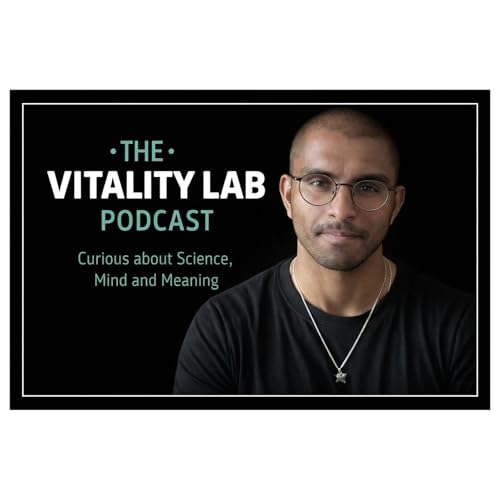
The Vitality Lab Podcast cover art

The Vitality Lab Podcast

The Vitality Lab Podcast

By: Aaran Vijayakumaran
Listen for free

About this listen

A New Podcast Hosted by Aaran Vijayakumaran Ph.D, a Scientist at Stanford University

Curious Together | Exploring science, mind, and meaning

Welcome to The Vitality Lab — a podcast about the science of being human. This show blends physiology, psychology, and philosophy to explore what it means to grow, adapt, and live with intention.

It's a space for people who ask why we are the way we are, and what we can do about it. We don’t claim to have the answers — but we believe in asking better questions. Whether it’s the stress of endurance, the complexity of the mind, or the search for meaning, this podcast invites you to think more deeply about the forces shaping our lives. Because the world is full of rich information — and we’re here to make sense of it, together.

New episodes weekly. For the curious. For the seekers. For those still becoming.

Aaran Vijay 2026
Episodes
  • What Actually Helps When You’re Struggling | Professor Pooja Saini
    Dec 28 2025

    Professor Pooja Saini is a UK-based academic and practitioner specialising in mental health, suicide prevention, and community-based support, with years of experience working at the intersection of research, healthcare, and real-world services.

    In this conversation, we explore why mental health is still so hard to talk about, why people often struggle in silence, and how misunderstanding, stigma, and system design shape the way we respond to distress. Rather than slogans or motivation, this episode focuses on understanding — what actually helps people cope, recover, and feel supported before things reach crisis.

    This episode is for anyone who wants to better understand mental health — whether for themselves, for someone they care about, or simply to have more compassionate and informed conversations.

    Show More Show Less
    1 hr
  • Why Exercise Helps Depression — Why Starting Is So Hard | Dr Emily Hird
    Dec 25 2025

    In this episode, we’re joined by Dr Emily Hird, a cognitive neuroscientist and research fellow at University College London’s Institute of Cognitive Neuroscience, whose research focuses on the brain mechanisms underlying depression and other mental health conditions.

    Dr Hird’s work examines how changes in reward processing, motivation, and effort-based decision-making contribute to symptoms such as anhedonia and apathy. Her research also explores how dopamine signalling, inflammation, and stress interact in depression — and why physical activity may help by reshaping these brain circuits over time.

    Together, we unpack why depression isn’t just a change in mood, why everyday tasks can feel disproportionately effortful, and why exercise can be as effective as antidepressants for some people. Rather than focusing on willpower or “pushing through,” this conversation looks at the neuroscience of effort, small wins, and how understanding the brain can make recovery feel more possible.

    Topics covered

    • How depression changes brain function
    • Anhedonia, apathy, and effort sensitivity
    • Dopamine, reward circuits, and motivation
    • Inflammation and mental health
    • Why exercise helps depression (neuroscience explained)
    • Why starting small matters

    This episode is for education and discussion, not medical advice. If you’re struggling, consider speaking to a healthcare professional.

    Show More Show Less
    1 hr and 18 mins
  • GLP-1 Drugs, the Brain, and Mental Health | Dr Riccardo De Giorgi
    Jan 11 2026

    Dr Riccardo De Giorgi, MD, DPhil, MRCPsych, is a Clinical Lecturer in Psychiatry at the University of Oxford and an Honorary Consultant in General Adult Psychiatry at Oxford Health NHS Foundation Trust. He teaches psychiatry and psychopharmacology, leads experimental medicine research, and focuses on repurposing immuno-metabolic drugs — including GLP-1 receptor agonists — for cognitive and mental disorders.

    In this episode, we explore GLP-1 receptor agonists (GLP-1RAs) — medications originally developed for diabetes and obesity — and their emerging relevance to psychiatry and brain health. Recent analyses, including work led by Dr De Giorgi, review preclinical and clinical evidence suggesting these drugs may influence cognitive processes, reward pathways, mood regulation, and inflammatory mechanisms implicated in conditions such as depression, addiction, Alzheimer’s disease, and other psychiatric or neurocognitive disorders.

    We discuss:

    • How GLP-1 signalling works in the body and the brain
    • Why psychiatrists are increasingly interested in GLP-1RAs beyond metabolic effects
    • The current evidence for psychiatric and cognitive benefits (and limitations)
    • Mechanistic challenges in translating animal findings to humans
    • The importance of stratifying patients and integrating biomarkers in future research

    This episode strips away hype to uncover what science currently supports — and what remains an open question — about the psychiatric potential of GLP-1 receptor agonists.

    Show More Show Less
    52 mins
No reviews yet
In the spirit of reconciliation, Audible acknowledges the Traditional Custodians of country throughout Australia and their connections to land, sea and community. We pay our respect to their elders past and present and extend that respect to all Aboriginal and Torres Strait Islander peoples today.