Episodes

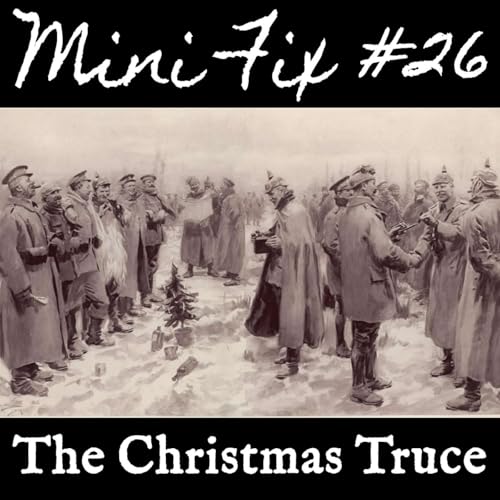
  • Mini Fix #26: The Christmas Truce
    Dec 21 2025

    I had planned to take this week and next off but I can't leave y'all hanging without your fix on Christmas! This week I'm bringing you a special mini fix episode about the Christmas Truce of 1914. This remarkable ceasefire that happened spontaneously all along the Western Front during the first winter of World War I has shocked and inspired the masses ever since. But despite tons of eyewitness accounts and tangible evidence like letters, autographs, and photos, there are many who refuse to believe that the Christmas Truce ever happened. So, what do you think? Is this actual history or merely a myth?

    Support the show!

    • Join the Patreon (patreon.com/historyfixpodcast)
    • Buy some merch
    • Buy Me a Coffee
    • Venmo @Shea-LaFountaine

    Sources:

    • Imperial War Museums video "How Did the Christmas Truce Happen?"
    • Imperial War Museums "The Real Story of the Christmas Truce"
    • History.com "The Christmas Truce"
    • Institute for Economics and Peace "The Christmas Truce"
    • "Western Front Companion" by Mark Adkin
    • Forces War Records by Ancestry "The True Story of the 'Christmas Truce'"

    Shoot me a message!

    Support the show

    Show More Show Less
    23 mins
  • Ep. 143 Internment: How the US Government Forced Japanese Americans Into Its Own Version of Concentration Camps
    Dec 14 2025

    After talking about the Pearl Harbor attack last week and how it prompted US involvement in World War II, I realized I glorified the aftermath pretty hard. Yes, Japan's attack on Pearl Harbor did directly lead to the US declaring war on both Japan and Germany. Yes, US involvement in World War II undeniably helped bring that war to a close. However, the US reacted in other ways at home that weren't quite as glorious. This week I'm talking about the ugly side of the Pearl Harbor aftermath, when the US government forced some 120,000 Japanese Americans, two thirds of them US citizens, into "relocation centers" or "internment camps" that could just as easily be called concentration camps. Mistakes were made, lessons were learned... lessons we can't afford to forget, especially now.

    Support the show!

    • Join the Patreon (patreon.com/historyfixpodcast)
    • Buy some merch
    • Buy Me a Coffee
    • Venmo @Shea-LaFountaine

    Sources:

    • densho.org
    • National Archives "Japanese-American Incarceration During World War II"
    • Densho Encyclopedia "Picture Brides"
    • Densho Encyclopedia "Executive Order 9066"
    • National World War II Museum "Japanese American Incarceration"
    • Wikipedia "Internment of Japanese Americans"

    Shoot me a message!

    Support the show

    Show More Show Less
    34 mins
  • Ep. 142 Pearl Harbor: Why Japan Attacked Pearl Harbor, Seemingly Out of Left Field, and Involved Itself in World War II
    Dec 7 2025

    I feel pretty well versed when it comes to World War II. I understand fairly well what was happening in Europe at least with Germany and whatnot. I know that the attack on Pearl Harbor on December 7, 1941 (84 years ago today) was the event that drew the United States into the war. But Pearl Harbor wasn't bombed by Germany. It was bombed by Japan. Wait, what? Japan? What does Japan have to do with Nazi Germany and World War II? This week I sit down with Quin Cho, an expert on the Pacific Theater during World War II, to talk about what was happening in Asia leading up to that fateful attack on Pearl Harbor. He'll fill us in on the rising action, like the Mukden Incident and the Second Sino-Japanese War, that led to the collision of two different war theaters into one big, bad world war.

    Quin's books:

    • "Rise of the Kwantung Army: Japan's Empire in Manchuria to 1932"
    • "Competing Empires in Burma: A Chronicle of the China-Burma-India Theater of Operations in World War 2"

    Support the show!

    • Join the Patreon (patreon.com/historyfixpodcast)
    • Buy some merch
    • Buy Me a Coffee
    • Venmo @Shea-LaFountaine

    Sources:

    • The National WWII Museum "Pearl Harbor Attack, December 7, 1941"
    • Office of the Historian "The Mukden Incident of 1931 and the Stimson Doctrine"
    • Office of the Historian "The Chinese Revolution of 1911"
    • History.com "Pearl Harbor"
    • Wikipedia "Zhang Zoulin"
    • Wikipedia "Mukden Incident"

    Shoot me a message!

    Support the show

    Show More Show Less
    48 mins
  • Ep. 141 Still Here Part 2: Setting the Record Straight With Chief Marilyn Berry Morrison of the Roanoke-Hatteras Tribe
    Nov 30 2025

    To follow up my perspective seeking conversation with Gray Parsons of the Secotan Alliance, I sat down next with Chief Marilyn Berry Morrison of the Roanoke-Hatteras Tribe. I asked Chief Morrison the same question: why do you think the misconception exists that Indigenous Americans no longer exist in the eastern part of the United States? She had similar thoughts to share. Chief Morrison spoke a lot about fear and shame stemming from the trauma of the past. She also clued me in to a personal journey she's been on for quite some time, a journey to get state and national recognition for her ancestry and her tribe, the Roanoke-Hatteras, and the unnecessary difficulty involved in the process. Again, this is a must listen!

    Support the show!

    • Join the Patreon (patreon.com/historyfixpodcast)
    • Buy some merch
    • Buy Me a Coffee
    • Venmo @Shea-LaFountaine

    Sources:

    • Native Heritage Project “The Pierce Family of Tyrrell County”
    • “Deliver Us from Evil: The Slavery Question in the Old South” by Lacy K. Ford

    Shoot me a message!

    Support the show

    Show More Show Less
    35 mins
  • Ep. 140 Still Here Part 1: Fixing the Narrative With Gray Parsons of the Secotan Alliance
    Nov 23 2025

    This week, I sat down with Gray Parsons of the Secotan Alliance to get to the bottom of a common misconception. It seems, to me at least, that there's a notion in our country that Indigenous Americans no longer exist in the eastern states, that they were either killed or forced to relocate west. Gray's response provided the much needed perspective I was seeking. Join us as we chat about Wingina, the first Indigenous American leader to be killed by the English for resisting colonization, and the shockwaves that act sent out, shockwaves that have mostly been ignored. We'll also discuss barriers to recognition, like an outdated appearance model, bureaucratic red tape, and generational trauma. Don't miss this one!

    Gray's books:

    • "Hope on Hatterask"
    • "Pampico Blue"

    Support the show!

    • Join the Patreon (patreon.com/historyfixpodcast)
    • Buy some merch
    • Buy Me a Coffee
    • Venmo @Shea-LaFountaine

    Sources:

    • "A Description of North Carolina" by John Lawson

    Shoot me a message!

    Support the show

    Show More Show Less
    44 mins
  • Ep. 139 Cahokia: Why We Misunderstand the Scale of Indigenous Civilizations in North America
    Nov 16 2025

    This week I’m shattering preconceived notions that Indigenous Americans north of Mexico didn’t build cities. That they organized, instead, into only small, nomadic villages. Because, for around 800 years there was a great city, the largest pre-Colombian city north of Mexico, a city that, if you were to have visited in the year 1200, is theorized to have been larger than both London and Paris at that same time. In fact, it held the record for largest city in the now United States for almost 700 years from around 1100 until Philadelphia broke the record in the 1780s. I’m talking about the city of Cahokia which sprawled along the Mississippi River in southern Illinois, a testament to the true scale, potential, and abilities of Indigenous Americans in what is now the United States. Never heard of it? I hadn’t either. Let’s fix that.

    Support the show!

    • Join the Patreon (patreon.com/historyfixpodcast)
    • Buy some merch
    • Buy Me a Coffee
    • Venmo @Shea-LaFountaine

    Sources:

    • “Cahokia: A Pre-Colombian American City” by Timothy R. Pauketat
    • Cahokia Mounds Museum Society
    • EBSCO “Cahokia Becomes the First North American City”
    • Wikipedia “Cahokia”
    • Wikipedia “Mississippian Culture”

    Shoot me a message!

    Support the show

    Show More Show Less
    43 mins
  • Ep. 138 The Hope Diamond: How the Dark History of the Most Famous Diamond in the World Led to Legends of a Curse
    Nov 9 2025

    Riding on the coat tails of last week's jewel heist episode, I'm back this week with the intriguing history of the Hope Diamond. The story of the Hope Diamond is convoluted. It changed hands many times, stolen on several occasions and was gradually cut down from 112 carats to just 45 and a half today. Known for its rich blue color and red phosphorescence, the Hope Diamond is extremely rare and highly coveted. But, a big part of the reason the Hope Diamond is so well known is not because it’s pretty and sparkly. It’s because it has a rather dark past. In fact, when you follow the story of the Hope Diamond back through its many owners, you may begin to notice a trail of destruction and tragedy left in its wake. For many, the tragic demise of many of the diamond’s former owners is even proof of a curse. This infamy is a big part of what makes the Hope Diamond the most famous diamond in the world with an estimated value of between 200 and 350 million dollars. But, is any of it true? Or is it all a publicity stunt? Let’s fix that.

    Support the show!

    • Join the Patreon (patreon.com/historyfixpodcast)
    • Buy some merch
    • Buy Me a Coffee
    • Venmo @Shea-LaFountaine

    Sources:

    • So Supernatural "The Curse of the Hope Diamond"
    • Wikipedia "Hope Diamond"
    • Wikipedia "Pierre C. Cartier"
    • Smithsonian "History of the Hope Diamond"
    • Chateau du Versailles "Louis XIII and Versailles"
    • National Institute of Demographics "Life Expectancy in France"
    • Wikipedia "Edward Beale McLean"


    Shoot me a message!

    Support the show

    Show More Show Less
    40 mins
  • Ep. 137 Louvre Jewel Heist: The Historical Side of the $102 Million Worth of Jewels Stolen From the Louvre
    Nov 2 2025

    Two weeks ago on Sunday, October 19th something rather extraordinary happened at the Louvre Museum in Paris, France. During broad daylight, thirty minutes after the museum opened for the day, and as hundreds of visitors streamed inside, 8 pieces of France’s crown jewel collection valued at an estimated 102 million dollars (but actually priceless when considering historical value) were stolen in less than 8 minutes. I don’t often cover current events on this show, I’m usually covering events centuries after they happened, but this one deals with history and it deals with history that I now find myself unable to stop thinking about. My mind races back to the Mona Lisa episode and the 1911 theft of the Mona Lisa from the Louvre, how that was possible. How this was possible. It fixates on the pieces themselves, these extravagant ostentatious manifestations of the wealth of the elite. Who were these women who sported such opulence? What gave them that right? And it gets stuck, my mind, it gets stuck on another question that not enough people seem to be asking. Where did these gems come from originally? I promise you they didn’t come from France. So where did they come from and at whose expense? And, possibly the question that haunts me the most, can you really steal something that was already stolen? Let’s fix that.

    Support the show!

    • Join the Patreon (patreon.com/historyfixpodcast)
    • Buy some merch
    • Buy Me a Coffee
    • Venmo @Shea-LaFountaine

    Sources:

    • Artnet "The Glittering Royal History Behind the Louvre's Stolen Jewels"
    • BBC "Everything we know about the Louvre jewelry heist"
    • CBS News "How thieves pulled off a brazen crown jewel heist at the Louvre"
    • ThoughtCo "The Rulers of France: From 840 to Present"
    • Wikipedia "Colonial India"
    • Wikipedia "French Crown Jewels"

    Shoot me a message!

    Support the show

    Show More Show Less
    48 mins