• Syria after the war: How the civil war redrew power in the Country
    Dec 24 2025
    By 2015, Syria’s civil war had reached a turning point. Russian military intervention reversed the regime’s fortunes, Iran entrenched itself through militias and economic networks, and the armed opposition steadily lost ground. ISIS was eventually defeated territorially, but its presence — and the conditions that enabled it — did not disappear. As active frontlines stabilised, Syria entered a new and uneasy phase. Large parts of the country remained fragmented, millions of refugees were unable to return, and sanctions deepened an already collapsing economy. Regional powers that once backed rival sides began recalibrating, reopening diplomatic channels with Damascus and adjusting to a war that had no clear end. At the same time, Syria witnessed a dramatic political shift. The fall of the Ba’athist order and the rise of a new leadership — shaped by years of jihadist conflict and international isolation — raised urgent questions about legitimacy, governance, and the country’s future. Who holds power in Syria today? And what kind of state has emerged from more than a decade of war? In this second part of our Syria series, Global Faultlines examines the post-2015 phase of the conflict — from foreign intervention and the defeat of ISIS to economic collapse and a profound reordering of political power. Expert: Stanly Johny, International Affairs Editor, The HinduResearch, Script & Production: Sharmada VenkatasubramanianCamera: Shivaraj S Learn more about your ad choices. Visit megaphone.fm/adchoices
    Show More Show Less
    54 mins
  • Understanding the Syrian crisis: What led the country into civil war?
    Dec 10 2025
    On March 15, 2011, a small protest in Daraa ignited what would become one of the 21st century’s deadliest conflicts. But Syria’s crisis didn’t start overnight. Decades of authoritarian rule, sectarian tensions, and political repression had already set the stage. The Assad family’s iron grip on power, combined with economic stagnation and deep social divides, left the country fragile. When peaceful protests erupted during the Arab Spring, a brutal regime crackdown and a divided opposition quickly turned unrest into full-scale civil war. Regional powers, foreign fighters, and jihadist groups like Jabhat al-Nusra and ISIS exploited the chaos, further splintering the nation. By 2015, Syria was a patchwork of contested territories, millions were displaced, and entire cities lay in ruins. In this first part of our two-episode series on Syria, Global Faultlines traces the country’s path from the early 20th century to 2015, examining the political, social, and regional forces that transformed a once-peaceful nation into a global crisis zone. Expert: Stanly Johny, International Affairs Editor, The Hindu Research: Sharmada Venkatasubramanian Camera: Shivaraj S Edited and Produced by Sharmada Venkatasubramanian Learn more about your ad choices. Visit megaphone.fm/adchoices
    Show More Show Less
    57 mins
  • Afghanistan Part 3: How the War on Terror Led to the Taliban’s Comeback in 2021
    Nov 26 2025
    After the 9/11 attacks, Afghanistan became the frontline of America’s “War on Terror.” The U.S. invasion in 2001 aimed to dismantle al-Qaeda and remove the Taliban, but the mission quickly expanded into a far more ambitious nation-building project. Over two decades, billions were spent and new institutions were created. Yet corruption, weak governance, and a resilient Taliban insurgency steadily undermined those goals. The Bonn Agreement sought to rebuild Afghanistan’s political system, but excluded key Afghan factions and helped entrench patronage networks. As international troops battled the Taliban across the countryside, the Afghan state struggled to gain public trust, even as elections and aid programs signaled progress on paper. By 2020, the Doha Agreement shifted the war’s trajectory again, setting the stage for a U.S. withdrawal without securing a sustainable peace. In August 2021, the Afghan government collapsed with unprecedented speed, leading to the Taliban’s return and raising urgent questions about the cost and outcome of America’s longest war. In this final part of the Afghanistan series at Global Faultlines, we trace the path from 9/11 to the fall of Kabul, examine why the U.S. mission failed, and explore what the Taliban’s comeback means for Afghanistan’s future. Expert: Stanly Johny, International Affairs Editor, The Hindu Research: Sharmada Venkatasubramanian Camera: Johan Sathyadas J Learn more about your ad choices. Visit megaphone.fm/adchoices
    Show More Show Less
    1 hr and 1 min
  • Afghanistan Part 2: The rise and rule of the Taliban
    Nov 12 2025
    The Taliban emerged in the mid-1990s amid the instability that followed the Soviet withdrawal and the civil war that devastated Afghanistan. Promising to restore order and justice, the movement drew support from war-weary Afghans and backing from sections of Pakistan’s military establishment. By 1996, it had captured Kabul and declared the Islamic Emirate of Afghanistan. The Taliban’s rule brought a measure of stability but imposed severe social restrictions. Its leadership enforced a strict interpretation of Islamic law, curtailed women’s rights, silenced dissent, and restricted access to education and public life, forcing Afghanistan into diplomatic and economic isolation. During this period, the Taliban forged close ties with Osama bin Laden and al-Qaeda, turning Afghanistan into a base for global militant networks. These alliances heightened international alarm and culminated in the regime’s downfall after the September 11 attacks in 2001. In this second part of the Afghanistan series at Global Faultlines, we trace the Taliban’s first rise to power, explore the nature of their rule, and examine how it shaped Afghanistan’s trajectory in the decades that followed. Expert: Stanly Johny, International Affairs Editor, The Hindu Research: Sharmada Venkatasubramanian Camera: Shivaraj S Editing and production: Sharmada Venkatasubramanian Learn more about your ad choices. Visit megaphone.fm/adchoices
    Show More Show Less
    55 mins
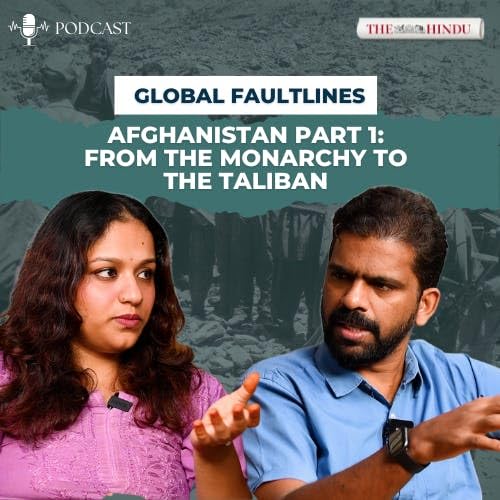
  • Afghanistan Part 1: From the monarchy to the Taliban
    Oct 29 2025
    Afghanistan has long held a pivotal place in regional geopolitics, its strategic location making it a prize and a battleground for competing powers. From the 19th-century “Great Game” between Britain and Russia to the Cold War proxy wars of the 20th century, external influence has continuously shaped its trajectory. Following independence in 1919, successive governments sought to modernise while balancing tribal, religious, and regional interests. Yet instability persisted, deepened by ideological divides and foreign interventions. The 1970s marked a turning point, from ending King Zahir Shah’s monarchy in 1973, to the Soviet invasion in 1979. What followed was a decade-long conflict that drew in the United States, Pakistan, and Saudi Arabia, leaving the country fractured after the Soviet withdrawal in 1989. In this first part of our three-part series on Afghanistan, we trace the country’s transformation from a buffer state to a theatre of global rivalries, and examine how decades of intervention and internal division have shaped the nation it is today. Learn more about your ad choices. Visit megaphone.fm/adchoices
    Show More Show Less
    48 mins
  • Iran’s Foreign Front: How is Tehran reshaping ties with the region and the world
    Oct 15 2025
    Iran today stands at a crossroads, acting as both a stabilising and destabilising force in one of the world’s most volatile regions. Its influence extends through a network of allies and proxies, from Hezbollah in Lebanon to the Houthis in Yemen, while its diplomatic and strategic moves continue to draw global attention. In this second part of our two-part series on Iran, we examine the country’s foreign relations and regional strategy. We look at Tehran’s rapprochement with Saudi Arabia in 2023, its growing partnerships with China and Russia, and the ongoing tensions with the United States following the collapse of the 2015 nuclear deal. We also explore how India navigates its ties with Iran, balancing economic engagement with broader regional considerations. This episode unpacks how Tehran’s alliances, rivalries, and strategic calculations shape West Asia and beyond, asking critical questions about the sustainability of its partnerships and the long-term implications for regional and global stability. Expert: Stanly Johny, International Affairs Editor, The Hindu. Video: Shivaraj S Research, Editing and Production: Sharmada Venkatasubramanian Learn more about your ad choices. Visit megaphone.fm/adchoices
    Show More Show Less
    57 mins
  • The Making of Islamic Iran: How one nation redefined the West Asia and global politics
    Oct 1 2025
    Iran has been a key force in East Asian politics for decades, influencing regional conflicts, global diplomacy, and international security. From the 1953 coup against Prime Minister Mossadegh to the transformative 1979 Islamic Revolution, Iran’s history has shaped a political system that blends elected institutions with the authority of a Supreme Leader. In this first part of our two-part series on Iran, we explore the country’s regional ambitions, its backing of groups like Hezbollah, Hamas, and the Houthis, and the long-standing pursuit of a nuclear program that has triggered international sanctions and scrutiny. We also delve into the Iran-Saudi rivalry, often seen as sectarian, but deeply rooted in geopolitical strategy and power dynamics. This episode unpacks how Iran’s history, politics, and regional strategies continue to influence East Asia and keep the country at the center of global attention. Expert: Stanly Johny, International Affairs Editor, The Hindu Video: Shivaraj S Edited and produced by Sharmada Venkatasubramanian Learn more about your ad choices. Visit megaphone.fm/adchoices
    Show More Show Less
    57 mins
  • Israel–Palestine Part 3: Why the world cannot agree on the crisis
    Sep 17 2025
    In the first two episodes of this three-part series, we traced the roots of the Israel–Palestine question - from the legacies of colonialism and partition in 1948 to the cycles of displacement, violence, and negotiations that followed. In this third and final episode, we shift the lens to the present, asking how the rest of the world is responding to a crisis that refuses to fade. While the United States continues to offer unwavering support to Israel, parts of Europe have moved towards recognizing Palestinian as a state. India has attempted to walk a fine line, balancing its historic solidarity with Palestine and its growing strategic ties with Israel. Through these faultlines, one theme emerges clearly: the Israel–Palestine question is no longer confined to the region. It has become a test of international order, reshaping diplomacy, alliances, and public opinion across the world. Expert: Stanly Johny Video: Shivaraj S Research and production: Sharmada Venkatasubramanian Learn more about your ad choices. Visit megaphone.fm/adchoices
    Show More Show Less
    1 hr and 3 mins