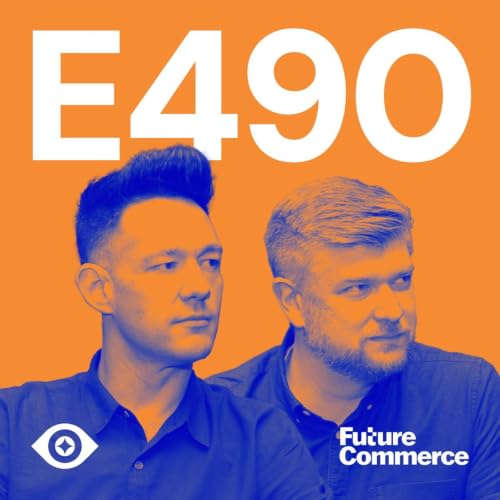
Future Commerce cover art

Future Commerce

Future Commerce

By: Phillip Jackson Brian Lange
Listen for free

This Season's Biggest Deal | $0.99/mo for 3 months + $20 Audible bonus

Auto-renews at $8.99/mo. after 3 months - terms apply.
Summary
Future Commerce is the culture magazine for Commerce. Hosts Phillip Jackson and Brian Lange help brand and digital marketing leaders see around the next corner by exploring the intersection of Culture and Commerce. Trusted by the world's most recognizable brands to deliver the most insightful, entertaining, and informative weekly podcasts, Future Commerce is the leading new media brand for eCommerce merchants and retail operators. Each week, we explore the cultural implications of what it means to sell or buy products and how commerce and media impact the culture and the world around us, through unique insights and engaging interviews with a dash of futurism. Weekly essays, full transcripts, and quarterly market research reports are available at https://www.futurecommerce.com/plus©2026 Future Commerce Economics Leadership Management & Leadership Marketing Marketing & Sales Philosophy Social Sciences
Episodes
  • Retail Prophet Doug Stephens on Fixing a K-Shaped Economy
    Nov 20 2026
    Only 15% of Americans trust large corporations, yet 30% trust a groundhog to predict spring. After 45 years of shareholder primacy, a new Gilded Age, and an AI wave poised to widen the gap, trust has become the most undersupplied asset in the market.Doug Stephens, Founder & CEO of Retail Prophet, joins Phillip and Brian to discuss his new book, The Future of Competitive Advantage. They walk through Costco’s success as a corporation that prioritizes fair wages, and why “fairness” is a softer-landing term in the boardroom than “equality.” PLUS: Why businesses should rethink advertising on Meta, and what leaving social media behind realistically looks like for the privacy-conscious.How to Split A Society In HalfKey takeaways:Only 15% of Americans trust large corporations.Costco’s fair wages mean 7–8% turnover, versus Walmart’s historic 70%.Shareholder primacy was a recipe for splitting the economy into halves: the super rich, and those left behind.“Fairness” wins boardrooms where “equality” raises hackles.Advertising on Meta may soon carry tobacco-level reputational risk.“There’s no human being in America that should work 40 hours and not be able to afford food and shelter.” — Doug Stephens“[Fair wages] isn’t just Kumbaya. This is a real and verifiable business tactic. Paying people well as an investment.” — Doug Stephens“If your brand appears on Meta, you may as well slap your brand on the side of a cigarette pack.” — Doug StephensIn-Show Mentions:Get The Future of Competitive Advantage by Doug Stephens (Wiley)Learn more about Doug Stephens at Retail ProphetListen to Future Commerce’s “Dissociating at Costco”Shop the Future Commerce print shopGet tickets to VISIONS Summit, February 10, 2027 at MoMAAssociated Links:Walmart’s Midlife Crisis (Ep. 173)The Existential Brand Part 1: Teleological Progress (Insiders)Category Deep Dive: Warehouse Clubs and the New Value Battleground (Insiders)Tru$t is the New eCommerce Currency (Insiders)The Great DEI Breakup Text (The Senses)The [True] Cost of Convenience (Ep. 307)The Top 12 Brands Rolling Back (or Investing In) DEI (Insiders)Check out Future Commerce on YouTubeCheck out Future Commerce Plus for exclusive content and save on merch and printSubscribe to Insiders and The Senses to read more about what we are witnessing in the commerce worldListen to our other episodes of Future CommerceHave any questions or comments about the show? Let us know on futurecommerce.com, or reach out to us on Twitter, Facebook, Instagram, or LinkedIn. We love hearing from our listeners! Hosted by Simplecast, an AdsWizz company. See pcm.adswizz.com for information about our collection and use of personal data for advertising.
    Show More Show Less
    52 mins
  • Shopify Exec Reveals the Future of Post-Anonymous Retail
    Nov 11 2026
    Shopify merchants set a record $14.6 billion over BFCM last year. But as discovery moves into AI and the season stretches longer, the store’s job is changing from closing a sale to starting a relationship.Ellen Linardi, VP of Product at Shopify, is obsessed with fixing in-store workflows and dreams of a world where items left in a shopper’s online cart are ready when the customer arrives in-store. We unpack how in-person purchases are both the most personal and the most anonymous transactions in retail, how POS workflows free merchants to focus on curation, and why 2027 should be the year businesses uplevel experiential commerce.When the Online Cart Follows You In-StoreKey takeaways:The customer relationship often starts online, and deepens in-store. Shopify is focusing on closing that gap.Retail-first merchants still need to be findable through AI search. That’s where awareness and discovery happen now, before consumers leave home.While the holidays are for new business acquisition, brands should treat every sale as a relationship moment: identified customers spend significantly more.Workflow is everything, and optimization differs from store to store. Customize POS to how each location actually sells.“A customer list is only as good as what you do with it afterward.” — Ellen Linardi“Buyers are not forgiving with wasted time. And time in store is not wasted time, [unless] you’re waiting.” — Ellen Linardi“I like to think of [small businesses] as people with consumer resources but enterprise problems.” — Ellen Linardi“An in-person transaction is the most anonymous transaction we have, and yet it is the most personal.” — Brian LangeIn-Show Mentions:Learn more about Shopify’s latest retail and POS updates at Shopify EditionsExplore Shopify POS and Smart GridConnect with Ellen Linardi on LinkedInFuture Commerce’s BFCM 2025: We Give Thanks for Couch CommerceFuture Commerce’s OMNIMODAL researchFuture Commerce’s The Concierge Economy guideFuture Commerce’s celebrity brands Signal Report with MercivGet tickets to VISIONS Summit, February 10, 2027 at MoMAAssociated Links:Memorable Over Measurable: Retail’s Lost Wonders (Ep. 482)Separating Real Signals from the Noise (Ep. 480)Member Brief: Return on Experience and the New KPIs of Store Design (Insiders)Field Notes: How Physical Retail’s Most Compelling Stores Activate the Senses (Insiders)The Good Friction Opportunity (Insiders)The Doorbusters Are Back (And So Are the 5 am Lines) (The Senses)Check out Future Commerce on YouTubeCheck out Future Commerce Plus for exclusive content and save on merch and printSubscribe to Insiders and The Senses to read more about what we are witnessing in the commerce worldListen to our other episodes of Future CommerceHave any questions or comments about the show? Let us know on futurecommerce.com, or reach out to us on Twitter, Facebook, Instagram, or LinkedIn. We love hearing from our listeners! Hosted by Simplecast, an AdsWizz company. See pcm.adswizz.com for information about our collection and use of personal data for advertising.
    Show More Show Less
    38 mins
  • How to Grow an eCommerce Business When the Math Doesn’t Math
    Nov 6 2026
    Selling online has never been more expensive. Cheap channels are saturated, factory and freight costs have climbed, and ad platforms keep getting better at extracting margin from brands. For a lean DTC brand in 2026, the old math simply doesn’t math.Ecommerce economics are broken. Dave Stickland, Co-Founder and President of Popsmith, joins Phillip and Brian to share how he rebuilt Popsmith’s marketing from the garage up. Dave explains how agentic AI tools take his ad creative from concept to live in 24 hours, why AI slop is a skill issue, and why the next generation of agencies and creative strategists will be paid for vision, not execution.Chasing A Frontierless FutureKey takeaways:There’s no more frontier for DTC brands. A decade ago, subsidized Amazon fees, direct access to overseas factories, and cheap paid social made healthy margins easy. Now factories sell against brands on Amazon, factory wages have doubled, freight costs have soared since COVID, and Meta keeps getting better at extracting ad spend.Contribution margin pays for everything below the line, including agencies, freelancers, and new hires. When that margin disappears, so does the budget to grow.AI creative is still not fully autonomous, but only works with scaffolding: product renders, brand context, and a clear process.It’s time for brands to extract new value from the creative library they’ve already paid for.Agencies will be paid to advise and build SOPs, not to execute inside the software.“You either own the software or the software will own what you do.” — Dave Stickland“What AI will never be is relational.” — Dave Stickland“The data set itself is what you are paying for, not the tool.” — Dave SticklandIn-Show Mentions:Dave on X: The Math Doesn’t MathShop the popcorn popper at popsmith.comRunneth by MotionJamey Gannon’s The AI Creative Director courseFuture Commerce’s LOREGet tickets to VISIONS Summit, February 10, 2027 at MoMAAssociated Links:The Growth v. Profitability Cage Match (Infinite Shelf)DTC Theory and The Innovator’s Dilemma (Ep. 253)[DECODED] The Power of AI-Enabled AmbitionFrom Plastic to Patek: What AI and Watchmaking Have in CommonThe End of Outside: How to Future-Proof Your Career Against the AI ApocalypseOur Post-Funnel Future: Brand Ethos is the New Competitive MoatThe Final Boss of Popcorn Buckets (The Senses)Check out Future Commerce on YouTubeCheck out Future Commerce Plus for exclusive content and save on merch and printSubscribe to Insiders and The Senses to read more about what we are witnessing in the commerce worldListen to our other episodes of Future CommerceHave any questions or comments about the show? Let us know on futurecommerce.com, or reach out to us on Twitter, Facebook, Instagram, or LinkedIn. We love hearing from our listeners! Hosted by Simplecast, an AdsWizz company. See pcm.adswizz.com for information about our collection and use of personal data for advertising.
    Show More Show Less
    54 mins
No reviews yet
In the spirit of reconciliation, Audible acknowledges the Traditional Custodians of country throughout Australia and their connections to land, sea and community. We pay our respect to their elders past and present and extend that respect to all Aboriginal and Torres Strait Islander peoples today.