Fit For Science cover art

Fit For Science

Fit For Science

By: Stephan Reichl and Rob ter Horst
Listen for free

Summary

Two scientists discuss how they live their best life, using science, data, tech, wearables, and systems. Fit For Science is a deep-dive podcast hosted by two biological data scientists, Rob and Stephan, exploring the intersection of research, health tech, and data-driven lifestyle design. The hosts provide evidence-based systems, layered with practical "N=2" personal experimentation, to cut through the noise and enable everyone to become their best N-of-1. The Quantified Scientist (Rob): youtube.com/TheQuantifiedScientist Stephan's Website: http://polytechnist.meStephan Reichl and Rob ter Horst Hygiene & Healthy Living
Episodes
  • Stanford's Aging Fish, Tracking Wishlist, Placebo Blueberries & Measuring Body Composition - Q1’26 Updates (Fit For Science Episode 15)
    Apr 27 2026
    In this episode, Rob and Stephan explore the intersection of lifespan research, the exposome, and daily health tracking, tackling everything from aging fish and AI stool analysis to passive exercise tracking and body composition scales.📝SummaryIn episode 15 of Fit For Science, Rob and Stephan explore the intersection of lifespan research, the exposome, and daily health tracking, tackling everything from fish behavior to body composition. The hosts, both biological data scientists, dive into a recent Stanford study published in Science that tracked the lifetime behavior of short-lived fish to uncover insights into aging, connecting these methods to human wearable technology and exposome tracking. They transition into discussing the potential benefits and practical hurdles of tracking daily bowel movements using AI and the Bristol stool chart compared to infrequent microbiome testing. The conversation also highlights wishlist features for wearables, specifically the ability to quantify passive exercises like saunas and cold plunges. A personal anecdote about a sudden burst of energy and reduced sleep need following the consumption of freeze-dried blueberries sparks a debate on whether this was due to antioxidants reducing neuroinflammation or simply project-induced excitement. Finally, they compare at-home bioelectrical impedance smart scales to clinical measurements, detailing the nuances between lean mass, visceral fat, and the importance of long-term trend averaging.⏳Chapters00:00:00 Fish Aging Study: Discussing a Stanford study connecting fish with wearables00:04:13 The Exposome: Exploring how environmental exposures are tracked00:12:05 Stool Tracking vs. Microbiome Analysis00:19:33 Quantifying Passive Exercise: A wishlist discussion00:25:30 The Blueberry Effect and Sleep: Stephan's placebo experience00:34:30 Body Composition and Smart Scales00:43:03 Advanced Body Composition Measurement Techniques00:46:07 Lean Mass vs. Visceral Fat00:51:22 Data Averages and Trends📚ResourcesLinkedIn post about Stanford's aging fish study Watching a lifetime in motion reveals the architecture of aging Youthful antics predict lifespan — at least for these fish Paper: Lifelong behavioral screen reveals an architecture of vertebrate aging Amazon's failed body composition app: The science behind the Halo Body feature Academic publishing: Open Access vs Paywalls Actigraphy An atlas of exposome–phenome associations in health and disease risk Exposome Snyder Lab - Exposome A Network-Based Framework for Assessing the Pathobiological Impact of Environmental Exposures on Human Development & Health - Salvo D LombardoCeMM - Research Center for Molecular Medicine (where we work) Massive biomolecular shifts occur in our 40s and 60s Microbiome Bristol Stool Chart: Types & What They Mean Zettelkasten system (Stephan uses his email inbox)Body Scan | Withings Europe The 10 Best Ways to Measure Your Body Fat Percentage The Evaluation of a Mass Media Campaign Aimed at Weight Gain Prevention Among Young Dutch Adults Sustained visceral fat loss is associated with attenuated brain atrophy and improved cognitive function in late midlife…There is more: complete show notes here🎙️AboutFit For Science is a deep-dive podcast hosted by two biological data scientists, Rob and Stephan, exploring the intersection of research, health tech, and data-driven lifestyle design. The hosts provide evidence-based systems, layered with practical "N=2" personal experimentation, to cut through the noise and enable everyone to become their best N-of-1.Learn more and subscribe on your favorite platforms:YouTubeSpotifyApple PodcastsAmazon MusicCollection of all show notes⚠️Disclaimer: This podcast represents our own opinions and is for informational purposes only. It does not constitute medical or financial advice or a professional relationship.
    Show More Show Less
    56 mins
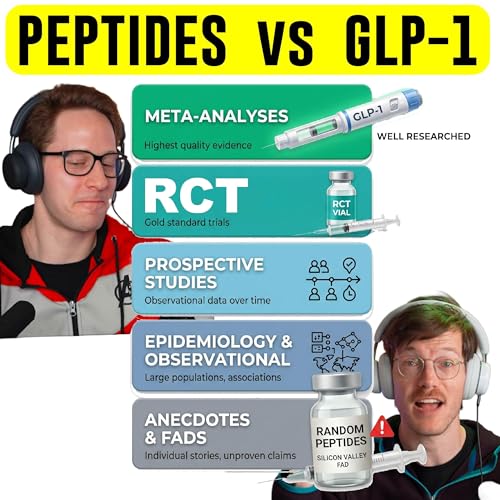
  • The Silicon Valley Peptide Craze: Trust the Science, Not the Influencer (+ Hierarchy of Evidence) (Fit For Science Episode 14)
    Apr 21 2026
    In this episode of Fit for Science, Rob and Stephan use the recent Silicon Valley "peptide craze" as a case study to explore how to critically evaluate health claims and navigate the scientific hierarchy of evidence.📝SummaryIn episode 14 of the Fit for Science podcast, biological data scientists Rob and Stephan delve into the growing trend of Silicon Valley tech elites self-injecting unregulated peptides, using this phenomenon as a launchpad to discuss how to critically assess health and lifestyle claims. They begin by demystifying what peptides actually are, providing examples ranging from life-saving insulin and GLP-1 agonists to harmful spider venom, while warning against the dangers of untested, gray-market substances. The core of the episode breaks down the hierarchy of scientific evidence, guiding listeners from the weakest forms, such as second-hand anecdotes and social media influencers, up through epidemiological observational studies, prospective studies, and rigorous randomized controlled trials, finally culminating at the pinnacle: meta-analyses. Furthermore, they offer practical advice on safely running personal health experiments using wearables, emphasizing the importance of systematic testing, understanding biological mechanisms versus actual tested outcomes, and relying on high-quality institutional guidelines over viral internet trends.⏳Chapters00:00:00 Unpacking the Silicon Valley peptide craze00:04:50 Defining Peptides: Understanding small proteins00:17:18 The Hierarchy of Evidence: Why anecdotes and personal experiences sit at the bottom00:26:59 Epidemiological Studies: The value and limitations of observational data00:32:45 Prospective Studies: Planning health research and utilizing wearable data00:35:08 Randomized Controlled Trials: The gold standard for testing interventions and eliminating bias00:43:24 Meta-Analyses: Combining data to form medical consensus and guidelines00:46:29 Evaluating Sources: Disentangling the message from the messenger00:52:17 AI in Health Research: Tips and pitfalls when using frontier models for scientific inquiries00:58:10 Community Q&A: How to safely use wearables to run systematic self-experiments01:07:11 Final thoughts on evaluating risks and a recap of the evidence hierarchy📚Resources‘Chinese Peptides’ Are the Latest Biohacking Trend in the Tech World - The New York TimesSilicon Valley's new miracle drugEric Topol - The Peptide Craze - Ground Truths Economist - Want to hack your body with peptides? If only the science agreed ‘People are turning themselves into lab rats’: the injectable peptides craze sweeping the US | The GuardianProPublica - A Las Vegas Festival Promised Ways to Cheat Death. Two Attendees Left Fighting for Their Lives. Hierarchy of evidence Survivorship bias (incl. airplane bullet holes anecdote) UK Biobank NHANES - National Health and Nutrition Examination Survey | CDC Meta-analysis - Examine VIP medicine aka VIP syndrome aka VIP effect Edison Platform for science-based AI researchPerplexity AI for research (you can select academic papers) Eddy Burback - ChatGPT made me delusional Principles from the episodeProteins are the smallest functional unit of life and peptides are just small proteins.…There is more: complete show notes here🎙️AboutFit For Science is a deep-dive podcast hosted by two biological data scientists, Rob and Stephan, exploring the intersection of research, health tech, and data-driven lifestyle design. The hosts provide evidence-based systems, layered with practical "N=2" personal experimentation, to cut through the noise and enable everyone to become their best N-of-1.Learn more and subscribe on your favorite platforms:YouTubeSpotifyApple PodcastsAmazon MusicCollection of all show notes⚠️Disclaimer: This podcast represents our own opinions and is for informational purposes only. It does not constitute medical or financial advice or a professional relationship.
    Show More Show Less
    1 hr and 10 mins
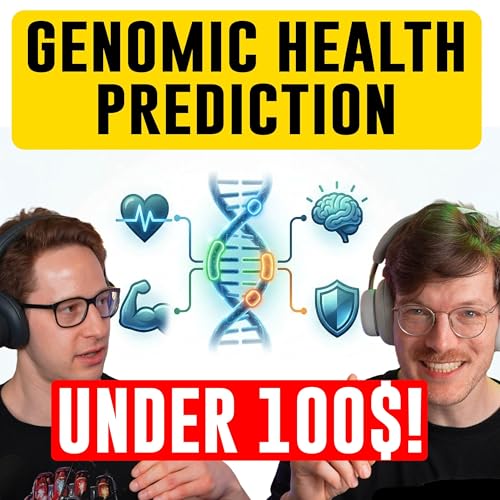
  • The $100 Genome: Genetic Risk Scores & Sequencing Babies (Fit For Science Episode 13)
    Mar 19 2026
    Rob and Stephan explore the new reality of $100 whole genome sequencing, the actionable value of polygenic risk scores, and the ethical future of personalized genomic medicine.📝SummaryBiological data scientists Rob and Stephan discuss the implications of the newly achieved $100 whole genome sequencing milestone, comparing unbiased whole genome reads to popular genotyping consumer products like 23andMe. They delve into the mechanics of genome-wide association studies and polygenic risk scores, examining how genetics interact with lifestyle and environmental factors to influence disease probability. The hosts share their personal experiences with services like Nebula Genomics, 23andMe and Dante Labs, revealing how insights, such as a high genetic predisposition for elevated ApoB levels, can drive actionable dietary changes like reducing saturated fats. Finally, they explore the psychological barriers, data privacy concerns, and ethical considerations of integrating genomic sequencing into standard medical practice and newborn screening to create a proactive, Bayesian model of preventative healthcare.⏳Chapters00:00:00 The $100 Genome: Cost breakthroughs and historical perspective00:07:41 Defining Sequencing: Genotyping consumer products vs. Whole Genome Sequencing00:16:19 Polygenic Risk Scores: Predicting complex diseases using multiple genes00:20:44 Nature vs. Nurture: How lifestyle pulls the trigger on genetic predispositions00:23:17 Medical Implementation: Psychological anxiety and the actionability of genetic data00:33:03 Personal Experiences: Reviews of Nebula Genomics, 23andMe, and Dante Labs00:44:23 Actionable Insights: Modifying saturated fat intake based on ApoB percentiles00:54:55 A Bayesian Healthcare Model: Combining genetics, demographics, and lifestyle01:06:20 Ethical Explorations: The future of sequencing newborns and preventative screening📚ResourcesHuman Genome Project cost ~$3 Billion and took ~13 years (1990-2003)How to sequence the human genome - TED-Ed Video Genetic disorder (monogenic i.e., single-gene cause) Scrappy San Diego startup goes toe-to-toe with gene-sequencing giant IlluminaElement BiosciencesEric Topol's X post about $100 Gneom The cost of sequencing human genome has fallen from $100M to under $100 in approximately 25 years The $100 Genome: Where’s the Limit? Genome-wide association study (GWAS)Polygenic score (PRS)What are Polygenic Risk Scores (PRS) and how can they be used in healthcare? Systematic comparison of family history and polygenic risk across 24 common diseases > “In most diseases, including coronary artery disease, glaucoma, and type 2 diabetes, a positive family history with a high PRS was associated with a considerably elevated risk, whereas a low PRS compensated completely for the risk implied by positive family history.”> “In addition to capturing shared DNA, FH [family history] measures non-genetic exposures and behaviors shared by families”Nebula Genomics now DNA Complete with subscription modelGeorge Church (geneticist) 23andMeDante LabsPromethease for DNA reportingReference genome Personalized genomics Apolipoprotein B (ApoB) The ‘thousand-dollar genome’: an ethical exploration | European Journal of Human Genetics (2013!)…There is more: complete show notes here🎙️AboutFit For Science is a deep-dive podcast hosted by two biological data scientists, Rob and Stephan, exploring the intersection of research, health tech, and data-driven lifestyle design. The hosts provide evidence-based systems, layered with practical "N=2" personal experimentation, to cut through the noise and enable everyone to become their best N-of-1.Learn more and subscribe on your favorite platforms:YouTubeSpotifyApple PodcastsAmazon MusicCollection of all show notes⚠️Disclaimer: This podcast represents our own opinions and is for informational purposes only. It does not constitute medical or financial advice or a professional relationship.
    Show More Show Less
    1 hr and 3 mins
adbl_web_anon_alc_button_suppression_c
No reviews yet
In the spirit of reconciliation, Audible acknowledges the Traditional Custodians of country throughout Australia and their connections to land, sea and community. We pay our respect to their elders past and present and extend that respect to all Aboriginal and Torres Strait Islander peoples today.