Episodes

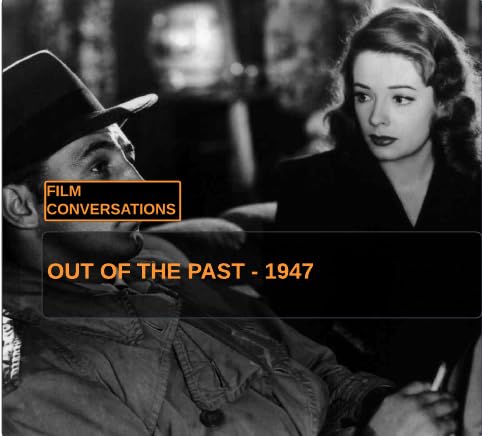
  • Out of the Past
    Mar 3 2026

    Hello everyone, this is the Film Conversations episode for March, 2026.

    In this show, we discuss the 1947 Film Noir classic, Out of the Past.

    Here's a synopsis from Wikipedia:

    Out of the Past (billed in the United Kingdom as Build My Gallows High) is a 1947 American film noir directed by Jacques Tourneur and starring Robert Mitchum, Jane Greer and Kirk Douglas. The film was adapted by Geoffrey Homes (Daniel Mainwaring) from his 1946 novel Build My Gallows High (also written as Homes), with uncredited revisions by Frank Fenton and James M. Cain.

    Its complex, fatalistic storyline, dark cinematography and classic femme fatale garnered the film critical acclaim and cult status. In 1991, the National Film Preservation Board at the Library of Congress added Out of the Past to the United States National Film Registry of "culturally, historically, or aesthetically significant" films.

    Here's the plot synopsis:

    Joe Stefanos arrives in the rural mountain town of Bridgeport, California seeking Jeff Bailey, who owns a local gas station. Joe asks Jeff's deaf-mute employee The Kid about Jeff's location, and the boy finds Jeff fishing with girlfriend Ann Miller. Jeff returns to the gas station, where Stefanos informs him that he must travel to Lake Tahoe to meet Whit Sterling. Jeff invites Ann to ride with him to Whit's place. He tells her about his past in a flashback that took place three years ago.

    Jeff Bailey's real name is Jeff Markham. He and Jack Fisher were partners and private investigators in New York City. Whit, a gambling kingpin, hires Markham alone to find Whit's girlfriend Kathie Moffat, who had shot Whit and stolen $40,000 from him. Whit promises Jeff that she will not be harmed if he locates and returns her. Jeff finds Kathie in Acapulco and is immediately taken by her beauty.

    Kathie admits to shooting Whit, whom she hates, but denies taking his money. Jeff falls in love with her and proposes that they run away together. Whit and Stefanos suddenly appear at Jeff's place in Acapulco. They ask Jeff whether he has found Kathie, but Jeff lies, saying that she is aboard a southbound steamer. Whit instructs Jeff to continue his search.

    Jeff and Kathie secretly escape to San Francisco. They gradually become more comfortable appearing in public, but Fisher, now working for Whit, spots Jeff at the racetrack. With their location revealed, Jeff and Kathie separate and later meet at a mountain cabin to evade Fisher, but Fisher follows Kathie and catches them at the cabin. Fisher tries to blackmail them and the men brawl. Kathie shoots Fisher and flees, leaving behind a bankbook showing a balance of $40,000, proving that she had indeed taken Whit's money.

    Back in the present, Jeff arrives at Whit's estate, where Whit informs him that he has a job for him. Jeff is surprised to find Kathie, who has returned to Whit. Kathie later speak privately with Jeff, telling him that she had no choice but to return. She told Whit about her relationship with Jeff but not about her murder of Fisher. Jeff scornfully rejects her.

    Crooked San Francisco lawyer Leonard Eels, who helped Whit dodge $1 million in taxes, is now blackmailing him. Whit wants Jeff to recover the incriminating records and tells him to meet with Eels' secretary, Meta Carson, who explains the plan to Jeff, but Jeff suspects that he is being framed. At Eels' apartment, Jeff alerts him about Whit's pursuit. Jeff trails Meta and then returns to find Eels dead. He hides the body in the closet of a neighboring apartment.

    [...]

    Full synopsis at the Wikipedia entry (link below).


    References:

    Psychoanalysing Horror Cinema by Mary Wild

    https://www.routledge.com/Psychoanalysing-Horror-Cinema/Wild/p/book/9781032545097


    'Out of the Past' at 78: The Quintessential Film Noir that Launched Robert Mitchum and Kirk Douglas' Careers


    https://cinephiliabeyond.org/past-quintessential-film-noir-launched-robert-mitchum-kirk-douglas-careers/


    Out of the Past (wikipedia)

    https://en.wikipedia.org/wiki/Out_of_the_Past


    Chester Himes

    https://en.wikipedia.org/wiki/Chester_Himes


    https://english.arizona.edu/person/charles-w-scruggs

    Film noir

    https://en.wikipedia.org/wiki/Film_noir

    The Simple Art of Murder by Raymond Chandler

    https://www.theatlantic.com/magazine/archive/1944/12/the-simple-art-of-murder/656179/

    Review of Eddie Muller's book, 'Dark City Dames'

    https://www.iseeadarktheater.com/dark-city-dames-review

    Out of the Black Past: The Image of the Fugitive Slave in Jacques Tourneur's "Out of the Past"

    https://www.jstor.org/stable/41328708


    John Gray

    https://en.wikipedia.org/wiki/John_Gray_(philosopher)

    Show More Show Less
    1 hr and 28 mins
  • The Influence of Film on Our Political Views: Part 3
    Sep 2 2025

    Hello everyone welcome to another episode of the Film Conversations podcast.

    In this episode, which is part three of our discussion about the impact of the movies we've viewed on our political leanings, Dennis takes the lead.

    He discusses films such as The Discreet Charm of the Bourgeoisie that influenced his thinking. Below, you'll find links to the films we talked about and realted things.

    References:

    The Discreet Charm of the Bourgeoisie

    https://en.wikipedia.org/wiki/The_Discreet_Charm_of_the_Bourgeoisie

    Jean-Luc Godard

    https://en.wikipedia.org/wiki/Jean-Luc_Godard

    My Dinner with Andre

    https://en.wikipedia.org/wiki/My_Dinner_with_Andre

    Francesca Albanese, UN Special Rapporteur

    https://x.com/FranceskAlbs

    Show More Show Less
    1 hr and 37 mins
  • The Influence of Film on Our Political Views: Part 2
    Aug 8 2025

    Hello everyone, this is Dwayne Monroe, the host, along with Dennis Claxton and RC Charles Roberts of the Film Conversations podcast. In today's show, we continue a conversation we started in the previous episode: the ways film shapes political views and the value of film to understanding politics.

    This has turned out to be a rich topic and so, we're planning a third episode to give Dennis a chance to fully develop his ideas which were cut a bit short this time around. There is, as always, a full listing of the films referenced during our conversation. I hope you enjoy.

    Film References Jean-Luc Godard Interview with Dick Cavett (1980)

    https://youtu.be/BdeHqesLx4s?si=O90_yIyvGUD8JELg

    Weekend

    https://en.wikipedia.org/wiki/Weekend_(1967_film)

    The Discreet Charm of the Bourgeoisie

    https://en.wikipedia.org/wiki/The_Discreet_Charm_of_the_Bourgeoisie

    Douglas Sirk

    https://en.wikipedia.org/wiki/Douglas_Sirk

    Luis Buñuel

    https://en.wikipedia.org/wiki/Luis_Bu%C3%B1uel

    Senses of Cinema

    https://www.sensesofcinema.com/2017/1967/weekend-jean-luc-godard-1967/

    Charlie Wilson's War

    https://en.wikipedia.org/wiki/Charlie_Wilson%27s_War_(film)

    Lions for Lambs

    https://en.wikipedia.org/wiki/Lions_for_Lambs

    Inherit the Wind

    https://en.wikipedia.org/wiki/Inherit_the_Wind_(1960_film)

    State of Play

    https://en.wikipedia.org/wiki/State_of_Play_(film)

    Bob Roberts

    https://en.wikipedia.org/wiki/Bob_Roberts

    Gattaca

    https://en.wikipedia.org/wiki/Gattaca

    Show More Show Less
    1 hr and 23 mins
  • The Influence of Film on Our Political Views
    Jul 1 2025

    Hello everyone, this is Dwayne Monroe, one of the hosts, alongside Dennis Claxton and RC Charles Roberts, of the Film Conversations podcast.

    In today's episode, we talk about the films that shaped our political views. Or, I should say, we intended to talk about this but global events intervened and we found ourselves talking about geopolitics and war (with relevant US domestic politics included for good measure).

    Eventually, we found our way to discussing film, including RC's mention of the 1992 released Bob Roberts and my mention of Akira Kurosawa's Ran, released in 1985.

    This was a good discussion and although we didn't spend as much time on film as originally planned, fear not, there will be a part two.

    We hope you enjoy.

    References

    Gore Vidal

    Karl Kraus

    Henry Simmons - Cheap Music, Numb Brains, and Stupidity

    John Gray - Humanism and Flying Saucers

    Doug Henwood - How the Ruling Class Became Vulgar

    Show More Show Less
    1 hr and 16 mins
  • FW Murnau's Faust (1926)
    Mar 8 2025

    Welcome back to another episode of Film Conversations. After a bit of a hiatus, we're back and at full force, so to speak: RC Charles Robert is back at the table.

    Today's film is FW Murnau's silent masterpiece, released in 1926: Faust.

    To set the scene, here's an excerpt from the Criterion article on the film:

    Criterion Excerpt

    https://criterioncast.com/column/for-criterion-consideration/for-criterion-consideration-f-w-murnaus-faust

    One of the most well known legends of the Renaissance period was Faust, a German necromancer whose exploits transformed into the tale of a man who sells his soul to the Devil in exchange for all the knowledge in the world. Over the centuries, the story has been countlessly reshaped and rebooted. Most recently Russian director Alexander Sokurov (who is most well known for his one-take wonder, Russian Ark) released a free-interpretation of the Faustian tale. The first film to directly adapt the story was made by Frederich Wilhelm Murnau in 1926, just before he moved to America. Based on a two-part dramatic poem by Goethe, Faust begins with the demon Mephisto who has made a bet with an Archangel that he can corrupt any righteous man's soul. If the Devil succeeds, he will win dominion over earth. The Archangel agrees, on the condition that the Devil set his sights on Faust, an elderly alchemist whose pursuit of knowledge and truth sets him apart from man. The Devil delivers the plague to a local village, forcing Faust to use his alchemic skills to create an antidote. After he fails to find a cure, Faust rejects God and science, turning to a book of dark magic to summon Mephisto (played by Emil Jannings). Once Mephisto materializes on Earth, he presents Faust with a contract stating that he will now be able to cure the plague in exchange for his soul.

    [...]

    This was a great conversation that, as usual, ranged beyond the film to wider, yet still related matters.

    Oh and during the intro, the German film company UFA is mentioned. You can learn more about UFA here.

    Show More Show Less
    1 hr and 25 mins
  • Battle of Algiers
    Dec 17 2024

    In today's episode, we discuss the 1966 Italian film, the Battle of Algiers. The film, based on events that occurred during the Algerian war against French occupation (1954-62) and specifically, the battle in the capital city of Algiers, depicts the actions of the various groups that fought against, and with each other during that war. Here is a synopsis from Criterion:

    "One of the most influential political films in history, The Battle of Algiers, by Gillo Pontecorvo, vividly re-creates a key year in the tumultuous Algerian struggle for independence from the occupying French in the 1950s. As violence escalates on both sides, children shoot soldiers at point-blank range, women plant bombs in cafés, and French soldiers resort to torture to break the will of the insurgents. Shot on the streets of Algiers in documentary style, the film is a case study in modern warfare, with its terrorist attacks and the brutal techniques used to combat them. Pontecorvo's tour de force has astonishing relevance today."

    As the Criterion synopsis states, 'Battle of Algiers' remains relevant. During this conversation, we use the film as a foundation for a broader conversation about its relevance to present concerns and the ongoing battle for liberation.

    References:

    Battle of Algiers - Criterion

    https://www.criterion.com/films/248-the-battle-of-algiers

    George Jackson Interview (mentioned by Dennis)

    https://www.historyisaweapon.com/defcon1/jacksoninterview.html

    Tariq Ali article

    https://socialistworker.co.uk/in-depth/the-killing-of-palestinians-is-undoubtedly-genocide-tariq-ali-and-others-speak-out/

    French Algeria

    https://en.wikipedia.org/wiki/French_Algeria

    Show More Show Less
    1 hr and 9 mins
  • Misogyny in Film
    Sep 23 2024

    On July 26 of 2024, a story was published by entertainment industry trade magazine Variety about Francis Ford Coppola's alleged behavior on the set of his film, Megalopolis.

    Here is an excerpt from the article:

    Video has surfaced of director Francis Ford Coppola that shows the legendary director trying to kiss young female extras on the set of his ambitious sci-fi epic. Variety has obtained two videos that were taken by a crewmember last year during the filming of a bacchanalian nightclub scene.

    Two sources told Variety that Coppola appeared to act with impunity on set. And unlike traditional movies, Coppola financed the entire $120 million budget himself, so there were none of the traditional checks and balances in place. The videos would appear to corroborate a bombshell report in the Guardian that claimed the 85-year-old director "tried to kiss some of the topless and scantily clad female extras" and told them "he was 'trying to get them in the mood.'" The Guardian story broke right before "Megalopolis" made its world premiere in Competition in Cannes.

    [...]

    After reading this story, I immediately experienced disappointment. As a filmmaker, I've admired Coppola, and considered him to be a venerable elder of the industry. Beyond disappointment however, I began to think of misogyny in the film industry - a matter of patriarchal society and power, among other things. This brings me to our guest, Mary Wild who, we're happy to say, has been on Film Conversations before to discuss Hitchcock's Vertigo.

    On Mary's bio page at the Global Center for Advanced Studies website she's described as a 'Freudian Cinephile' and pop psychoanalyst, creating content related to cinema, philosophy, and the modern cultural landscape, founder of the Projections lecture series at Freud Museum London, applying psychoanalysis to film interpretation, which has been running since 2012. She teaches film at City Lit and Picturehouse Cinemas, and has produced events for London Centre for Interdisciplinary Research, Picturehouse Cinemas, White Cube Gallery, and Morbid Anatomy. She also co-hosts Projections Podcast, contributes to Evolution of Horror Podcast.

    In this episiode, we use the story of Coppola to examine misogyny in the film industry and beyond.

    Links

    Variety article on Coppola

    https://variety.com/2024/film/news/megalopolis-set-video-francis-ford-coppola-kissing-extras-1236082653/

    Mary Wild GCAS Page

    https://gcascollege.ie/mary-wild

    Projections Lecture Series

    https://www.freud.org.uk/tag/projections/

    Projections Podcast

    https://www.projectionspodcast.com/

    Evolution of Horror Podcast

    https://www.evolutionofhorror.com/player

    Hollywood by Garson Kanin

    https://www.goodreads.com/book/show/1105839.Hollywood

    Why women had better sex under socialism by Kristen R. Ghodsee

    https://www.goodreads.com/book/show/53284567-why-women-had-better-sex-under-socialism?ref=nav_sb_ss_1_18

    Show More Show Less
    1 hr and 10 mins
  • Film Conversations The Edge
    Jul 3 2024

    In this episode, we discuss 1997's The Edge starring Anthony Hopkins, Alec Baldwin, Harold Perrineau and Elle Macpherson, written by David Mamet and directed by Lee Tamahori.

    Here is an excerpt from the Wikipedia entry:

    "The Edge is a 1997 American survival thriller film written by David Mamet and directed by Lee Tamahori starring Anthony Hopkins and Alec Baldwin. The plot follows wealthy businessman Charles Morse (Hopkins), photographer Bob Green (Baldwin), and assistant Stephen (Harold Perrineau), who must trek through the elements and try to survive after their plane crashes in the Alaskan wilderness, all while being hunted by a large Kodiak bear and the men's fraying friendships. Bart the Bear, a trained Kodiak bear known for appearances in several Hollywood movies, appears in the film as the bloodthirsty Kodiak, in one of his last film roles."

    [...]

    Full at the Wikipedia entry

    During our conversation, Charles offers an interpretation of The Edge based on an examation of the themes of masculinity it presents in a pop culture, action adventure film form (as that existed in the 1990s). Dennis came into the conversation with quite a few criticisms but adjusts his view, somewhat, as we chat. It was an interesting and lively discussion which I hope you'll enjoy.

    References:

    The Treasure of the Sierra Madre The Searchers Taxi Driver

    Show More Show Less
    1 hr and 12 mins