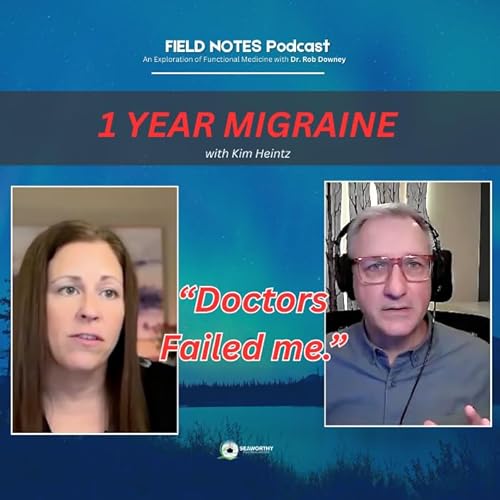
Field Notes: An Exploration of Functional Medicine cover art

Field Notes: An Exploration of Functional Medicine

Field Notes: An Exploration of Functional Medicine

By: Rob Downey MD IFMCP
Listen for free

About this listen

Bringing you the leaders in Functional and Integrative Medicine, Dr. Rob Downey explores the cutting edge protocols and strategies to reclaim health and create a better life, from the inside out. Hygiene & Healthy Living Physical Illness & Disease
Episodes
  • Doctors Told Her to Live With Migraines… Until She Found This. Kim Heintz
    Mar 4 2026

    In this episode of Field Notes, Dr. Rob sits down with functional health practitioner Kim Heintz to explore the long and frustrating journey that led her from chronic illness to vibrant health.

    Kim shares how debilitating migraines that began in childhood eventually spiraled into anxiety, fatigue, brain fog, and digestive issues—symptoms that conventional medicine struggled to explain or resolve.

    After being told she might simply have to live with these problems, Kim began digging deeper and discovered the power of functional medicine testing, root-cause investigation, and lifestyle changes.

    Together, Kim and Dr. Rob discuss how hidden stressors—ranging from gut dysfunction and food sensitivities to mineral imbalances and environmental stress—can quietly accumulate until the body reaches a breaking point.

    Kim's story offers both a cautionary tale about ignoring subtle health signals and an empowering reminder that when we identify and address the real drivers of illness, meaningful healing is possible.

    Learn more about Kim here: https://www.kimheintz.com/

    Key Takeaways

    • Chronic symptoms often have deeper root causes. Migraines, fatigue, anxiety, and digestive issues are frequently connected through underlying imbalances rather than being isolated problems.

    • The "bucket theory" explains symptom overload. When stressors like poor diet, toxins, infections, and emotional stress pile up, the body eventually reaches a tipping point where symptoms appear.

    • Functional testing can reveal hidden drivers of illness. Tools like GI testing and mineral analysis can uncover imbalances that traditional labs often miss.

    • Gut health plays a central role in whole-body wellness. Many chronic symptoms—from migraines to mood changes—can be linked back to gut dysfunction and inflammation.

    • Small foundational habits can create big health shifts. Hydration, mineral balance, diet changes, and stress management can dramatically reduce symptom burden when applied consistently.

    Show More Show Less
    33 mins
  • Your Child Isn't a "Picky Eater." Here's What's Really Going On at the Dinner Table with Lena Livinski
    Feb 26 2026

    In this Field Notes conversation, Dr. Rob Downey sits down with speech-language pathologist and holistic feeding specialist, Lena Livinsky to reframe "picky eating" as a whole-body, whole-family issue—less about willpower or "bad behavior," and more about safety, biology, skills, and environment.

    Lena shares how conventional feeding therapy often over-focuses on behavior, and how working through her own child's selective eating helped her connect the dots: when a child's nervous system is dysregulated or their gut and sensory systems are off, eating can feel threatening, not nourishing.

    She introduces her BLOOM Framework—rooted in connection—to help caregivers zoom out, identify the real bottleneck, and create steady, realistic shifts that help kids feel safe enough to explore food again.

    Learn more about Lene here: https://lenalivinsky.com/

    Key takeaways

    • Connection and nervous system regulation are the "root" of progress—kids can't "rest and digest" when they don't feel safe.

    • "Picky eating" is often better understood as selective eating with underlying drivers (discomfort, sensory load, stress, gut imbalance).

    • Lena's BLOOM Framework maps the core levers: Balanced health, Learned oral skills, Optimal microbiome, Open exploration, Mealtime boundaries.

    • You can do a lot at home before (or alongside) extensive testing: simplify gut disruptors, support circadian/light hygiene, and create low-pressure exposure to food.

    If something feels off (limited foods, gagging/choking, food pocketing), trust your gut and seek the right-fit, interdisciplinary support—small changes, started early or late, can still move the needle.

    If you have a child (or grandchild) in your life who struggles at the dinner table… this conversation might change how you see everything.

    Show More Show Less
    38 mins
  • What If You've Been Looking at Mental Health All Wrong? The 4 Pillars Approach to Lasting Happiness
    Feb 19 2026

    In this episode of Field Notes, Dr. Rob Downey sits down with integrative psychiatric provider Dr. Josh Waddell to unpack mental health through a functional medicine lens—moving beyond symptom labels and "chemical imbalance" shortcuts to ask what's actually driving anxiety, depression, and emotional instability in the first place.

    Dr. Waddell lays out a clear roadmap for understanding mental illness as a progression—from real-world triggers to cellular/mitochondrial disruption to downstream neurotransmitter changes—then introduces his practical "Four Pillars" framework (Body, Mind, Spirit, Environment) to help people pinpoint where their system is wobbling and what to address first.

    The conversation is equal parts compassionate and actionable, emphasizing that mental health struggles are not a character flaw, that healing is often about restoring stability in the right pillar(s), and that the best plan is the one that meets you where you are—sometimes including medication as a bridge so deeper root-cause work can actually stick.

    Learn more about Dr. Josh Waddell here: http://www.arukahwell.co

    5 Key Takeaways

    Mental health symptoms often follow a progression: triggers → mitochondrial/cellular dysfunction → neurotransmitter changes, so "root cause" usually sits upstream of brain chemicals.

    The Four Pillars (Body, Mind, Spirit, Environment) offer a simple way to identify what's most off—and why progress can stall when you're only focusing on one area.

    You can't out-supplement a toxic context: chronic stress, unhealthy relationships, burnout jobs, or constant distressing media exposure can keep the nervous system stuck.

    A timeline exercise (mapping life events, illnesses, stressors, and turning points) can reveal the earliest catalyst and clarify where to start.

    Supplements can help, but basics matter: food-first, third-party testing, avoid vague proprietary blends, and match herbs/supports to your symptom pattern—not trends.

    Show More Show Less
    39 mins
No reviews yet
In the spirit of reconciliation, Audible acknowledges the Traditional Custodians of country throughout Australia and their connections to land, sea and community. We pay our respect to their elders past and present and extend that respect to all Aboriginal and Torres Strait Islander peoples today.