El Podcast cover art

El Podcast

El Podcast

By: El Podcast Media
Listen for free

About this listen

In El Podcast, anything and everything is up for discussion. Grab a drink and join us in this epic virtual happy hour!2022 El Podcast Media Economics Leadership Management & Leadership Politics & Government Social Sciences
Episodes
  • E174: Acquired Broke Every Podcast Rule: Harvard Business School Professor Explains Why
    Dec 23 2025

    Harvard’s Shane Greenstein explains why Acquired wins by treating each episode like an audiobook—high-signal, audience-first, and built for durable value.

    GUEST BIO: Dr. Shane M. Greenstein is a Professor of Business Administration at Harvard Business School, where he teaches technology, operations, and management and writes HBS case studies on modern businesses.

    TOPICS DISCUSSED (IN ORDER):

    • WHY ACQUIRED WORKS: Breaking podcast “rules,” competing with audiobooks, high-signal editing, host chemistry, and durable content that doesn’t expire
    • AUDIENCE & NICHE STRATEGY: High-income aspirational listeners, “big niche” logic, Slack feedback loops, and expanding breadth without losing focus
    • BUSINESS & MONETIZATION MODEL: B2B advertisers, high-value contracts, season sponsorships, rejecting 95% of ads, and protecting audience trust
    • OPERATIONS & CONSTRAINTS: Extreme prep, editing workflow, no staff beyond an editor, time scarcity, and intentional limits on scaling
    • CASE STUDY ORIGINS & RESEARCH: How the HBS case began, analytics access, third-party validation, and teaching-case methodology
    • MEDIA LANDSCAPE & FUTURE: Podcasting vs legacy media, audience balkanization, video tradeoffs, and the role of live, unpredictable formats
    • RISKS & UNKNOWN UNKNOWNS: Reputation exposure, topic selection risk, family/work tradeoffs, AI slop, and platform uncertainty

    MAIN POINTS:

    • Acquired “breaks rules” but follows classic business rules: match product to audience, align advertisers to audience, build operations around constraints.
    • They win by not wasting time: heavy editing + high density of insight, built for repeat listening and long shelf life.
    • Their edge is durability: they target ~80% of content still relevant a year later, so the back catalog keeps earning.
    • Their advertising works because it’s B2B + high contract value: a few conversions can justify huge spends; they protect audience trust by rejecting most ads.
    • Avoiding video is a control tradeoff: YouTube distribution can mean less control over ad experience and more audience annoyance.
    • Scaling is intentionally limited: the “team of 3” model preserves quality but raises risks (time pressure, topic selection errors, burnout).
    • Biggest threats aren’t competitors—they’re reputation risk, platform/tech shifts, and AI-driven slop reducing trust.

    TOP 3 QUOTES:

    • “They deliberately don’t waste anybody’s time.”
    • “Their primary substitute… is someone going out and buying an audiobook.”
    • “A niche on the internet can be six people in your hometown times a billion.”

    🎙 The Pod is hosted by Jesse Wright
    💬 For guest suggestions, questions, or media inquiries, reach out at https://elpodcast.media/
    📬 Never miss an episode – subscribe and follow wherever you get your podcasts.
    ⭐️ If you enjoyed this episode, please rate and review the show. It helps others find us.

    Thanks for listening!

    Show More Show Less
    1 hr and 5 mins
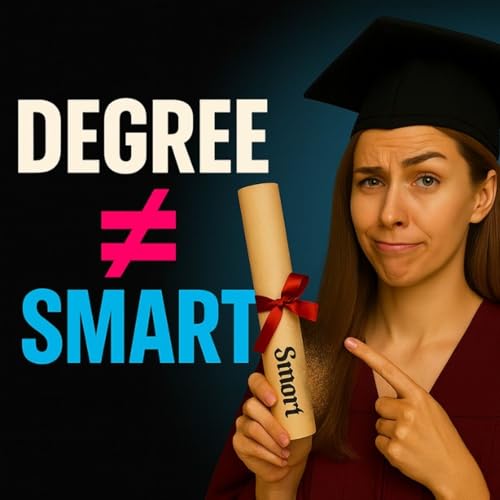
  • E173: Broke. Woke. Stroke. A tenured prof explains why college is failing
    Dec 17 2025

    Tenured sociology professor Mark Horowitz explains why falling preparedness, grade inflation, and perverse incentives are eroding college standards—and why “broke, woke, stroke” helps describe the pattern.

    GUEST BIO: Dr. Mark Horowitz is a sociology professor at Seton Hall University and co-author of a survey-based study of tenured faculty perceptions about academic standards, grade inflation, student preparedness, and institutional incentives in higher education.

    TOPICS DISCUSSED IN ORDER:

    • Why the authors ran a higher-ed “crisis” survey (faculty perspectives vs pundit/parent narratives)
    • Horowitz’s “honors student with junior-high-level writing” anecdote
    • Key survey findings: perceived decline in preparedness, increased pushback, grade inflation
    • “Broke, Woke, Stroke” framework: market pressures, egalitarian/compassion impulses, therapeutic ethos
    • “Most shocking” claim: some functionally illiterate students graduating (and why that happens)
    • Which factor matters most: Horowitz argues “broke” (economics/market incentives) is decisive
    • Admin growth and student-support infrastructure; retention/compassion language vs rigor/merit
    • Taboo around ability/intellectual differences; political psychology and educational romanticism
    • Concern about watering down harming gifted students; standards vs equity tensions
    • Potential solutions: admissions tests, exit/credentialing signals, eliminating student evals; bigger structural funding conversation

    MAIN POINTS:

    • Many tenured faculty report signs of a standards problem: lower preparedness, more grade pressure, more pushback.
    • “Broke” incentives (enrollment/revenue pressure + reduced public support + debt-financed model) push institutions toward admitting and passing more students.
    • “Woke” sensibilities (egalitarian compassion for disadvantaged students) can combine with market incentives to reduce rigor and resist sorting/standards.
    • “Stroke” dynamics (therapeutic/mental-health framing, protecting student feelings) further discourages hard grading, failure, and frank talk about ability.
    • The result is a weakened “signaling function” of the degree: if everyone gets A’s/B’s, employers learn less from credentials.
    • Fixes are hard because incentives punish the people who enforce standards (evals, backlash, institutional pressure), but small reforms could still matter.

    TOP 3 QUOTES:

    • “We use that kind of cheeky mnemonic of broke, woke, stroke.”
    • “We think the incentive structure in higher ed right now is perverse.”
    • “It’s kind of a tragedy of the commons in a way. No university can afford to raise standards, but if none do, the long-run tendency is to have the system collapse.”

    🎙 The Pod is hosted by Jesse Wright
    💬 For guest suggestions, questions, or media inquiries, reach out at https://elpodcast.media/
    📬 Never miss an episode – subscribe and follow wherever you get your podcasts.
    ⭐️ If you enjoyed this episode, please rate and review the show. It helps others find us.

    Thanks for listening!

    Show More Show Less
    1 hr and 8 mins
  • E172: MMT Is Going Mainstream - Right as the AI Bubble Is About to Pop: Explained by Dr. Maggiori
    Dec 9 2025
    A wide-ranging conversation with economist and AI consultant Dr. Emmanuel Maggiori on why Modern Monetary Theory overpromises a “free lunch,” what really causes inflation, how Bitcoin and AI are misunderstood, and why seductive economic stories are so dangerous.GUEST BIO:Emmanuel Maggiori is an armchair economist, computer scientist, and AI consultant based in the UK. Originally from Argentina, he has a PhD (earned in France), works with companies to build AI systems, and writes widely about economics and artificial intelligence. He is the author of several books, including If You Can Just Print Money, Why Do I Pay Taxes? Modern Monetary Theory Distilled and Debunked in Plain English, Smart Until It’s Dumb, and The AI Pocket Guide, and has a large following on LinkedIn and X/Twitter.TOPICS DISCUSSED:What Modern Monetary Theory (MMT) actually claimsHow money is created in modern economies (broad money vs reserves)Why MMT’s “taxes don’t fund spending” story is misleadingStephanie Kelton’s accounting error and the “deficit myth”The Cantillon effect and who really pays for money printingArgentina, Venezuela, Zimbabwe, and real-world inflation episodesJavier Milei, austerity, and Argentina’s recent disinflationGovernment debt, “we owe it to ourselves,” and default via inflationBitcoin as a supposed solution to monetary problemsWho really created Bitcoin and what it’s actually good forThe current AI boom, why it’s a bubble on the business side, and unit economicsOpenAI, DeepSeek, Nvidia, and why foundational models lack a moatHow AI will change the labor market (coders, translators, blue-collar work)AI, Hollywood/TV writing, and the gap between “good enough” and truly excellent workFinal cautions about seductive economic theories and AI hypeMAIN POINTS:MMT in a nutshell: MMT says a government with its own currency can always create money to pay for spending and debt, and that taxes exist mainly to control inflation, create demand for the currency, and shape behavior—not to “fund” spending.Accounting problems in MMT: Emmanuel argues that key MMT figures (especially Stephanie Kelton) made basic accounting errors about government bank accounts and money aggregates like M1, then papered over them with exceptions (e.g., temporary overdrafts at central banks).Why taxes really matter: Even if a government could print money, in practice you need taxes before spending because the Treasury’s accounts can’t just go endlessly negative—and politically, raising taxes fast enough to control inflation is extremely unlikely.Cantillon effect & asset swaps: Paying off debt with newly created money is not a harmless “asset swap.” It channels new money first to financial institutions, inflates asset prices and credit, and ultimately erodes the real value of ordinary people’s cash savings.Real-world inflation is not an accident: In cases like Argentina, Venezuela, Zimbabwe, or Weimar Germany, there were real triggers (droughts, war reparations, commodity shocks), but the hyperinflation came from repeated resort to money printing as the default response.Argentina as a warning: Emmanuel’s personal experiences—suitcases of cash for a normal dinner, unusable mortgages, dollarized house purchases—illustrate how chronic money printing and price controls destroy trust, planning, and basic economic functioning.Javier Milei & austerity: Milei sharply cut deficits and money printing; inflation has fallen quickly. Critics say it’s just recession-driven demand collapse, but Emmanuel notes history shows disinflation often follows when governments stop printing and cut spending.Debt and “we owe it to ourselves”: Government debt is a real intertemporal deal: some people give up current consumption so the state can use resources now, in exchange for more consumption later. Unexpected inflation is an economic default on those savers.Bitcoin skepticism: Bitcoin solves a fascinating technical problem (a decentralized, hard-to-alter ledger), but Emmanuel questions its use as a stable store of value (because of huge volatility) and notes there are other ways to protect savings (equities, etc.).AI bubble dynamics: AI as a technology is here to stay and genuinely useful, but foundational model providers have thin or no moats—methods are public, competitors catch up, and models become commodities competing on price with brutal compute costs.Nvidia and the “shovel sellers”: Chip makers selling GPUs may fare better than model labs, but there are worrying signs (like unsold inventory) that they may be over-producing “shovels” for a gold rush that can’t all pay off.AI startups on top of models: Most AI-powered apps (wrappers for therapy, yoga, productivity, etc.) have almost no defensible edge. Anyone can build similar products, so profits will be squeezed and many will fail.Work & careers in the AI age: He wouldn’t steer a kid away from computer science—but urges them to be at ...
    Show More Show Less
    1 hr and 44 mins
No reviews yet
In the spirit of reconciliation, Audible acknowledges the Traditional Custodians of country throughout Australia and their connections to land, sea and community. We pay our respect to their elders past and present and extend that respect to all Aboriginal and Torres Strait Islander peoples today.