Episodes

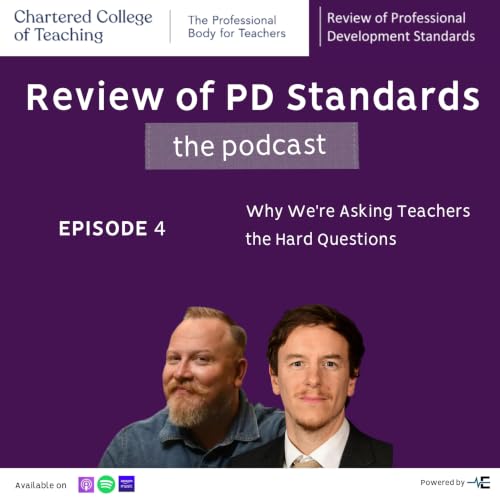
  • Review of PD Standards: The Podcast | Episode 4: Why We're Asking Teachers the Hard Questions
    Nov 20 2026

    Adam Kohlbeck is joined by Gareth Conyard, former CEO of the Teacher Development Trust and a civil servant for 19 years, to unpack the Teacher Forum at the heart of the Review of Professional Development Standards.


    The forum brings the same 100 classroom teachers together four times over the course of the review, starting in December. They were chosen from several hundred applicants to broadly reflect the profession by school type, region, career stage and more. Gareth explains why the review has borrowed from citizens' assemblies, why it is deliberately bringing tensions into the open rather than smoothing them over, and why "showing our working" matters as much as the final standards.


    In this episode:

    - Why so much consultation with teachers feels surface level, and how the forum tries to do it differently

    - Citizens' assemblies and what a manageable version for a busy profession looks like

    - How representative 100 teachers can be, and where extra engagement with specific groups comes in

    - The tension between school improvement plans and teachers' own professional ambitions

    - Are teachers really best placed to decide? Gareth's answer may surprise you

    - How the Golden Thread (ECF and NPQs) may be shaping how teachers see professional development

    - What happens next: the School Leaders Forum with NAHT and ASCL, wider surveys and an academic symposium with Manchester Metropolitan University


    GET INVOLVED

    Follow the review: https://chartered.college/research-and-policy/policy-and-advocacy/review-of-professional-development-standards/

    Register for project updates (including news on the School Leaders Forum): https://r1.dotdigital-pages.com/p/449V-177Q/pd-standards


    Got a tough question for the review team? Post it on social media or send us a message and we'll tackle it in a future episode.


    MENTIONED IN THIS EPISODE

    Improving Education Policy Together by Nansi Ellis and Gareth Conyard (Routledge): https://www.routledge.com/product/isbn/9781032650982


    FOLLOW THE CHARTERED COLLEGE

    LinkedIn: linkedin.com/company/chartered-college-of-teaching

    X: @charteredcoll

    Bluesky: @collegeofteaching.bsky.social


    This podcast is part of the Education Leaders Podcast Network. More shows at https://www.educationleaders.co/network

    Show More Show Less
    34 mins
  • S6: E2 - Is Teacher Training Broken? with Anna Beresford
    Nov 16 2026

    Is initial teacher training broken, and if it isn't, where is it under the most strain? Adam Kohlbeck talks to Anna Beresford, who leads a school-centred teacher training provider in East London. They cover mentoring, the pressure schools are under, what great teacher training looks like, and why new teachers need to be comfortable with uncertainty.


    Anna Beresford moved from magazines into teaching at around 30. She held senior leadership roles in primary schools in Hertfordshire, Islington and Tower Hamlets, and now leads a SCITT serving schools across Tower Hamlets, Newham and Hackney. She brings both sides of the partnership to this conversation.

    She argues that the training trainees get in the centre is probably as strong as it has ever been: it is built on evidence and informed by cognitive science. The weak point is the school system it depends on. Schools are short of money and staff, and many mentors fit their mentoring into PPA time, lunchtimes and the end of the day. Trainees can also hit a gap between what they learn in the training room and what they see in the classroom, which Ofsted has called cognitive dissonance.

    Anna sets out a "three Cs" model for great teacher training (concept, context, content) and describes how a well-prepared trainee sounds in a post-observation conversation. They notice what is happening, make decisions based on it and keep their self-efficacy when things are uncertain. She and Adam then explore uncertainty as the bedrock of creativity and possibility, before turning to what schools and trusts can do: make mentoring a highly regarded role and give mentors protected time.

    Key takeaways

    • In the SCITT model, schools deliver the curriculum alongside the provider, so pressure on schools is a direct risk to training quality.
    • When it works, mentoring benefits both sides: mentors stay current and trainees see how experts think.
    • Great teacher training mirrors great teaching. Start with the big ideas before the techniques.
    • The impact of good training shows in the learners, not just in the trainee.
    • Being too certain shuts down curiosity, and curiosity is where possibilities open up.
    • Schools make room for what they value. Mentoring deserves protected time and recognition.


    About our guest
    Anna Beresford worked in magazines before training to teach at around 30. She has taught and held senior leadership roles in primary schools in Hertfordshire, Islington and Tower Hamlets. Four years ago she moved into initial teacher training, and she now leads the London East Teacher Training Alliance, a SCITT that works with around 30 schools across Tower Hamlets, Newham and Hackney.

    Mentioned in this episode

    • Mary Kennedy on grain size and persistent problems of practice
    • Rob Coe's "multiple inadequate glances"
    • Emma Hollis, CEO of NASBTT, on uncertainty
    • NASBTT's survey on mentoring
    • Margaret Mulholland, Bridging the SEND Practice Gap
    • Stuart Kime on time and prioritisation


    This podcast is part of the Education Leaders Podcast Network. For more information, see ⁠⁠⁠⁠⁠⁠educationleaders.co/network⁠⁠⁠⁠⁠⁠.


    Original music by Caffeinated Studios

    Show More Show Less
    34 mins
  • Review of PD Standards: The Podcast | Episode 3: Doing With, Not To: Problems of Practice and the PD Standards Review
    Nov 13 2026

    Adam Kohlbeck is joined by Sam Gibbs, Director of Professional Learning at Greater Manchester Education Trust and a member of the review's steering group. Sam also co-leads the Trust-Wide CPD Leaders' Forum with Tracy Goodyear, a free national network for anyone leading professional development at scale.First, a quick update. More than 400 teachers applied to join the Teacher Forum, which has now closed. Sam Twiselton has also met with ASCL and NAHT about running a School Leaders Forum alongside it, so school leaders who want to take part should look out for news soon.Then Sam makes the case for building professional development with teachers rather than doing it to them (or selling it to them). She explains why the review needs to sit with the Chartered College as the profession's own independent body. She and Adam also dig into what goes wrong when CPD flows straight down from the school improvement plan.In this episode:- Why teachers want to get better at their job, and what Sam Sims calls "fluff load"- Why the review has to be independent of commercial and government interests- The difference between school improvement priorities and professional learning- What goes wrong with "everyone in the hall at 3pm, this year's focus is retrieval practice"- Problems of practice: what they are and how they connect leaders' hunches with what teachers experience in their classrooms- Quality improvement versus quality assurance- Giving teachers permission to genuinely try something, including permission for it not to work- Tracy Goodyear's question: is school improvement a process or an art?GET INVOLVEDFollow the review and register for project updates: https://chartered.college/research-and-policy/policy-and-advocacy/review-of-professional-development-standards/

    Updates sign-up: https://r1.dotdigital-pages.com/p/449V-177Q/pd-standardsMENTIONED IN THIS EPISODETrust-Wide CPD Leaders' Forum blog: https://trustwidecpdleads.blogspot.com

    Sam Gibbs and Tracy Goodyear in Tes, How to lead better teacher CPD: https://www.tes.com/magazine/teaching-learning/general/how-to-lead-better-teacher-cpdGUESTSSam Gibbs, Greater Manchester Education Trust: linkedin.com/in/sam-gibbs-01418ab0FOLLOW THE CHARTERED COLLEGELinkedIn: linkedin.com/company/chartered-college-of-teachingX: @charteredcollBluesky: @collegeofteaching.bsky.socialPlease share the review and this podcast with friends, colleagues and even people you don't like. The more voices we hear, the more representative the new standards will be.This podcast is part of the Education Leaders Podcast Network.

    More shows at https://www.educationleaders.co/network
    Show More Show Less
    31 mins
  • Coaching Unpacked - Episode 16 - Coaching Pitfalls: Over-modelling
    Nov 13 2026

    In this episode, Adam, Sarah and Chris explore the common coaching pitfall of over-modelling and how to avoid it by focusing on modelling only the essential action steps.

    Coaches will learn practical strategies to enhance their teaching routines and improve teacher decision-making.


    This podcast is part of the Education Leaders Podcast Network. For more information, see ⁠⁠⁠⁠educationleaders.co/network⁠⁠⁠⁠.


    Original music by Caffeinated Studios

    Show More Show Less
    23 mins
  • S6:E1 - What is Human Flourishing? with special guest Andy Wolfe
    Nov 9 2026

    Flourishing is everywhere in education right now, but what does it actually mean? Adam Kohlbeck talks to Andy Wolfe, founder of the new Initiative for Flourishing (IF), about wellbeing versus "well-doing", why flourishing is not the same as happiness, and how a bigger vision can help trusts and schools solve their most persistent problems.

    "Flourishing" has become one of the most talked-about words in education. In this episode Adam sits down with Andy Wolfe to ask what it really means and what it doesn't.

    Andy traces the idea back to Aristotle's eudaimonia and sets out five domains of flourishing: purpose, relationships, learning, resources and wellbeing. He draws on Professor Matt Lee's description of flourishing as the move from wellbeing to well-doing, something seen in our actions and relationships rather than in how we feel on a given day. He argues that flourishing often grows most in the hardest times, which is why it should never be treated as a stand-in for happiness.

    The conversation then turns to organisations. Andy explains why a school's vision only matters if people actually live it, and suggests a revealing test: ask what a teacher's partner says about the school on a Friday night. He also introduces IF, the Initiative for Flourishing, launched this autumn to help leaders use a vision for flourishing to tackle persistent challenges such as attendance, curriculum design and employability.


    Key takeaways

    • Flourishing is active. It shows in what people do, not only in how they feel.
    • It is not a proxy for happiness, and often grows through challenge.
    • Resilience is better seen as a by-product of flourishing than as a goal in itself.
    • A school's vision is tested by people's lived experience, not by what's on the wall or the website.
    • "Where there are few flourishing adults, there'll be few flourishing children."


    Timestamps

    • 00:00 Welcome and introduction
    • 01:50 Andy's journey from professional musician to education leader
    • 04:21 What does human flourishing mean? Aristotle, eudaimonia and the five domains
    • 05:31 From wellbeing to well-doing
    • 07:32 Why flourishing is not a proxy for happiness
    • 09:55 Resilience, mistakes and learning through challenge
    • 12:22 Can organisations flourish? Accountability, metrics and purpose
    • 15:37 Vision, ethos and the "teacher's partner" test
    • 19:02 Educating the whole person: we measure what we value
    • 20:54 Introducing IF, the Initiative for Flourishing
    • 24:09 IF in practice: attendance and the OECD flourishing framework
    • 28:31 How trusts can get involved, and why flourishing adults matter
    • 30:30 Close


    About our guest
    Andy Wolfe started out as a professional musician before teaching music production and performance at a large FE college in Nottingham. He went on to be head of music and then vice principal at a Church of England school in Nottingham, and spent around ten years with the Church of England's national education team, most recently as interim chief executive of the National Society. In autumn 2026 he founded IF, the Initiative for Flourishing. He lives in Nottingham and still plays jazz piano whenever he can.

    Mentioned in this episode

    • Aristotle's concept of eudaimonia
    • Andy's book on flourishing, co-authored with Lynn Swaner
    • Professor Matt Lee (Baylor University and the Harvard Human Flourishing Program)
    • The OECD's framework for human flourishing
    • Michael Young on powerful knowledge


    Get involved with IF: Connect with Andy on social media: https://www.linkedin.com/in/andy-wolfe-484569167/

    This podcast is part of the Education Leaders Podcast Network. For more information, see ⁠⁠⁠⁠⁠⁠educationleaders.co/network⁠⁠⁠⁠⁠⁠.


    Original music by Caffeinated Studios


    Show More Show Less
    32 mins
  • Review of PD Standards: The Podcast | Episode 2: What even is a conceptual framework?
    Nov 6 2026

    Conceptual Framing: What's Really Driving the PD Standards Review?


    Adam Kohlbeck is back with Professor Sam Twiselton OBE, independent chair of the Review of Professional Development Standards, to check in on progress and take on a question sent in by a listener: what is the conceptual framing behind the review?


    Sam explains why the review is being built from the inside out. Instead of starting with a fixed idea of what good CPD looks like, it starts with teachers and school leaders and puts the evidence in front of them. The common thread is decision making at every level of the system. That runs from the split-second choices teachers make in lessons, through the CPD choices leaders make, to how trusts, local authorities and government spend their time and money.


    In this episode:

    - Where the review is up to, from local authority leaders to conversations with the DfE about Universal RISE and the hubs

    - Why disagreeing on the detail shouldn't stop us backing the bigger picture

    - What a conceptual framework actually is (and why doctoral students find it so slippery)

    - The assumptions behind the review: teaching is complex, teachers build mental models and much of what they notice is tacit

    - Sam's "task manager" mental model and how expert teachers free up their headspace for learning

    - Why expert teachers don't automatically make expert mentors (and what learning to drive has to do with it)

    - Pigeons, mice and lockdown: what happens when a situation is new enough to force your thinking into the open

    - Trade-offs between school development plans and individual teachers' aspirations

    - Why the forums will ask "what changed on Monday morning?" rather than "did you enjoy it?"


    MENTIONED IN THIS EPISODE

    Review of Professional Development Standards: https://chartered.college/research-and-policy/policy-and-advocacy/review-of-professional-development-standards/

    Register for project updates: https://r1.dotdigital-pages.com/p/449V-177Q/pd-standards

    Wolff, Jarodzka, van den Bogert and Boshuizen (2016) Teacher vision: expert and novice teachers' perception of problematic classroom management scenes. Instructional Science: https://doi.org/10.1007/s11251-016-9367-z

    Universal RISE (DfE): https://www.gov.uk/government/publications/regional-improvement-for-standards-and-excellence-rise


    Got a question you'd like us to dig into? Send it to us by email or on social media and we'll tackle it in a future episode.


    FOLLOW THE CHARTERED COLLEGE

    LinkedIn: linkedin.com/company/chartered-college-of-teaching

    X: @charteredcoll

    Bluesky: @collegeofteaching.bsky.social


    This podcast is part of the Education Leaders Podcast Network. More shows at https://www.educationleaders.co/network

    Show More Show Less
    45 mins
  • Review of PD Standards: The Podcast | Episode 1: Why does professional development need a review?
    Oct 30 2026

    The CPD Standards Review: Why It Matters and How You Can Shape It


    This is the first episode in our series following the Review of Professional Development Standards, the profession-led review hosted by the Chartered College of Teaching that will set new standards for teacher CPD in England.


    Adam Kohlbeck is joined by the rest of the review's working group: Professor Sam Twiselton OBE (independent chair), Dr Grace Healy (Director of Education at the Chartered College and vice chair of the steering group), Gareth Conyard (former CEO of the Teacher Development Trust) and Nansi Ellis (education policy specialist and co-author, with Gareth, of Improving Education Policy Together).


    Around £1 billion a year is spent on professional development in England. Yet nearly four in ten teachers and leaders surveyed for TDT's 2025 CPD Landscape report said it hadn't clearly improved their practice. So what's going wrong, and what would better look like?


    In this episode:

    - Why CPD belongs at the centre of school life, not on the margins

    - Teacher decision making, from the classroom right up to trust and government level

    - Professional identity and why one-size-fits-all CPD keeps missing the mark

    - What Chartered Teacher Status has taught the College about agency and ownership

    - Didagogy: the evidence, the school context and the teacher's own belief in what they're doing

    - The Teacher Forum, a citizens' assembly style group of 100 teachers who will help write the new standards


    GET INVOLVED

    Apply to join the Teacher Forum (teachers in England, closes Friday 6 November): https://forms.gle/JGYnzcKFsNkYnCjW7


    Register for project updates: https://r1.dotdigital-pages.com/p/449V-177Q/pd-standards


    About the review: https://chartered.college/research-and-policy/policy-and-advocacy/review-of-professional-development-standards/


    MENTIONED IN THIS EPISODE

    Teacher Development: The CPD Landscape in 2025 (TDT): https://chartered.college/research-and-policy/publications/teacher-development-the-landscape-in-2025/

    What is Didagogy? Exploring the Discipline of Teaching Teachers (TDT): https://chartered.college/research-and-policy/publications/what-is-didagogy-exploring-the-discipline-of-teaching-teachers/

    Chartered Teacher Status: https://chartered.college/chartered-status/


    Got a question you'd like the working group to tackle? Send it to us on LinkedIn and we'll put it to them in a future episode.


    FOLLOW THE CHARTERED COLLEGE

    LinkedIn: linkedin.com/company/chartered-college-of-teaching

    X: @charteredcoll

    Bluesky: @collegeofteaching.bsky.social


    This podcast is powered by EduPulse is part of the Education Leaders Podcast Network. More shows at https://www.educationleaders.co/network

    Show More Show Less
    59 mins
  • Coaching Unpacked - Episode 15 - Coaching Pitfalls: Hypothetical Modelling
    Oct 30 2026

    In this episode, the team explore the pitfalls of hypothetical modelling in coaching and demonstrate how to effectively model techniques through demonstration rather than description.

    This week, learn how to bridge the gap between intention and execution for more impactful coaching.


    This podcast is part of the Education Leaders Podcast Network. For more information, see ⁠⁠⁠⁠educationleaders.co/network⁠⁠⁠⁠.


    Original music by Caffeinated Studios


    Show More Show Less
    20 mins