Episodes

  • The Khurramites: Religion, Revolt, and Memory. Part II.
    Nov 16 2025

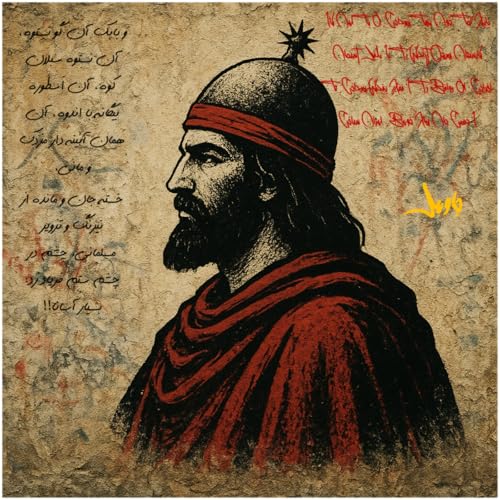
    Episode number 5 continues the exploration of the story of the Khurramites, a religious movement in Medieval Iran. The movement was nativist in nature, but had features of a syncretic cult. Neither fully Zoroastrian, nor Islamic, however rooted in the long history of Iranic religious traditions.

    In part II, we focus on the Khurramite rebellion against the Abbasid Caliphate, under the leadership of Babak Khorramdin. We delve into the history of the movement after Babak's defeat, including the intricate relations between the Khurramites and the Byzantine Empire, as well as their likely influence on various heterodox currents across the Persianate world.

    We then have a glimpse into how the image of Babak has been used in literature and art of modern Iran and Azerbaijan to shape divergent political and cultural narratives. We also attempt to grasp the role of Babak and the Khurramites in modern Kurdish and Talysh discourses.

    What makes Babak's story so compelling for modern artists and political activists?

    Show More Show Less
    40 mins
  • The Khurramites: Religion, Revolt, and Memory. Part I.
    Oct 24 2025

    The fall of the Sasanian Empire in the mid-7th century CE marked not just a political upheaval, but a profound transformation of Iranian society. The Islamic conquests introduced new religious paradigms, administrative structures, and social hierarchies. While Islam became the dominant faith, the process of Islamization was neither immediate nor uniform.

    Khurramism was, perhaps, one of the most notable movements in Early Islamic Iran. Neither fully Zoroastrian nor Islamic, they drew from deep wells of Persian religion, folk messianism, and anti-imperial rage.

    The episode no. 4 unfolds in two parts. The first part is focused on the historical context where the movement emerged, available sources about the Khurramites, their belief system and rituals, as well as the personality of their most famous leader - Babak Khorramdin.

    Show More Show Less
    41 mins
  • Bardesan: Humanist Before Humanism
    Sep 26 2025

    Before Renaissance philosophers proclaimed the ideal of man as free, rational, and divine— the Christian world had already known such a voice.

    Not from Florence or Padua, but from the banks of the Euphrates. Not at the high noon of humanism, but in the first light of Christian civilization.

    Before universities, before scholasticism, before creeds had hardened or canon closed— there, in the second century, lived a man named Bardaisan.

    Philosopher, poet, astrologer, theologian. A polymath...

    In another age, Bardaisan might have been remembered as a sage or a universal historian. It was only the narrowing margins of orthodoxy that cast him instead as a heretic...

    Show More Show Less
    34 mins
  • Hypsistarians: Pagan Monotheists at the Threshold
    Sep 13 2025

    There’s a tendency in religious history to draw hard lines — between gods and idols, orthodoxy and error, insiders and others. But in reality, belief is often fluid, and not always easy to categorise.

    In the eastern provinces of the Roman Empire, particularly around Asia Minor and the Black Sea, inscriptions and writings reveal a fascinating phenomenon. People — perhaps Gentile sympathizers with Judaism, or disillusioned pagans influenced by Stoic and Platonic thought — began to worship a singular, supreme deity. They rejected idols, observed Sabbath-like customs, and honored dietary restrictions, yet never underwent circumcision or adopted Jewish law. Nor did they convert to Christianity...

    Who were these worshipers of the Most High ("Hypsistos")? What did they believe — and why did their faith vanish into obscurity?

    Show More Show Less
    34 mins