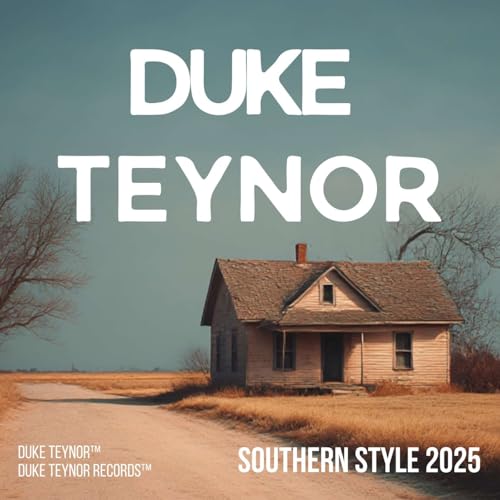
Duke Teynor cover art

Duke Teynor

Duke Teynor

By: DUKE TEYNOR
Listen for free

About this listen

Welcome to The Duke Teynor Show—the podcast that proves artistry has no limits. Hosted by musical innovator Duke Teynor, this is where Southern Rock Rap meets Berlin techno, where outlaw country collides with EDM, and where the only rule is: there are no rules. Duke Teynor isn't just a musician—he's a creative force who refuses to be boxed in. From crafting gritty Southern outlaw anthems like "Dirt Road Renegade" and "Backroads & Broken Rules" to dropping German-language industrial techno bangers like "Kaltes Feuer," Duke represents the next generation of genre-defying artists. And on this podcast, he brings you inside the creative process. WHAT TO EXPECT: 🎵 Behind-the-scenes stories from Duke's latest projects 🎙️ Deep dives into music production, AI collaboration, and creative innovation 🎸 Conversations about breaking genre boundaries and artistic evolution 🌍 Explorations of music cultures from Southern rock to Berlin underground techno 🚀 Discussions on the future of music, AI tools like Suno, and digital creativity 💡 Inspiration for artists who want to create without compromise Whether Duke is talking about the making of his epic sci-fi rock opera "3i ATLAS," explaining how he mastered German phonetics for techno tracks, or sharing wisdom from his transition from government work to full-time creative entrepreneurship, every episode delivers raw authenticity and actionable insights. This isn't your typical music podcast. This is a movement. This is proof that you don't have to choose between country and techno, between tradition and innovation, between what you were and what you're becoming. You can be ALL of it. Perfect for: Musicians, producers, creative entrepreneurs, genre-bending artists, AI music enthusiasts, and anyone who believes art should have no boundaries. New episodes drop weekly. Subscribe now and join the revolution. 🎧 "From dirt roads to techno raves—Duke Teynor does it all, and he's taking you along for the ride." WHAT LISTENERS ARE SAYING: "Duke's podcast is like a masterclass in creative courage. Every episode makes me want to go create something fearless." - Independent Musician "Finally, a music podcast that understands AI is a TOOL, not a threat. Duke gets it." - Music Producer "From outlaw country to German techno? I didn't know I needed this range in my life until I found Duke." - Music Fan #DukeTeynorPodcast #MusicPodcast #GenreBending #SouthernRock #Techno #IndependentArtist #MusicProduction #CreativeEntrepreneur #NoLimits #ArtisticEvolution #MusicInnovation #OutlawMusic #BerlinTechno #3iATLAS #CreativeProcess #MusicBusiness #GenreFluid #ArtistLife Duke Teynor podcast, music innovation podcast, genre-bending music, AI music creation, Southern rock rap, techno production podcast, independent artist podcast, music entrepreneur, creative process podcast, multi-genre musician, outlaw country podcast, electronic music podcast, concept album podcast, music production tips, artist evolution, creative inspiration podcast, music industry podcast, Berlin techno culture, Southern music culture© 2025 DUKE TEYNOR™. All Rights Reserved. Politics & Government Social Sciences
Episodes
  • BEHIND "ENERGY GUM" SONG WITH DUKE TEYNOR
    Dec 21 2025
    Now, if you've been following Duke's work, you know him for Southern Gothic rock ballads about cursed circles and ghostly brides. You know him for German industrial techno recorded in abandoned factories. You know him for Carolina Outlaw Soul—that dirt road, whiskey-soaked storytelling that's been the foundation of most of what he does."Energy Gum" is... none of that."Energy Gum" is bright, colorful, unapologetically commercial indie pop. It's 140 BPM of pure sunshine energy. It's electronic synths, layered harmonies, and literal gum-chewing sounds turned into percussion. It's Duke stepping completely outside his comfort zone and diving headfirst into territory he's never explored before.And you know what? Duke's not gonna apologize for it. He's gonna tell us exactly why he made it, how it came together, and what it taught him about creative fearlessness and artistic integrity.So let's dive in. PART ONE: WHY THE SHIFT? First question everyone asks: Duke, why the hell did you make a pop song about energy gum?Fair question. Let me share what Duke explained to me.Duke's spent years building a reputation as someone who doesn't care about commercial expectations. He writes three-hour sci-fi rock operas about killer robots. He records German techno in languages he barely speaks. He dives deep into regional folklore that most people have never heard of. Duke does what interests him creatively, period.But here's the thing—and this is straight from Duke—creative fearlessness can't just mean "I only do dark, serious, artistic stuff." Real fearlessness means being willing to explore anything, including things that might seem commercial or mainstream or outside your established brand.When the opportunity came up to work on a project celebrating productivity, focus, and that caffeinated flow state we all chase, Duke could've said no. He could've said, "That's not my brand. I'm the Southern Gothic guy. I don't do commercial pop."But that would've been creative cowardice disguised as artistic integrity.Instead, Duke thought: What if I approached this with the same authenticity I bring to everything else? What if I actually leaned into the challenge of creating genuine, infectious pop music without compromising who I am as an artist?So that's what he did.Duke started listening to early MGMT, Tame Impala—bands that blend electronic production with organic energy and genuine enthusiasm. He studied what makes pop music work. Not just catchy hooks, but the production techniques, the layering, the way great pop songs make you feel something even when they're ostensibly about simple subjects.And he realized something important: celebrating focus and productivity isn't shallow. It's actually really relatable. We all know that feeling of waking up foggy, struggling to get our brains online, needing that boost to unlock our potential. There's genuine human experience there.So Duke wrote "Energy Gum" as an honest celebration of that moment when everything clicks. When the fog clears. When your brain unlocks and suddenly you're in flow state, creating, producing, making things happen.The fact that it's also celebrating a specific product? Duke says that doesn't make it less authentic. It just means he found a brand partnership that aligned with something he genuinely experiences and values. PART TWO: THE PRODUCTION - MAKING IT WORK Now let's talk about how Duke actually made this thing, because the production was a completely different process than anything he'd done before.First, the tempo. 140 BPM is fast—way faster than most of what Duke does. Southern Gothic ballads live around 70-90 BPM. Even his rock stuff rarely pushes past 120. But pop music thrives on energy, and 140 BPM gives you that driving, can't-sit-still momentum.Duke built the foundation on electronic synths and programmed drums rather than live instruments. That was a shift for him. He's used to recording live guitars, real percussion, organic sounds. But pop production requires precision, layering, electronic textures that create that polished, commercial sound.Duke told me the bassline is absolutely critical in this track. It drives everything. It's repetitive, hypnotic, locked into the kick drum pattern. That bass-kick relationship is what makes people move, what creates physical response to the music.Then they layered synths—bright, shimmering, optimistic sounds. Nothing dark or brooding. These are sounds that evoke sunshine, energy, forward momentum. Each synth line serves a specific purpose in the frequency spectrum, creating fullness without muddiness.The vocal production was probably the biggest departure for Duke. He's used to raw, gritty vocal delivery with minimal processing. For "Energy Gum," they did extensive vocal layering—lead vocal, harmony stacks, background vocals creating texture and depth. They used pitch correction not to fix mistakes but as a stylistic choice, giving that polished pop sound.And here's the fun part that ...
    Show More Show Less
    12 mins
  • THE STORY BEHIND THE SONG, "WOMAN IN BLACK" BY DUKE TEYNOR
    Dec 21 2025
    Hey everyone, Summer here, and welcome back to the Duke Tyner podcastToday we're diving deep into the Carolina pinewoods. We're talking about ghosts, curses, and eternal longing turned malevolent. We're talking about one of Duke Tyner's most haunting creations—"The Woman in Black."If you've been following Duke's work in the Southern Gothic realm, you already know about "Devil's Circle"—that chilling ballad about North Carolina's legendary Devil's Tramping Ground, where nothing grows and the Devil himself is said to pace at night. "The Woman in Black" takes that mythology and expands it into something even darker, even more tragic, and honestly, even more terrifying.This isn't just a music video. This is a cinematic descent into North Carolina folklore's darkest corner, where a spectral bride waits in cursed circles for souls foolish enough to answer her siren call.So settle in, maybe leave a light on, and let's talk about Duke Tyner's masterpiece of Southern Gothic horror. PART ONE: THE LEGEND EXPANDS Let's start with the mythology, because "The Woman in Black" doesn't exist in isolation. Duke built this on the foundation he established with "Devil's Circle."The Devil's Tramping Ground is a real place near Siler City, North Carolina. It's a forty-foot circle of barren earth where nothing grows, nothing has grown for over a century, and according to local legend, the Devil himself paces there nightly, plotting humanity's downfall. Objects placed in the circle get thrown out by morning. Animals refuse to enter. People who sleep there report nightmares so vivid they wake up screaming.Duke captured all of that in "Devil's Circle." But then he asked a deeper question: What if the Devil isn't alone out there? What if something else haunts that cursed ground?Enter the Woman in Black.Duke researched local folklore and found whispered stories—not as well-known as the main legend, but there, if you know where to look. Stories about a woman in a wedding gown seen at the circle's edge. Stories about a voice that sounds like wind through pines but carries words. Stories about men who went into those woods and never came back, or came back changed, haunted, speaking about a bride who wouldn't let them go.Duke took those fragments and built a complete mythology. The Woman in Black was promised—engaged to be married—but abandoned on her wedding day. The betrayal and heartbreak were so profound, so consuming, that when she died, her spirit couldn't rest. She was drawn to the Devil's circle, that place of abandonment and cursed earth, and there she waits. Eternal. Patient. Lonely.But here's the tragic transformation Duke captures so brilliantly: loneliness, when it lasts long enough, curdles into something darker. The Woman in Black isn't just waiting for her lost love anymore. She's waiting for anyone. Anyone foolish enough to cross into her domain becomes hers. She doesn't chase—she doesn't need to. She simply waits, knowing eventually someone will come.Duke told me this is what makes the best ghost stories work—they're not just about scares. They're about tragedy. The Woman in Black is terrifying, yes, but she's also heartbreaking. She's a victim who became a predator. An abandoned bride who now abandons her victims to eternal darkness.That duality—victim and monster, tragic and terrifying—runs through the entire song and video. PART TWO: THE MUSIC - SOUTHERN GOTHIC ATMOSPHERE Now let's talk about the music itself, because Duke crafted "The Woman in Black" to sound exactly like its subject—seductive, dangerous, impossible to ignore.The tempo sits around 80-90 BPM. That's slower than a lot of rock, but it's perfect for this story. It's the tempo of a heartbeat. The tempo of footsteps through dark woods. The tempo of something approaching slowly, inevitably, with all the time in the world.Duke's vocals are gritty and emotional—this isn't polished pop singing. This is raw, lived-in storytelling. You can hear the warning in his voice. The fear. The fascination. When he sings "She waits in the circle when the moon is high, a shadowed bride with a hollow eye," you believe he's seen her. You believe he's barely escaped.The instrumentation builds this incredible Southern Gothic atmosphere. Electric guitar with atmospheric slide accents creates that distinctly Southern sound—think slide guitar wailing through humid night air, Spanish moss hanging from cypress trees, everything dripping with decay and beauty.The bass grooves deep and steady, anchoring everything. The drums hit heavy, echoing like heartbeats through empty woods. And then there's the fiddle—subtle but essential. That fiddle adds layers of authentic Americana, connecting this song to centuries of Southern storytelling tradition.But here's what makes the production truly special: the female ghostly harmonies.In the chorus—"Lost to the night with the Woman in Black"—you hear these ethereal female voices layered behind Duke's lead...
    Show More Show Less
    15 mins
  • MAKING CHRISTMAS CANDY
    Dec 19 2025
    MAKING CHRISTMAS CANDY Well, we're in the heart of the holiday season now, and if you're like me, you've probably been thinking about all those traditions that make this time of year special. The decorations, the music, the gatherings with family and friends. And of course... the candy.Today we're diving into something that's been part of Christmas celebrations for generations—homemade Christmas candy. We're talking about those sweet traditions that get passed down through families. The recipes written on index cards in your grandmother's handwriting. The techniques that seem almost magical when you're a kid watching the adults work in the kitchen.Whether it's fudge, peanut brittle, divinity, pralines, peppermint bark, or any of the dozens of candies that show up on holiday tables across the South and beyond—there's something special about making candy at Christmastime. It's chemistry, it's art, it's tradition, and honestly, it's a little bit of magic.So grab yourself something warm to drink, settle in, and let's talk about the sweet science and beautiful tradition of making Christmas candy. PART ONE: THE TRADITION AND HISTORY Let's start with why candy-making became such a central part of Christmas traditions, particularly here in the South.Go back a hundred years or more, and sugar wasn't something people had access to year-round the way we do now. Sugar was expensive. It was special. It was something you saved for occasions, and Christmas was the biggest occasion of the year.Families would save up sugar rations, pool their resources, and dedicate time to making sweets that would last through the holiday season. Making candy wasn't just about having dessert—it was about celebration, abundance, showing love through the effort of creation.In my own family, candy-making was an event. My grandmother would commandeer the kitchen for entire afternoons, and us kids would hover around watching the process like it was pure magic. Because honestly, it kind of is. You take simple ingredients—sugar, butter, cream, nuts—apply heat and technique, and suddenly you've got something completely transformed. Liquid becomes solid. Clear becomes opaque. Sweet becomes... well, even sweeter.Different regions developed their signature candies based on what was locally available. Down South, we had pecans in abundance, so pralines became a staple—those creamy, nutty confections that melt on your tongue. We had sorghum and molasses, so candies incorporating those distinctive Southern sweeteners showed up on Christmas tables. Peanut brittle became popular because peanuts were plentiful and cheap.Up North, maple candy made sense because maple syrup was readily available. Coastal regions incorporated ingredients like coconut. Every area put its own stamp on Christmas candy traditions based on local agriculture and cultural influences.But beyond regional differences, there's something universal about the act of candy-making at Christmas. It requires patience. It requires attention. You can't rush good candy. You have to watch temperatures carefully, stir consistently, wait for exactly the right moment. In our modern world of instant gratification, there's something almost meditative about the slow, careful process of candy-making.And then there's the gifting aspect. Homemade candy became the perfect Christmas gift—something that required time, skill, and care to create. When you gave someone a tin of homemade fudge or a bag of peanut brittle, you weren't just giving them sugar. You were giving them hours of your time, expertise passed down through generations, and a piece of your family's tradition.That tradition continues today, even though we can buy candy any time we want from any store. People still make Christmas candy because it connects them to the past, to family members who are no longer with us, to a slower way of doing things that feels increasingly precious in our fast-paced world. PART TWO: THE SCIENCE - UNDERSTANDING CANDY TEMPERATURES Now let's talk about what's actually happening when you make candy, because understanding the science makes you a better candy-maker.Candy-making is all about sugar chemistry. Specifically, it's about controlling how sugar molecules behave at different temperatures. When you heat sugar dissolved in water, the water gradually evaporates, and the concentration of sugar increases. As that concentration changes, the physical properties of the mixture change dramatically.This is where candy thermometers become your best friend. Professional candy-makers and experienced home cooks know that temperature is everything. A few degrees difference can mean the difference between perfect fudge and grainy disaster, between crisp peanut brittle and chewy mess.Let me break down the main temperature stages:Thread Stage (230-235°F): At this temperature, sugar syrup forms thin threads when dropped from a spoon. This stage is used for making syrups and some icings.Soft Ball Stage (235...
    Show More Show Less
    17 mins
No reviews yet
In the spirit of reconciliation, Audible acknowledges the Traditional Custodians of country throughout Australia and their connections to land, sea and community. We pay our respect to their elders past and present and extend that respect to all Aboriginal and Torres Strait Islander peoples today.