Dialogues in Judaic Studies cover art

Dialogues in Judaic Studies

Dialogues in Judaic Studies

By: Ari Barbalat
Listen for free

About this listen

This podcast features educational, informative and intellectually compelling conversations with authors of newly-published books and recently-released monographs on Jewish history, Jewish religion, Jewish philosophy and Jewish literature. The podcast intends to reach academic specialists, members of the reading public and beginners with entry-level curiosity.

© 2026 Dialogues in Judaic Studies
Judaism Philosophy Social Sciences Spirituality World
Episodes
  • Matthew S. Goldstone, *The Dangerous Duty of Rebuke: Leviticus 19:17 in Early Jewish and Christian Interpretation*. Leidein: Brill, 2018.
    Apr 15 2026

    In this monograph, Matthew Goldstone investigates the perceptions of religious texts in early Jewish and Christian communities regarding the responsibility to rebuke others, based on the biblical verse: "Rebuke your fellow but do not incur sin" (Leviticus 19:17).

    Through a thorough analysis of texts from the Bible, the Talmud, late Midrashim, and early Christian monastic writings, he highlights a progression from questioning how to rebuke during the Second Temple and early Christian periods, to exploring whether rebuke is permissible in early rabbinic texts, and ultimately to discussing whether rebuke should be practiced in later rabbinic and monastic sources.

    By mapping these insights onto changing sociological contexts, this work presents a novel perspective on the nature of interpersonal responsibility in antiquity.

    Show More Show Less
    1 hr and 12 mins
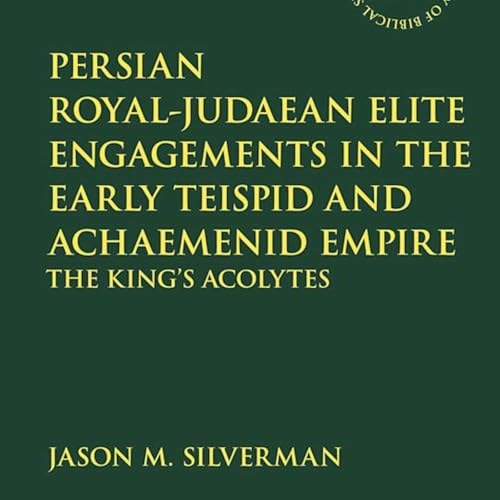
  • Jason Silverman, *Persian Royal-Judaean Elite Engagements in the Early Teispid and Achaemenid Empire: The King's Acolytes*. London: T&T Clark, 2020.
    Apr 14 2026

    Jason Silverman offers a timely and essential examination that enhances our comprehension of Achaemenid ideology and Persian Period Judaism.

    Although the Achaemenid Persian Empire (c. 550–330 BCE) surpassed all prior empires of the Ancient Near East in both scale and duration, the royal system that created and sustained this civilization is still only partially understood, as is the imperial and religious heritage left for future generations. To address this gap, Silverman presents a critically advanced and interdisciplinary framework for comparative studies.

    As the Achaemenids reconstructed the Jerusalem temple, the Judaean literature from this era reveals conflicts regarding its Persian restoration, showcasing clashing religious viewpoints. While both First Zechariah (1–8) and Second Isaiah (40–55) are subjects of debate, the broader imperial context is seldom examined in detail; both texts directly address the temple's legitimacy, linking them closely to the kings' interactions with cults. Silverman investigates how the Achaemenid kings depicted their authority to subjugated minorities, the methods by which minority elites adapted this ideology, and the duration of this influence, as evidenced by the Judaean responses to the temple's restoration in Jerusalem.

    Show More Show Less
    1 hr and 13 mins
  • Elisa Uusimäki, *Lived Wisdom in Jewish Antiquity: Studies in Exercise and Exemplarity*. London: T & T Clark, 2016.
    Mar 30 2026

    Shifting away from the traditional view of wisdom as merely a literary genre, this book explores the lived, embodied, and formative aspects of wisdom as outlined in Jewish texts from the Persian, Hellenistic, and early Roman periods. By examining a variety of writings that extend beyond later canonical limits, the book illustrates that wisdom is not merely an abstract concept, but rather something to be enacted and practiced at both individual and community levels. The analysis particularly focuses on the characteristics of a 'wise' individual, including the emergence of the sage as a model figure. It also examines how ancestral figures and modern educators are envisioned to embody and apply wisdom, while reflecting on communal representations of a wise and virtuous existence. In this way, Elisa Uusimäki reveals that the earlier emphasis on wisdom as a literary category has obscured important inquiries concerning wisdom, behavior, and social dynamics. Furthermore, Jewish wisdom is situated within its broader ancient Mediterranean context, enhancing the book's significance for biblical scholars, classicists, religious studies experts, ancient Near Eastern scholars, and theologians.


    Show More Show Less
    41 mins
No reviews yet
In the spirit of reconciliation, Audible acknowledges the Traditional Custodians of country throughout Australia and their connections to land, sea and community. We pay our respect to their elders past and present and extend that respect to all Aboriginal and Torres Strait Islander peoples today.