• EP#28-From Pro Athlete To Head Coach-Nick King On His Vision For Shadow Hills Football
    Mar 14 2026

    Send us Fan Mail

    A familiar Coachella Valley name is stepping into a brand-new role. We’re joined by Nick King, the newest head coach at Shadow Hills, to unpack the real story behind the headset: how a three-sport standout and former pro baseball player turns experience into a clear, grounded plan for building a high school football program that lasts.

    We talk about why he chose coaching through teaching, how relationships drive culture, and what he learned moving from Riverside City College to the University of Georgia and into professional baseball. Then we get into the football details that coaches and fans love: why the trenches decide games, how offensive alignment and formation variety can stress a defense, and why a head coach has to build a system around the kids who actually show up, not a perfect playbook.

    We also hit the big-picture topics shaping modern high school football in Desert Valley and beyond: scheduling in the era of the playoff algorithm, whether tough nonleague games help or hurt, and how “just win” simplifies the noise around seeding. Nick closes with advice for the next generation on sacrifice, emotional regulation, and the off-field habits that make on-field success possible.

    Subscribe for more Desert Valley football conversations, share this with a coach or player who needs it, and leave a review with your biggest takeaway.

    Show More Show Less
    45 mins
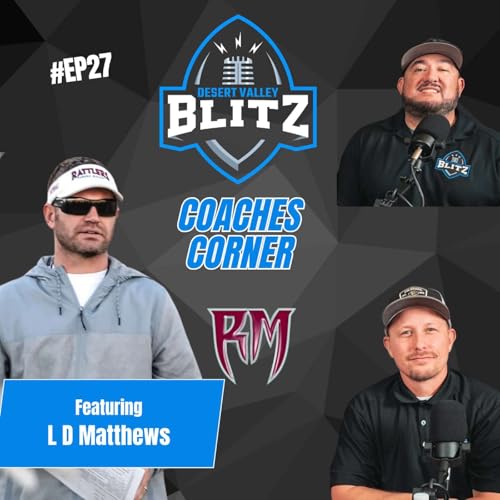
  • EP#27-How Coach LD Matthews Built A Consistent High School Football Power
    Mar 14 2026

    Send a text

    You can hear it in Coach LD Matthews’ voice: high school football isn’t just a sport to him, it’s a community engine. We talk about how a kid from rural Montana grows up on Friday night lights, survives a winding college football journey full of injuries, and eventually lands in the Coachella Valley to coach and teach. What starts as a leap with no job lined up turns into two decades of lessons on leadership, toughness, and showing up for people when it’s hard.

    We get into what it really takes to build a winning program at Rancho Mirage High School when you’re starting from zero: no traditions, no alumni base, and the daily grind of earning trust. Coach Matthews breaks down the years that led to playoff runs and a CIF championship game appearance, plus the story every local football fan needs to hear, an eight-overtime marathon that tested hydration, focus, and belief. Along the way, we dig into the mentors and community members who shaped him, and why gratitude is a competitive advantage.

    If you’re a coach, parent, or athlete, the practical takeaways hit fast: consistency comes from staff alignment, clear standards, and a life-after-football mission. Coach Matthews shares his “E + R = O” approach to adversity, explains how his shotgun and midline identity forces defenses into conflict, and gives an honest look at discipline, competitive equity, playoff algorithms, and scheduling strategy in today’s data-driven high school football landscape. We also shout out the Rancho Mirage football golf tournament fundraiser and how to support the program at rmhs.psusd.us/football.

    Subscribe for more Coachella Valley football conversations, share this with a coach who needs it, and leave a review with your biggest takeaway from Coach Matthews’ mindset.

    Show More Show Less
    53 mins
  • EP-#26 How A Local Legend Built Consistent Winners And Shaped Generations-The Pat Blackburn Story
    Mar 7 2026

    Send a text

    What does it take to turn a high school program into a perennial contender without chasing trends or making excuses? We invited Coach Pat Blackburn—the godfather of Palm Desert Aztec football—to share the straight story: how mentors at Utah State lit the fuse, why college coaching’s churn sent him back to build at the high school level, and how a simple, relentless philosophy—alignment, technique, effort—became the backbone of 22 seasons of consistency.

    We walk through the early Rubidoux years where one formation and two coverages carried a team to 13 straight wins, and we revisit a raw, honest look at Notre Dame’s pressure-cooker—position switches, jammed depth charts, and the reality of fighting for snaps among 130 scholarships. Those lessons became guardrails for leadership: set standards you can see, demand effort you can feel, and earn the right to coach players hard by showing up first and leaving last.

    From there, we zoom into Coachella Valley football. Blackburn breaks down the golden era of local semifinal runs, the power of true rivalries, and the sting of quieter bleachers that dull home-field edge. He digs into the widening playoff gap with Orange County programs—where speed at the perimeter and year-round development raise the bar—and explains how to close it with sharper fundamentals, staff alignment, and schemes that match your roster. Then it gets tactical: the shift from I-backs to spread spacing designed to run the ball, deep study of Chris Ault’s pistol, and why two-way toughness still separates great high school teams. Along the way, he spotlights players who never came off the field and assistants who kept the culture tight.

    If you’re an aspiring coach, Blackburn lays out a path you can start today: cut your teeth with the freshmen, master film, coach both sides of the ball, keep your word, and protect the program. If you’re a player or parent, you’ll hear how trust, clarity, and accountability turn talent into habits and habits into wins. Subscribe, share with a fellow coach or fan, and leave a review—what’s the one standard you won’t compromise this season?

    Show More Show Less
    39 mins
  • EP#25-Rajah That!! Rajah Nation Reborn with Coach Doc
    Feb 7 2026

    Send a text

    The Rajahs have waited three decades to feel this kind of buzz—and we’re ready to say it out loud: the turnaround starts now. We sit down with Coach Doc, who left a nine‑year run at Xavier Prep to lead Indio with a bold, simple plan: close the borders, rebuild the trenches, and make staying home the obvious choice for Indio families.

    We dig into why Indio was the right fit and how Principal Monica Rodriguez and Shipley pitched a vision bigger than football: a surging city, a massive alumni base, and a campus built to compete. Doc lays out the on‑field identity—physical offensive line, fast defense, and detailed habits that show up in alignment, assignments, and special teams. He spotlights returning talent, from a maturing QB to real speed outside, and explains how the staff blends young former D1 athletes teaching on campus with veteran mentors who lead beyond the game.

    Rivalries and structure matter, too. We talk Bell game history, the Mayor’s Cup pause, and why stepping back to calibrate before stepping into marquee matchups can pay off. The new tiered league system gets a thoughtful breakdown on how it supports organic growth, smarter scheduling, and healthier programs. Then we go deeper: reclassing for maturity and academics, what college recruiting looks like in the NIL era, and an honest take on transfers—why freedom and fit often serve kids better than restrictive rules, and why consistent standards across regions would level the playing field.

    If you care about Indio football, this conversation is your blueprint: keep local talent, connect the youth pipeline, lead from the weight room, and celebrate a proud tradition while building something modern and tough. Subscribe, share with a fellow Rajah, and leave a review telling us the first rivalry you want back on the schedule.

    Show More Show Less
    39 mins
  • EP#24-How Coach Ruiz Rebuilt A High School Powerhouse By Prioritizing Strength, Structure, And Student Success
    Feb 7 2026

    Send us a text

    Ever wonder how a high school program finds its backbone and keeps it through decades of change? We invited Coach Ramon Ruiz of La Quinta High School to share the unglamorous truth behind sustainable success: January commitments, classroom standards, and a culture that refuses shortcuts. From his start in Sacramento to shaping the Blackhawks into a consistent playoff team, Coach Ruiz lays out a clear plan—get stronger, stay disciplined, protect the football, and let the results stack up.

    We dig into the real work that most people don’t see: daily lifts, accountability, and the steady climb from 0–10 frustration to competing with regional powers. Coach Ruiz salutes mentors like Ron Alford and Walt Kriner who taught him how to implement systems, not just draw them up, and how to run practices that translate to Friday nights. He explains why balance is a myth, why the classroom keeps rosters intact, and how a program becomes transfer-proof by offering structure, belonging, and honest standards. You’ll hear why he schedules for growth, not optics, and how the CIF algorithm era shapes nonleague games, rivalries with Imperial Valley teams, and even choices about zero week.

    Parents and coaches will appreciate his thoughtful take on holding back eighth graders, the importance of aligning family decisions with eligibility rules, and the bigger mission of shaping boys into men. Aspiring coaches get practical guidance: become a teacher if you can, be a sponge in staff rooms, serve the kids first, and let humility fuel your learning. It’s a conversation about culture, not clichés—how weight rooms build confidence, how GPA goals build stability, and how process builds the kind of team that shows up in November.

    If this conversation gave you something to think about, tap follow, share it with a coaching friend, and leave a quick review to help more listeners find Desert Valley Blitz.

    Show More Show Less
    27 mins
  • EP#23-How Athletes Can Get To The College Level
    Feb 1 2026

    Send us a text

    Want a real roadmap from high school hallways to D1 sidelines? We sat down with Angel Meraz, head athletic counselor at College of the Desert and president of California’s statewide counselor association for student athletes, to decode the rules behind recruiting, eligibility, and the transfer portal. Angel brings the counselor’s perspective—clear steps, no fluff—and shows how smart planning turns talent into offers.

    We break down the 16 NCAA core courses, how core GPA is actually calculated, and why course titles and retakes matter more than most families realize. Angel explains how California’s A–G requirements align with NCAA standards, what changes every year at the rulemaking level, and how a single missed unit can sideline a dream. We also explore the transfer portal’s new hierarchy: coaches scout the portal first, junior colleges second, and high schools third, unless you’re a standout. That shift creates both opportunity and risk, including a growing wave of “bounce backs” using JC programs to reset their path.

    The conversation goes deep on NIL at the community college level—real deals, rising interest from local businesses, and the legal traps in contracts signed by teenagers eager to play. Angel details the evolving legal landscape around eligibility clocks and how potential changes could reshape the timeline for athletes starting at junior colleges, even opening doors to finish faster and pursue graduate degrees on scholarship. Her step-by-step advice for 10th and 11th graders is refreshingly concrete: register with the NCAA Eligibility Center, verify your high school’s approved course list, track your core GPA, and ask for help early.

    If you’re a student athlete or a parent navigating the maze—eligibility rules, portal choices, NIL offers—this conversation gives you a working plan. Subscribe, share this with a teammate or coach, and drop your biggest eligibility question so we can tackle it next.

    Angel can be reached at: ameraz@collegeoftghedesert.edu


    Show More Show Less
    30 mins
  • EP#22-How A Reluctant Assistant Turned Palm Springs Football Into A Powerhouse
    Jan 24 2026

    Send us a text

    A head coach who never planned to be one. That’s the heart of our conversation with Palm Springs’ Darryl Gore—an assistant who almost walked away when his mentor retired, then stepped up because his players asked him to. What follows is a story about tradition, buy-in, and the quiet work that turns a program into a family.

    We trace Coach Gore’s journey from Pop Warner fields in 1992 to balancing football, basketball, and even baseball—all while learning under legends like Coach Fabian and Coach Murph. He shares how sprinting between JV and varsity made him a better teacher, why alumni coaches strengthen the culture, and what actually changes when the assistant everyone loves becomes the head coach who has to make the hard calls. The real shift? Handling parents, managing the unseen logistics, and building a staff that can carry the standard without losing the human touch.

    Gore breaks down the 8–0 start with specifics: a tougher summer, more strength work, and a relentless focus on unity to erase divides between linemen and skill, offense and defense. He explains how a senior-heavy roster matured, how plug-and-play on the line is built on fundamentals, and why the run game clicked. His philosophy is clear and refreshing—don’t treat every player the same. Listen first, coach the kid in front of you, and earn trust before demanding more. We also talk mentors in Texas high school football, what translates, and what doesn’t, and we end with actionable advice for young coaches: learn the unglamorous parts, hire for character, and let tradition do its work.

    If this story of culture, development, and leadership resonates, tap follow, share it with a coach or parent who needs it, and leave a quick review to help more listeners find the show. Your support keeps these conversations going.

    Show More Show Less
    22 mins
  • EP#21-From El Paso To Palm Desert: Building A High School Football Program That Lasts-The Rudy Forti Story
    Jan 16 2026

    Send us a text

    Football isn’t just a season for Rudy Forty—it’s a family lineage, a craft learned on long bus rides in El Paso and refined across college fields and high school sidelines. We sit down with the Palm Desert head coach to unpack how a second-generation coach builds a durable program in a valley where the heat is brutal, the rivalries are real, and the community shows up every Friday.

    Rudy walks through the moments that shaped him: lessons from revered mentors at North Texas, the switch from defense to offense, and the blueprint that defines Palm Desert—load the best 11 on defense and engineer an offense that fits the remaining pieces. He breaks down his run-first, quick-game philosophy, why the offensive line anchors everything, and how coaching his son at center simplified calls and elevated the unit’s confidence. We contrast tight-knit valley football with the juggernauts west of the pass, exploring what changes when you face one-school powerhouses with deep rosters and deeper pipelines.

    The conversation gets candid about the leap from coordinator to head coach. Rudy lays out the hidden work few see: grades, discipline, staffing around off-campus schedules, fundraising, and keeping the clock and the culture on time. We talk defensive identity under a trusted coordinator, the integrity of transfer rules in the valley, and why tradition still matters—from triple-overtime thrillers to alumni-packed field dedications. For coaches climbing the ladder, Rudy’s advice is blunt and valuable: earn your credentials, learn every position, take the jobs others skip, and build trust that holds under pressure.

    If you care about high school football culture, leadership, and the real mechanics of building a program, this conversation delivers practical insight and a grounded perspective. Subscribe, share with a coach or parent who needs it, and leave a review telling us your biggest takeaway from Coach Forty’s playbook.

    #highschoolfootball #coaching #footballcoach #texasfootball #northtexasfootball #palmdesertaztecs #headcoach #coachellavalley #desertvalleyblitz #californiafootball

    Show More Show Less
    32 mins