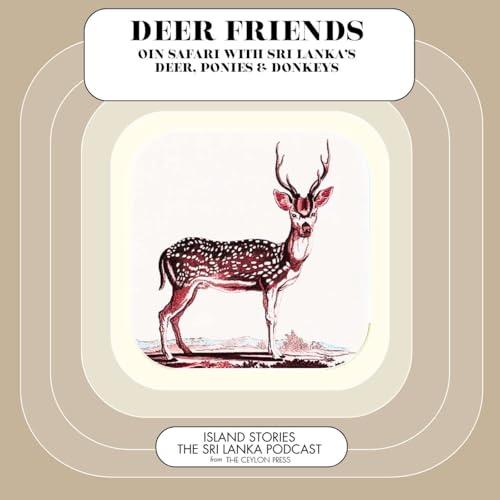
Deer Friends: On Safari with Sri Lanka's Deer, Ponies & Donkeys cover art

Deer Friends: On Safari with Sri Lanka's Deer, Ponies & Donkeys

Deer Friends: On Safari with Sri Lanka's Deer, Ponies & Donkeys

Listen for free

View show details

About this listen

Deer abound across Sri Lanka, some like the Ceylon Spotted Deer are increasingly vulnerable, prey to poachers and habitat loss; others – like the Barking Deer – are flourishing and present little concern to the scientists who maintain the Red List of Threatened Species. Two species are considered endemic to the island – the Ceylon Spotted Deer, the Sri Lankan Spotted Chevrotain, with the Sri Lankan Sambar Deer the subject of mild debate among patriotic environmentalists trying to assess if it is so significantly more evolved as to present nature with what amounts to a new subspecies unique to the island. The remaining species found in Sri Lanka are also found across South and Southeast India – the Hog Deer and the Barkling Deer. Joining these quadrupeds are an extraordinary herd of feral ponies, abandoned by departing colonists, and a pack of wild donkeys, descendants of beasts brought to the island by ancient traders. Troubled by the sheer lack of scientific information about the behaviour of the Ceylon Spotted Deer, the Department of Zoology at Sri Lanka’s Eastern University conducted a detailed study of a particular population in Trincomalee. After months of observation, they concluded, reassuringly, that “their main activities were feeding and play.” Scientists are much divided on the subject of animal play, and tortured monographs have been written attempting to pin down the very concept of animal play. To some, it is merely an evolutionary byproduct; others claim it ensures animals teach one another about fairness and consequences. That the Sri Lankan Axis Deer should be minded to play at all is encouraging for it is an increasingly vulnerable species, its preferred habitats - lowland forests, and shrub lands –are shrinking, and with it the grasses, leaves, and fruit it lives on. Their numbers are now counted in the thousands. They live in herds of up to one hundred and are seen by leopards, bears, crocodiles, jackals, and hungry villagers as living supermarkets of fresh meat. Standing up to a hundred centimetres high, their delicately white spotted fawn coats present them as everything a perfect deer ought to be, as is appropriate for an animal that is part of the island’s select few endemic mammals. The Mouse Deer, or Sri Lankan Spotted Chevrotain, has evolved so dramatically that it presents scientists with the opportunity to grant it full endemic status as the Sri Lankan Spotted Chevrotain. Barely twelve inches high, it lives scattered in the forests of South & Southeast Asia. The Sri Lankan variant mostly sticks to the dry zones, especially Wilpattu, Udawalawa, and Sigiriya. It is tiny, gorgeous, even-toed and, unless you are a plant, entirely harmless– although popular superstition adds the caveat that a man who gets scratched by the hind foot of one will develop leprosy. This has yet to be verified by scientists. Tiny too is the Hog Deer – barely seventy centimetres tall. It has short legs, a predilection to whistle, fine antlers and dark brown fur. It actually looks nothing like a pig but gains that interspecies appellation for its tendency to rush through the forest, head down like one of the racing pigs at Bob Hale Racing Stables in far-off Michigan. Stretching across the grasslands of Sri Lanka and South and Southeast Asia, it is now classified as highly vulnerable, with its small herds shrinking amid habitat loss. Less threatened is the Indian Muntjak or Barking Deer. Carefree and with a propensity to eat almost anything, the Barking Deer is a cuddly irritant in the jungle and on low-hill estates, its numbers flourishing across South and Southeast Asia. It grows to around sixty centimetres in height and is covered in reddish brown fur and, for males, throws in a modest set of antlers. Shy, solid, rarely seen in numbers more than two, it gets its name for the dog-barking sound it makes when alarmed. It is a modest, if reliable breeder, with pregnancies lasting six months after which one or, occasionally, two pups are born. But among the island deer, the Sambar Deer claims the title of the largest and most impressive of the several deer species with which it shares genes. Within Sri Lanka, the species has evolved further and teeters on the edge of being declared endemic, as the Sri Lankan Sambar (Rusa unicolour). Much mistaken for an elk by early British colonists eager to shoot it, it can be seen in herds in places like Horton Plains – but it is classified as highly vulnerable all the same. It is a tempting target for poachers stocking up on game meat to sell, and the pressures on its grassland habitats are not getting any easier. Typically one and a half metres high (sometimes more), their herds consist of females with their fawns, which they usually produce yearly. The males, like men with sheds who have taken the designation to extremes, prefer to live alone - except when the mating urge overcomes them. Fossil records from tens of thousands of ...
No reviews yet
In the spirit of reconciliation, Audible acknowledges the Traditional Custodians of country throughout Australia and their connections to land, sea and community. We pay our respect to their elders past and present and extend that respect to all Aboriginal and Torres Strait Islander peoples today.