

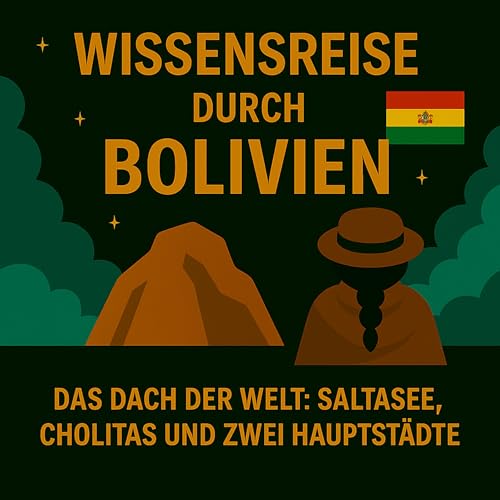
Bolivien – Das Dach der Welt: Saltasee, Cholitas und zwei Hauptstädte
Failed to add items
Sorry, we are unable to add the item because your shopping cart is already at capacity.
Add to basket failed.
Please try again later
Add to Wish List failed.
Please try again later
Remove from Wish List failed.
Please try again later
Follow podcast failed
Unfollow podcast failed

Bolivien – Das Dach der Welt: Saltasee, Cholitas und zwei Hauptstädte
-
Narrated by:
-
By:
About this listen
Bolivien, offiziell Plurinationaler Staat Bolivien, wurde am 6. August 1825 unabhängig. Fläche: 1.098.581 km². Einwohner: ca. 12,1 Mio. (2024). Amtssprachen: Spanisch sowie 36 indigene Sprachen, darunter Quechua und Aymara. Regierungssitz: La Paz (3.640 m). Verfassungshauptstadt: Sucre (2.810 m). Währung: Boliviano (BOB).
Ausgewählte Quellen und weiterführende Literatur:
- Instituto Nacional de Estadística Bolivia (INE): www.ine.gob.bo – Bevölkerungs- und Wirtschaftsdaten
- UNESCO World Heritage: „Historic City of Sucre" (1991) – whc.unesco.org
- United States Geological Survey (USGS): Lithiumreserven weltweit – www.usgs.gov
- Rabatel, A. et al. (2013): Current state of glaciers in the tropical Andes. The Cryosphere, 7(1), 81–102 – doi:10.5194/tc-7-81-2013 (Gletscherschwund Chacaltaya)
- Metais, G. & Beard, K. C. (2020): Forschungen zur Paläogeografie des Titicacasees, Journal of South American Earth Sciences
- Rivera, S. (2012): Violencias (re)encubiertas en Bolivia. La Paz: La Mirada Salvaje – indigene Geschichte und Kolonialismus
- Constitución Política del Estado Plurinacional de Bolivia (2009): Rechte der Pacha Mama, Artikel 33 und 34 – www.bolivialegal.com
- Bakewell, P. (1984): Miners of the Red Mountain: Indian Labor in Potosí, 1545–1650. University of New Mexico Press
- Teleférico Mi Teleférico, offiziell: www.miteleferico.bo
- World Bank Data: Bolivia poverty indicators – data.worldbank.org
No reviews yet
In the spirit of reconciliation, Audible acknowledges the Traditional Custodians of country throughout Australia and their connections to land, sea and community. We pay our respect to their elders past and present and extend that respect to all Aboriginal and Torres Strait Islander peoples today.