Beyond Barbarossa: The Eastern Front of World War 2 cover art

Beyond Barbarossa: The Eastern Front of World War 2

Beyond Barbarossa: The Eastern Front of World War 2

By: Scott Bury
Listen for free

About this listen

You know about Stalingrad, the siege of Leningrad, maybe Kursk. But how well do you know the history of the ”Russian front” of the Second World War? Join this detailed description of the largest part of WW2 in Europe, the titanic clash between tyrants Hitler and Stalin.Copyright 2022 All rights reserved. World
Episodes
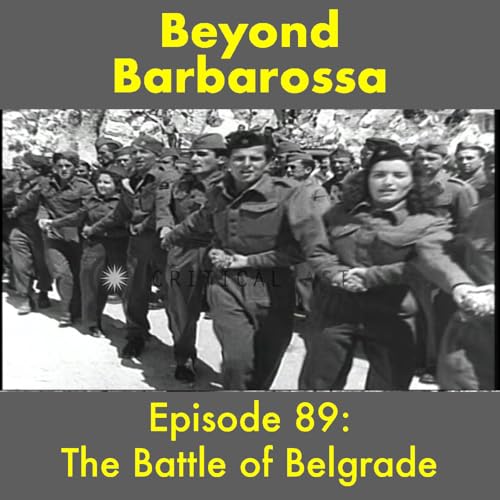
  • The Battle of Belgrade—Episode 89
    Dec 8 2025

    There was a lot of action on the Eastern Front in the autumn of 1944. In late September, the Red Army and its new allies enter Yugoslavia and connect with communist Partisans led by a man called Tito. The results will echo across the decades.

    Map 1: The Balkan military theatre, September 1944–January 1945

    Map 2: The Bulgarian incursion

    Map 3: The Battle of Belgrade

    Photos

    The Lockheed P-38 Lightning and the Focke-Wulf fw189

    The Yakovlev Yak-9 in flight

    The Yakovlev Yak-9 in the Russian military museum

    Josip Broz, a.k.a. Tito, far right, with his staff.

    Sources

    Antony Beevor, The Second World War. New York, NY, USA: Little, Brown and Company, 2012.

    Evan Mawdsley, Thunder in the East: The Nazi-Soviet War, 1941–1945. London: Bloomsbury Academic, 2016.

    Giles Milton, The Stalin Affair: The impossible alliance that won the war. New York, NY, USA: Henry Holt and Company, 2022.

    Anthony Tucker-Jones, Slaughter on the Eastern Front: Hitler and Stalin’s War, 1941–1945. Stroud, Gloucestershire, UK: The History Press, 2017.

    Morse code by Thane Brown

    Music composed and recorded by Nicolas Bury

    Show More Show Less
    40 mins
  • Horror in East Prussia—Episode 88: The Red Army enters Germany
    Nov 24 2025

    In October 1944, the Red Army entered East Prussia, the heart of German militarism. Horrific war crimes ensued.

    Map 1: The Red Army’s advances all across the broad front

    Map 2a: European Theatre, 1 October 1944

    Map 2b: European Theatre, 1 November 1944

    Map 3a: The Pacific Theatre, 1 October 1944

    Map 3b: The Pacific Theatre, 1 November 1944

    Map 4: The Gumbinnen Operation

    Historical photos

    Konigsberg Castle before World War 1

    German officers find evidence of massacre at Nemmersdorf, East Prussia

    Civilians killed at Nemmersdorf, 1944

    Sources

    Antony Beevor, The Second World War. New York, NY, USA: Little, Brown and Company, 2012.

    Evan Mawdsley, Thunder in the East: The Nazi-Soviet War, 1941–1945. London: Bloomsbury Academic, 2016.

    Pat McTaggart, "Goldap Operation: Soviets in the Prussian Heartland,” in WWII History, vol. 14, No. 2, February 2015. Cited in Warfare History Network, February 2015, https://warfarehistorynetwork.com/article/goldap-operation-soviets-in-the-prussian-heartland/

    Anthony Tucker-Jones, Slaughter on the Eastern Front: Hitler and Stalin’s War, 1941–1945. Stroud, Gloucestershire, UK: The History Press, 2017.

    Morse code by Thane Brown

    Music composed and recorded by Nicolas Bury

    Show More Show Less
    34 mins
  • The Axis collapses: Beyond Barbarossa, episode 87
    Nov 10 2025

    In the autumn of 1944, nation after nation abandons the cruel, insane Axis to join the Western Allies or USSR: Romania, Bulgaria, Slovkia … as Finland signs an armistice with the USSR. With the Red Army on the border of Germany itself, Hungary faces the choice: to fight on with, or against, the nazis.

    Map 1: The Red Army invades Slovakia

    The Dukla Pass is to the right.

    Map 2: The Battle of Debrecen

    Photos

    General (later Marshal) Rodion Malinovsky, 1944

    General (later Marshal) Fyodor Tolbukhin, 1944

    Marshal Ivan Konev, 1945

    Milos Horthy, Regent of Hungary, 1944

    Ferenc Szalisi, Leader of the Hungarian Nation, 1944

    General Heinz Guderian, Inspector-General of the Army, 1944

    Show More Show Less
    35 mins
No reviews yet
In the spirit of reconciliation, Audible acknowledges the Traditional Custodians of country throughout Australia and their connections to land, sea and community. We pay our respect to their elders past and present and extend that respect to all Aboriginal and Torres Strait Islander peoples today.