• Artist Spotlight: Caravaggio (audio)
    Mar 2 2026

    Rome, around 1600—alleyway Rome. Knife-in-the-boot Rome. A city where debts are loud, tempers are louder, and the shadows feel like they’ve got teeth.


    In this Artist Snapshot of Art Happens: The Divine Mess of Art History (presented by J-Squared Atelier), host James William Moore dives into the life and lighting of Caravaggio—the volatile genius who didn’t paint saints like polished icons… but like real people dragged straight out of the messy human world.


    We’ll break down the signature punch of chiaroscuro—that brutal slash of illumination that doesn’t comfort, it accuses. Caravaggio’s light isn’t a spotlight. It’s evidence. His darkness isn’t atmosphere. It’s consequence.


    But this isn’t just about style. It’s about stakes.


    Because while Caravaggio was reinventing the sacred as something sweaty, bruised, and uncomfortably close… he was also racking up arrests, carrying weapons, starting fights—until one moment tipped into a death, and the most electrifying painter in Rome became a fugitive.


    And he kept painting.


    From hiding. From borrowed rooms. From the road. With urgency in the brushwork and paranoia in the compositions—like time itself was closing the door.


    Why does he matter? Because he changed the rules. He made realism feel like revelation, turned light into psychology, and built a visual language we still speak today—in film noir, stage lighting, portrait photography, and even music videos.


    Caravaggio: not a gentle genius. A storm with a brush.

    And a reminder that art history isn’t clean… it’s a crime scene with a halo.


    J-Squared Atelier, LLC
    for the love of art

    Disclaimer: This post contains affiliate links. If you make a purchase, I may receive a commission at no extra cost to you.

    Send us a text

    Don't miss the video podcast version on YouTube!!!

    Follow & Subscribe to Art Happens

    Connect with Us:
    J-Squared Aterlier (J2Atelier)

    🌐 Website: J2 Atelier
    📸 Instagram: @J2Atelier
    James William Moore
    🌐 Website: James William Moore
    📸 Instagram: @the_jwmartist

    Catch Lattes & Art, our sister podcast—coffee-fueled conversations with artists about process, inspiration, and the beautiful mess behind the work.

    You can find it on Apple Podcasts, Spotify, iHeart, Amazon Music, and Buzzsprout

    Show More Show Less
    10 mins
  • Marcel Duchamp: The Fountain (audio)
    Feb 23 2026

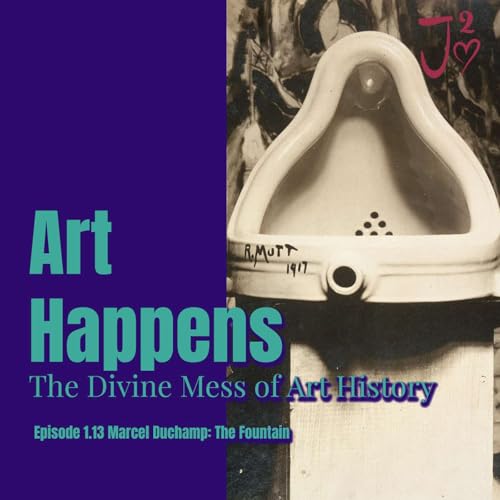
    Imagine walking into a gallery in 1917 and seeing… a urinal. Not in a restroom. Not in a hardware store. In the sacred, echoing temple of “taste.” The label reads: The Fountain. The artist: R. Mutt. And suddenly the art world makes that same sound you make when you bite into something that should not be crunchy.


    In this episode of Art Happens: The Divine Mess of Art History (presented by J-Squared Atelier), host James William Moore dives into Marcel Duchamp’s Fountain—the artwork that didn’t just start arguments… it industrialized them.


    Duchamp’s prank wasn’t really a prank. It was a trap: a philosophical tripwire that exposes how art is shaped by context, permission, and power. Because if a show claims “no jury, no gatekeeping,” why does the moment a porcelain urinal appears… a bouncer suddenly materialize?


    We unpack the birth of the readymade, the meaning behind the pseudonym R. Mutt, and the deliciously inconvenient truth that the “artwork” isn’t only the object—it’s the decision, the framing, and the argument it produces. Along the way, we follow the ripple effect across Dada, conceptual art, performance, installation, and basically the entire contemporary art world.


    And by the end, you’ll be left with one uncomfortable, beautiful question:

    If the world is full of frames… who controls the frame controls the meaning.

    J-Squared Atelier, LLC
    for the love of art

    Disclaimer: This post contains affiliate links. If you make a purchase, I may receive a commission at no extra cost to you.

    Send us a text


    Disclaimer: This post contains affiliate links. If you make a purchase, I may receive a commission at no extra cost to you.

    Follow & Subscribe to Art Happens
    Stay inspired with new episodes every week! Don’t miss out on deep conversations with artists, curators, and creators exploring the vibrant world of contemporary art.

    Connect with Us:

    J-Squared Aterlier (J2Atelier)

    🌐 Website: J2 Atelier
    📸 Instagram: @J2Atelier
    James William Moore
    🌐 Website: James William Moore
    📸 Instagram: @the_jwmartist

    Leave a Review:
    Love what you hear? Help us grow by leaving a review on your favorite podcast platform! Your feedback keeps us inspired. 🎙️☕

    Show More Show Less
    11 mins
  • Frida Kahlo: The Two Fridas
    Feb 16 2026

    In this Masterpiece Moment, we step into the storm-lit space of Frida Kahlo’s The Two Fridas (1939)—a double self-portrait painted in the emotional aftermath of her divorce from Diego Rivera. Two nearly identical Fridas sit hand-in-hand beneath a heavy sky, dressed in opposing identities: European white lace on one side, Tehuana tradition on the other. Their hearts are exposed. A single vein connects them. And one of them is bleeding.

    This episode is an intimate, lyrical close-look at how Kahlo turns the body into biography—where heartbreak isn’t metaphor, it’s anatomy. We trace the painting’s visual logic: the portrait of Rivera, the medical clamp, the stained dress, the shared artery that feels like the last thread of love. Along the way, we unpack duality as lived experience—heritage, belonging, rejection, survival—and why Kahlo refused to be boxed in as a Surrealist when she insisted she was painting her reality.

    With heartbeat sound cues, rustling fabric, and a faint guitar underscoring the tension, this is a quiet, emotional witness to a painting that doesn’t “resolve.” It simply tells the truth: sometimes you are more than one self at the same time—and sometimes the bravest thing you can do is keep holding your own hand.

    Final Stroke: “Frida didn’t paint portraits — she painted her own truth.”

    J-Squared Atelier, LLC
    for the love of art

    Disclaimer: This post contains affiliate links. If you make a purchase, I may receive a commission at no extra cost to you.

    Send us a text


    Disclaimer: This post contains affiliate links. If you make a purchase, I may receive a commission at no extra cost to you.

    Follow & Subscribe to Art Happens
    Stay inspired with new episodes every week! Don’t miss out on deep conversations with artists, curators, and creators exploring the vibrant world of contemporary art.

    Connect with Us:

    J-Squared Aterlier (J2Atelier)

    🌐 Website: J2 Atelier
    📸 Instagram: @J2Atelier
    James William Moore
    🌐 Website: James William Moore
    📸 Instagram: @the_jwmartist

    Leave a Review:
    Love what you hear? Help us grow by leaving a review on your favorite podcast platform! Your feedback keeps us inspired. 🎙️☕

    Show More Show Less
    11 mins
  • Pop Art
    Feb 9 2026

    Pop Art is everywhere—on soup cans, comic panels, billboards, and celebrity faces. But this episode isn’t asking, “Is it beautiful?” It’s asking, “Who sold this to you… and why did you buy it?”

    In this episode of Art Happens: The Divine Mess of Art History, host James William Moore dives into the movement that dragged advertising, packaging, and fame onto the gallery wall—and made it impossible to unsee the machinery underneath. From Andy Warhol’s silkscreen assembly line of Campbell’s Soup and Marilyn, to Roy Lichtenstein’s Ben-Day dot melodramas that turn emotion into a product, Pop Art reveals a culture built on repetition, recognition, and desire.

    We also rewind to British Pop’s sharper, more ironic edge with Richard Hamilton’s iconic collage—Just what is it that makes today’s homes so different, so appealing?—a showroom of modern life where everything is “new,” “improved,” and quietly selling you a dream.

    Because Pop Art doesn’t land cleanly as celebration or critique. It’s complicit—and that’s the point. It’s a mirror. And the mirror is… extremely high definition.

    Final Stroke: Pop Art didn’t celebrate fame — it exposed the factory behind it.

    J-Squared Atelier, LLC
    for the love of art

    Disclaimer: This post contains affiliate links. If you make a purchase, I may receive a commission at no extra cost to you.

    Send us a text


    Disclaimer: This post contains affiliate links. If you make a purchase, I may receive a commission at no extra cost to you.

    Follow & Subscribe to Art Happens
    Stay inspired with new episodes every week! Don’t miss out on deep conversations with artists, curators, and creators exploring the vibrant world of contemporary art.

    Connect with Us:

    J-Squared Aterlier (J2Atelier)

    🌐 Website: J2 Atelier
    📸 Instagram: @J2Atelier
    James William Moore
    🌐 Website: James William Moore
    📸 Instagram: @the_jwmartist

    Leave a Review:
    Love what you hear? Help us grow by leaving a review on your favorite podcast platform! Your feedback keeps us inspired. 🎙️☕

    Show More Show Less
    11 mins
  • David Hockney: Pools, Polaroids, & iPads
    Feb 2 2026

    A splash is the fastest thing in the world—blink-and-it’s-gone. So how did David Hockney turn a half-second event into an entire philosophy of looking?


    In this episode of Art Happens: The Divine Mess of Art History, James dives into Hockney’s lifelong obsession with vision: not “How accurate is it?” but “How does seeing feel?” We start with “A Bigger Splash” (1967)—that calm modern pool interrupted by a frozen white explosion—now in Tate Britain. From there, we jump to Hockney’s 1980s Polaroid “joiners,” where a scene becomes a stitched-together experience—more like memory than a single authoritative snapshot.


    Then we zoom out to Hockney’s bigger provocation: perspective isn’t a law, it’s a habit. In Secret Knowledge: Rediscovering the Lost Techniques of the Old Masters, he argues that optics may have shaped how Old Masters built realism—and whether you buy every claim or not, the creative takeaway is liberating: if the tool stops helping you see, change the tool.


    Finally, Hockney picks up the iPhone and iPad and does what he’s always done—makes new tech feel handmade. We visit Fleurs fraîches in Paris at Fondation Pierre Bergé – Yves Saint Laurent (Oct 20, 2010–Jan 30, 2011): glowing digital flowers presented in their original device format, like pocket-sized stained glass.


    If you’ve ever worried about doing it the “right” way, this is your permission slip to ask a better question: Is this helping me see?

    And for more creative fuel, hop over to Lattes & Art after this episode.


    J-Squared Atelier, LLC
    for the love of art

    Disclaimer: This post contains affiliate links. If you make a purchase, I may receive a commission at no extra cost to you.

    Send us a text


    Disclaimer: This post contains affiliate links. If you make a purchase, I may receive a commission at no extra cost to you.

    Follow & Subscribe to Art Happens
    Stay inspired with new episodes every week! Don’t miss out on deep conversations with artists, curators, and creators exploring the vibrant world of contemporary art.

    Connect with Us:

    J-Squared Aterlier (J2Atelier)

    🌐 Website: J2 Atelier
    📸 Instagram: @J2Atelier
    James William Moore
    🌐 Website: James William Moore
    📸 Instagram: @the_jwmartist

    Leave a Review:
    Love what you hear? Help us grow by leaving a review on your favorite podcast platform! Your feedback keeps us inspired. 🎙️☕

    Show More Show Less
    7 mins
  • When Art Gets Political (audio)
    Jan 26 2026

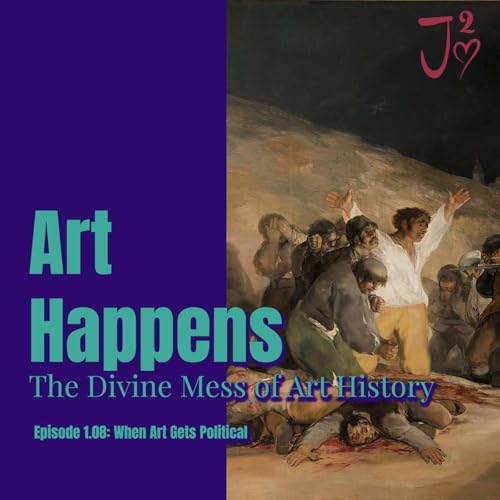
    In this episode of Art Happens: The Divine Mess of Art History (presented by J-Squared Atelier), host James William Moore pulls back the curtain on the myth that art is “above politics.” Because history doesn’t back that up—when the world catches fire, artists don’t always whisper. Sometimes they make images so loud you can’t unsee them.


    In Behind the Brush: When Art Gets Political, we follow political art as witness, protest, and pressure—starting with Francisco Goya’s The Third of May 1808, a painting that refuses to romanticize war and instead stares brutality straight in the face. Then we jump to the 1980s, where the Guerrilla Girls weaponize anonymity, humor, and hard data to expose inequality inside the museum itself—turning visibility into a battleground.


    This episode breaks down what makes art political (hint: it’s not the style—it’s the intent), why institutions are never truly “neutral,” and how images can outlive their moment to ensure future generations can’t claim, “I didn’t know.”


    Because the point isn’t to be approved.

    The point is to be seen.

    J-Squared Atelier, LLC
    for the love of art

    Disclaimer: This post contains affiliate links. If you make a purchase, I may receive a commission at no extra cost to you.

    Send us a text


    Disclaimer: This post contains affiliate links. If you make a purchase, I may receive a commission at no extra cost to you.

    Follow & Subscribe to Art Happens
    Stay inspired with new episodes every week! Don’t miss out on deep conversations with artists, curators, and creators exploring the vibrant world of contemporary art.

    Connect with Us:

    J-Squared Aterlier (J2Atelier)

    🌐 Website: J2 Atelier
    📸 Instagram: @J2Atelier
    James William Moore
    🌐 Website: James William Moore
    📸 Instagram: @the_jwmartist

    Leave a Review:
    Love what you hear? Help us grow by leaving a review on your favorite podcast platform! Your feedback keeps us inspired. 🎙️☕

    Show More Show Less
    10 mins
  • The Arnolfini Portrait: Secrets in the Mirror
    Jan 19 2026

    A portrait that refuses to sit still.


    In this episode of Art Happens: The Divine Mess of Art History, host James William Moore opens the case file on Jan van Eyck’s Arnolfini Portrait (1434)—a painting where the real plot twist isn’t the couple… it’s the mirror. A convex glass “eye” on the back wall reflects two unexpected figures in the doorway, pulling us into the room and turning a simple portrait into a staged moment, a legal-looking document, and a psychological trap.


    We examine the painting’s most suspicious “clues”—the single burning candle, abandoned shoes, watchful dog, expensive oranges, prayer beads, and the mirror ringed with tiny Passion scenes—then follow the scholarly debate: wedding scene, betrothal, memorial, status flex… or a deliberate mash-up designed to multiply meaning.


    Van Eyck’s famous inscription—“Jan van Eyck was here”—lands less like a signature and more like witness testimony. And once you notice that, the painting stops being something you look at… and becomes something that looks back.

    J-Squared Atelier, LLC
    for the love of art

    Disclaimer: This post contains affiliate links. If you make a purchase, I may receive a commission at no extra cost to you.

    Send us a text


    Disclaimer: This post contains affiliate links. If you make a purchase, I may receive a commission at no extra cost to you.

    Follow & Subscribe to Art Happens
    Stay inspired with new episodes every week! Don’t miss out on deep conversations with artists, curators, and creators exploring the vibrant world of contemporary art.

    Connect with Us:

    J-Squared Aterlier (J2Atelier)

    🌐 Website: J2 Atelier
    📸 Instagram: @J2Atelier
    James William Moore
    🌐 Website: James William Moore
    📸 Instagram: @the_jwmartist

    Leave a Review:
    Love what you hear? Help us grow by leaving a review on your favorite podcast platform! Your feedback keeps us inspired. 🎙️☕

    Show More Show Less
    10 mins
  • Surrealism: Dreams, Freud, and Lobsters on Telephones
    Jan 12 2026

    In this episode, we drop straight into Surrealism—where logic takes a back seat and the subconscious grabs the wheel. If you’ve ever seen a lobster perched on a telephone and thought, “Yep… that tracks,” you already understand the vibe.


    Born in the 1920s after World War I, Surrealism wasn’t “random for random’s sake”—it was a rebellion against the idea that reason alone could explain (or prevent) catastrophe. Guided by André Breton’s manifesto and supercharged by Sigmund Freud’s dream theories, Surrealists chased the hidden forces underneath everyday life: desire, fear, memory, obsession—everything we pretend isn’t running the show.


    We break down the movement’s signature tactics—automatism, chance-based games like Exquisite Corpse, and juxtaposition—then step into the worlds of three iconic Surrealists: Salvador Dalí, with melting clocks and the famously unsettling Lobster Telephone; René Magritte, quietly sabotaging reality with razor-clean images and mind-bending statements; and Leonora Carrington, expanding Surrealism into myth, transformation, and a symbolic language that refuses to shrink women’s inner worlds into someone else’s fantasy.


    Surrealism endures because it tells a truth we don’t love admitting: we’re not as rational as we think. This episode is your invitation to let the weird out—not to escape reality, but to expose what it’s hiding.


    “They painted dreams not to escape reality — but to expose it.”

    If Surrealism lit a spark, pour another shot with Lattes & Art—where we talk to artists about how the magic actually gets made.

    Lattes & Art Podcast

    J-Squared Atelier, LLC
    for the love of art

    Disclaimer: This post contains affiliate links. If you make a purchase, I may receive a commission at no extra cost to you.

    Send us a text


    Disclaimer: This post contains affiliate links. If you make a purchase, I may receive a commission at no extra cost to you.

    Follow & Subscribe to Art Happens
    Stay inspired with new episodes every week! Don’t miss out on deep conversations with artists, curators, and creators exploring the vibrant world of contemporary art.

    Connect with Us:

    J-Squared Aterlier (J2Atelier)

    🌐 Website: J2 Atelier
    📸 Instagram: @J2Atelier
    James William Moore
    🌐 Website: James William Moore
    📸 Instagram: @the_jwmartist

    Leave a Review:
    Love what you hear? Help us grow by leaving a review on your favorite podcast platform! Your feedback keeps us inspired. 🎙️☕

    Show More Show Less
    9 mins