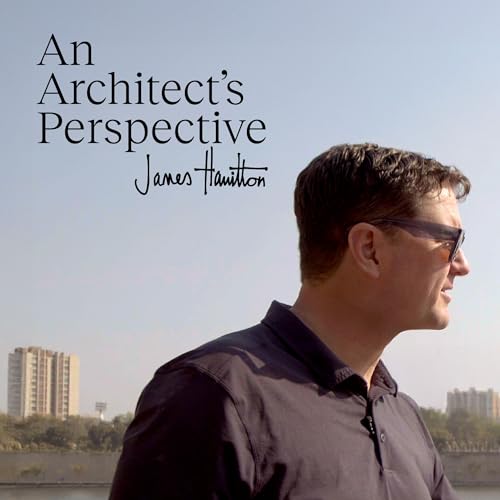
An Architect's Perspective cover art

An Architect's Perspective

An Architect's Perspective

By: James Hamilton Architects
Listen for free

About this listen

An Architect's PerspectiveCopyright 2026 James Hamilton Architects Art Social Sciences Travel Writing & Commentary World
Episodes
  • What does it mean to build with humility?
    Apr 28 2026

    In this episode, I sit down with Neelkanth Chhaya, architect and academic, to talk about the Gandhi Memorial Museum - and how Charles Correa embedded Gandhi’s values into its very form.

    We explore how the building reflects humility through materials, structure, and sequencing - and how it echoes the Indian tradition of open courtyards and sky as a central space. Neelkanth shares both personal insights and a grounded analysis of what makes the Ashram feel so profound.

    Key Topics:

    ● Gandhi’s philosophy translated into built form

    ● Open courtyards and sky as compositional tools

    ● Material humility and ethical restraint

    ● How Correa’s architecture resists spectacle

    ● The museum as a site of memory and daily life


    Guest Info:

    Neelkanth Chhaya is a prominent Indian architect and former Dean of Architecture at CEPT University. His work and teaching focus on vernacular wisdom, cultural continuity, and ethics in architecture.


    Quotes from the Episode:

    On humility in design: "There are no grand gestures here. Just space, light, and a deep sense of purpose."

    On the building’s presence: "It doesn’t speak loudly. It speaks with moral clarity - like Gandhi himself."

    On learning from tradition: "Architecture isn’t about invention. It’s about listening to what’s already there."


    Website: www.jameshamiltonarchitects.com

    Instagram: @jameshamiltonarchitects

    Production: OneFinePlay.com

    Show More Show Less
    26 mins
  • Charles Correa and the birth of tropical modernism
    Apr 21 2026

    I visit Ahmedabad to explore the life and work of Charles Correa, a pioneering voice in post-independence Indian architecture. We look at how Correa translated modernist ideas into a distinctly Indian language — rooted in climate, tradition, and civic purpose.

    From the Gandhi Memorial Museum to his urban design legacy, Correa’s work reveals how architecture can be both modern and deeply local. This is an episode about climate, ethics, and the power of spatial restraint.

    Host Info

    James Hamilton, founder of James Hamilton Architects. Trained at Cambridge and Harvard, James brings a practitioner’s eye to every episode - offering grounded insight, clear storytelling, and a deep respect for the buildings under discussion.


    Key Topics:

    ● The philosophical roots of Correa’s work

    ● What defines Tropical Modernism beyond aesthetics

    ● Lessons from the Gandhi Ashram and its quiet symbolism

    ● How Correa positioned architecture as a tool for democracy

    ● The tension between monumentality and humility in his work


    Quotes from the Episode:

    On Correa’s ethics: "He never built to be noticed. He built to be useful — to serve."

    On Gandhi’s influence: "This is modernism as principle. Light, silence, and conviction."

    On architecture and identity: "What he gave India wasn’t a style. It was a way to build without forgetting where you are."


    Website: www.jameshamiltonarchitects.com

    Instagram: @jameshamiltonarchitects

    Production: OneFinePlay.com

    Show More Show Less
    16 mins
  • The woman who almost got written out of architectural history
    Apr 14 2026

    I sit down with Spanish architect and academic Carmen Espegel to explore the life and work of Eileen Gray, with a particular focus on the complexities of authorship, identity, and gender within architectural history.

    Carmen offers an incisive reading of Villa E-1027 not just as a physical space, but as an architectural manifesto — one where form, emotion, and politics are deeply intertwined. We discuss Gray’s design intelligence, her artistic independence, and the cultural dynamics that led to her marginalisation for much of the 20th century.

    This is a conversation about recognition: how architecture is credited, who gets remembered, and how we begin to set the record straight.

    Key Topics:

    ● The originality of Eileen Gray’s architectural vision

    ● The politics of authorship and gender in modernism

    ● Carmen’s academic work on restoring Gray’s legacy

    ● How space and identity intersect in architectural history

    ● Villa E-1027 as a manifesto for modern domesticity


    Guest Info:

    Carmen Espegel is a practising architect and professor at ETSAM Madrid, whose work focuses on collective housing, gender studies, and the re-reading of modernist history through a critical feminist lens.


    Quotes from the Episode:

    On Gray’s authorship: "This house was not co-authored. Villa E-1027 was entirely Eileen Gray’s vision."

    On architecture and gender: "Architecture is never neutral. It reflects the hand and the gaze of its author — and historically, that gaze has been overwhelmingly male."

    On setting the record straight: "We don’t need to invent heroes. We just need to tell the truth about the ones we ignored."


    Website: www.jameshamiltonarchitects.com

    Instagram: @jameshamiltonarchitects

    Production: OneFinePlay.com

    Show More Show Less
    42 mins
No reviews yet
In the spirit of reconciliation, Audible acknowledges the Traditional Custodians of country throughout Australia and their connections to land, sea and community. We pay our respect to their elders past and present and extend that respect to all Aboriginal and Torres Strait Islander peoples today.