Episodes

  • the story of the league of revolutionary Black workers
    Nov 6 2025
    The struggle of the LRBW was centered on the political development of Black workers inside the development of global capitalism in the United States and within a leading sector of capitalist production in the early and mid-twentieth century, which was then, the auto-industry. This socio-economic location molded a section of Black workers into working-class revolutionaries. The historical moment that shaped LRBW was located at the nexus of the post-World War II capitalist expansion and the beginning of capitalist globalization, rooted in the new technical evolution of the forces of production: a turn to industrial automation of the workplace. The very process of their pedagogy of revolution, was their study of theory and what is produced when this theory is applied to real-world experiences, which shaped their practice into workers power. To study the intellectual processes of the LRBW in the context of a developing global capitalism, as they are identifying a pedagogy of revolution is an essential frame of reference that can offer contemporary working-class movements a guide of action. Meaning, the point of discovering the intellectual processes (theoretical development) of the LRBW opens space for us to understand the processes of how [and in what ways] they were intent to developing a worker’s movement. As we pay attention to their ability to identify and name the world around them and the steps they took to then engage their realities in a larger context is an important point of entry to building working class unity. This development, seen as a process, serves to situate them historically, while also guiding us to identify what to extract from their practice that can be applied to the [static] and evolving conditions workers find themselves in today. What questions were left for us to take up, what are the contours of their thought and practice that be extended and expanded? What are the similarities and dissimilarities in the conditions that workers find themselves across sectors? And What is to be done? The LRBW is an interesting and complicated expression of the relationship between Black workers in Detroit and the global capitalist system. It was a struggle between autoworkers, the union, and the automobile industry. It encompassed the struggles and contradictions between the workers and the bosses, as well as between workers and the union of which they were a part. This period exposed the glaring internal and external contradictions of racism within and around the workers movement, historically and in that moment. Yet, the LRBW was able to develop a process of struggle combining both theory and practice. Today, we explore the story of the League of Revolutionary Black Workers with Jerome Scott and walda katz-fishman, authors of Motown and the Making of Working-Class Revolutionaries: The story of the League of Revolutionary Black Workers. walda katz-fishman is a scholar activist and professor of sociology at Howard University. A founding member and former board chair of Project South: Institute for the Elimination of Poverty & Genocide, she is a contributing author or editor of popular education toolkits and books, including The United States Social Forum: Perspectives of a Movement and The Roots of Terror, among others. Jerome Scott is a former autoworker, labor organizer in Detroit auto plants, and member of the League of Revolutionary Black Workers. The founding director of Project South: Institute for the Elimination of Poverty & Genocide, he is a contributing author or editor of popular education toolkits and books, including The United States Social Forum: Perspectives of a Movement and The Roots of Terror, among others, as well.
    Show More Show Less
    1 hr and 19 mins
  • Pt. III | Fanon & the decolonial imperative Pt II
    Oct 16 2025
    This cannot be repeated enough, as the dialectical relationship between anti-colonial praxis and the colonial logic of capital becomes ever more fascistic, we must be ever more clear on how violence is necessary to distort and make imperceptible … the possibilities of a future. Simply put, the ever more overt application of violence as a means to maintain oppressive social structures that guide the formation of consciousness, the more it arrests our ability to engage with ‘the beyond struggle’, beyond the now moment. The vast majority of us are caught within the cyclical patterns of manufactured realities of capitalist imagination. Capital needs the literal life-[blood] of those who are constituent parts of these manufactured realities; realities captured in incorrect notions of the inevitability of conflict, induced resource scarcity, the logic of private property, aggressive individualism, and the insolvability of the climate crisis. We are expected to spend majority of our time and energy surviving the daily crucible designed by capital. Ok, I can go on … but let’s not get lost in the rhetoric and now that you are probably equally lost in this long opening thought, we should, at this point, circle back to what I suggest cannot “be repeated enough” …: And that is…: Colonial violence and colonial discourse are at the heart of Western modernity. They are constituent features of Western European modern ontology, knowledge production and distribution, and sociopolitical thought and economic practice codified in the 14th century. The use of ontology is another way of saying, the study of the reality of ‘being’; in simpler terms, what makes a thing, a thing. It is clear [or at least it should be] what and who the ‘monsters’ are, so it is not necessarily novel in itself. But it still bears repeating. To add more clarity, adding more perspective, hoping to make more sense, what I am suggesting here is that we are living in the 21st century with 14th century conceptualizations of reality produced from the subsequent violence inherent in the contradictions built over centuries through capitalist logic … all interdependent on supremacist notions of a constructed whiteness. A world where false notions of reality are attached to color [and class, culture, gender, and formations of consciousness]. This violence we are facing is what Fanon was unpacking. Structures of violence is what Fanon was intent to deconstruct, and one of his important contributions to a: decolonial imperative. Therefore, it is, here, within the material and nonmaterial parameters of violence that we can explore and examine Fanon’s corpus to construct frameworks of analysis. Though we should never neatly apply, nor seek to use linear logic, without taking into consideration the historical evolution in the material [and nonmaterial] conditions over time and space, Fanon’s decolonial imperative stands as an important point of entry to understanding the current historical moment. Nicholas Mwangi is a writer, organiser, and member of the Ukombozi Library in Kenya. He contributes regularly to People’s Dispatch. Nicholas has co-edited Breaking the Silence on NGOs in Africa and Kenyan Organic Intellectuals Reflect on the Legacy of Pio Gama Pinto. He is currently working on a forthcoming book titled The Crisis of Capitalism in Africa with the Organic Intellectuals Network in Kenya. Waringa Wahome is an organizer, political theorist, lawyer and also the coordinator of the legal empowerment hub at Mathare Social Justice Centre (MSJC). Waringa Wahome is a lawyer at Waringa Wahome & CO Advocates as well as member of the Kenyan Organic Intellectuals Network. Please forgive the quality of audio in certain parts of our conversation, the ideas and voices are essential and vital, so we choose to share with you. Not to mention one of our comrades/colleagues was outside of Nairobi at the time of the recording.
    Show More Show Less
    1 hr and 10 mins
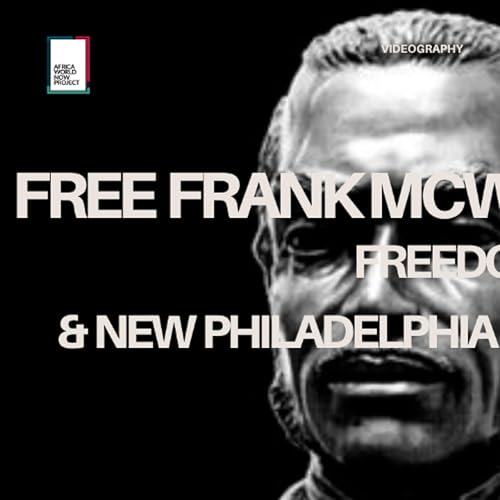
  • Free Frank McWorter, Freedom Seekers & New Philadelphia w/ Abdul Alkalimat
    Oct 6 2025
    It was 1839 and Frank and Lucy McWorter were getting married for the second time. The wedding was a reaffirmation of their love and a recommitment to all they’d built together. They had come to Illinois with four of their children and built a farm of golden wheat fields and towering stalks of corn. Though there was plenty of symbolism in their renewed vows, the McWorters remarried for a more pragmatic reason — they had been enslaved in Kentucky when they first committed to each other, but such marriages were rarely respected by U. S. courts. They had still been enslaved when they started their family, but Frank quickly began to plot their way to freedom. Frank’s owner and father, George McWhorter, trusted Frank to manage his farm and gave him leeway to earn money doing extra work. So, Frank learned how to mine and manufacture his own saltpeter, a necessary component in gunpowder. He used the money he earned selling saltpeter to buy freedom for him and his family. He began freeing his family in 1817. By this time Lucy and Frank were raising Judah, Frank Jr., Sarah, and Solomon, but Frank first bought Lucy’s freedom. She was pregnant at the time, so not only did he free Lucy, but his purchase also ensured that their son, Squire, would be born free. In 1819, he bought his own freedom, becoming Free Frank, and later changed his name to Frank McWorter — dropping the “h” from his former enslaver’s last name. Frank and Lucy, along with several children they had managed to free, moved west to Illinois in 1830 to the land that would become their farm in Pike County. He traded his saltpeter operation for Frank Jr.’s freedom after Junior had fled his enslavement to Canada. Frank made trips back to Kentucky to purchase the freedom of each of his three remaining enslaved children and at least one grandchild. On each trip, Frank McWorter had to make the gut-wrenching decision of which child he would free and which he would leave behind to endure slavery. The McWorters spent $14,000 to free their family. Adjusted for inflation, that is nearly $500,000 in 2023. Frank McWorter began his farm with 160 acres and eventually increased those holdings to over 500 acres. Along with his corn and wheat, he grew oats and raised cattle, hogs, and horses. In 1836, Frank divided forty-two acres of his land into town lots and founded the town of New Philadelphia. The town, the first officially founded by African Americans, prospered with both Black and white residents and formed part of a larger rural community of farmers. The town’s very existence as a biracial community in a state with repressive Black Codes on the books until 1865 was a defiant statement against racial inequality. New Philadelphia was an audacious project, a prelude to Black communities like Nicodemus, Kansas; DeWitty, Nebraska; Blackdom, New Mexico; and Boley, Oklahoma, founded in the West after the Civil War. For more: New Philadelphia, Gerald A. McWorter and Kate Williams-McWorter Sign the petition: https://chng.it/q5Q5XS9cFd
    Show More Show Less
    55 mins
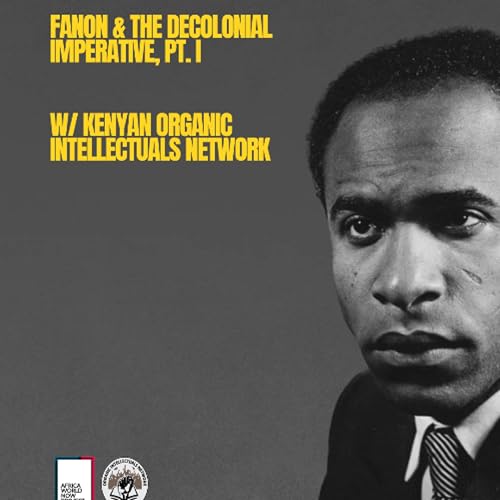
  • Pt. III | Fanon & the decolonial imperative Pt. I
    Sep 26 2025
    Colonial violence and colonial discourse are at the heart of Western modernity. They are constituent features of Western European modern ontology, knowledge production and distribution, and sociopolitical thought and economic practice codified in the 14th century. The use of ontology is another way of saying, the study of the reality of ‘being’; in simpler terms, what makes a thing, a thing. It is clear [or at least it should be] what and who the ‘monsters’ are, so it is not necessarily novel in itself. But it still bears repeating. To add more clarity, adding more perspective, hoping to make more sense, what I am suggesting here is that we are living in the 21st century with 14th century conceptualizations of reality produced from the subsequent violence inherent in the contradictions built over centuries through capitalist logic … all interdependent on supremacist notions of a constructed whiteness. A world where false notions of reality are attached to color [and class, culture, gender, and formations of consciousness]. This violence we are facing is what Fanon was unpacking. Structures of violence is what Fanon was intent to deconstruct, and one of his important contributions to a: decolonial imperative. Therefore, it is, here, within the material and nonmaterial parameters of violence that we can explore and examine Fanon’s corpus to construct frameworks of analysis. Though we should never neatly apply, nor seek to use linear logic, without taking into consideration the historical evolution in the material [and nonmaterial] conditions over time and space, Fanon’s decolonial imperative stands as an important point of entry to understanding the current historical moment. Nicholas Mwangi is a writer, organiser, and member of the Ukombozi Library in Kenya. He contributes regularly to People’s Dispatch. Nicholas has co-edited Breaking the Silence on NGOs in Africa and Kenyan Organic Intellectuals Reflect on the Legacy of Pio Gama Pinto. He is currently working on a forthcoming book titled The Crisis of Capitalism in Africa with the Organic Intellectuals Network in Kenya. Waringa Wahome is an organizer, political theorist, lawyer and also the coordinator of the legal empowerment hub at Mathare Social Justice Centre (MSJC). Waringa Wahome is a lawyer at Waringa Wahome & CO Advocates as well as member of the Kenyan Organic Intellectuals Network.
    Show More Show Less
    55 mins
  • Abolition, Labor & the Palestine Question
    Sep 24 2025
    Destiny Blackwell, is a labor organizer in North Carolina focusing on the interaction between the praxis of abolition, labor and the Palestine question. According to ‘The Labor Movement is Key for Palestinian Liberation’, “before Israel launched its offensive on Gaza in October, the U.S. labor movement was experiencing an important resurgence. This resurgence challenged the neoliberal offensive that, over the decades, has eaten away at historical benefits won by the labor movement of the 1930s, like pensions, a system that ensured wages kept up with inflation, and even the right to unionize. From the entertainment industry, to healthcare, logistics, and manufacturing, labor has been fighting hard against concessionary contracts. The most important expression of this insurgent labor movement was the United Auto Workers’ (UAW) strike across the Big Three; GM, Ford, and Stellantis. The strike of a workforce in an industry that is responsible for three percent of U.S. GDP proved to be so powerful that both President Biden and former president Donald Trump had to address it. On the first day of the strike, every major news publication, station, and broadcast featured the strike. We aired a program on this, search the archive for this title: ’the Black Worker, the strike, & UAW’ According to, ‘The Labor Movement's History of Backing Israel—and the Changing Climate Amid the War on Gaza’, as the Israeli government continues to carry out what experts describe as a genocide in Gaza — with full political, financial, and military backing from the United States — millions of people around the world are mobilizing to demand an immediate cease-fire and a free Palestine. Workers in the United States, including numerous rank-and-file unionists and local union representatives, are similarly speaking out against the ongoing siege and bombardment of Gaza and pledging their solidarity with Palestinian trade unions, which have called on organized labor to refuse to manufacture or transport weapons destined for Israel. While rank and file labor leaders in various countries have joined in these calls, top US labor officials — especially those in the AFL-CIO, the country’s top labor federation — have mostly refrained from supporting a cease-fire, with a few making tepid statements about the ​“humanitarian crisis” in Gaza. After a central labor council in Olympia, Washington, unanimously passed a cease-fire and Palestine solidarity resolution a few weeks ago, the national AFL-CIO even stepped in to quash the measure. Today, we attempt to add more clarity to the Palestine question and the disconnects between rank and file and union leadership.
    Show More Show Less
    48 mins
  • Pt. II | Patrice Lumumba's Pan Africanism w/ the Kenyan Organic Intellectual Network
    Jul 12 2025
    This year represents an important historical conjuncture that has very important implications for our contemporary moment of crisis, yet extremely instructive in how we can move toward a different future. It is the 100th year recognition of the birth of Malik El Shabazz [aka Malcolm X] as well as Frantz Fanon, Patrice Lumumba, Robert F. Williams, and Medgar Evers. There are, have been, and will be an assortment of panels, programs, conferences, talks, and colloquium that explore and contextualize them, individually, and together. What we intend to offer is an identification of the continuities and discontinuities with the conditions and structures that produced the thought and practice of this group, not intended to isolate them for the many others, but to provide a lens to telescope up, down, above, and under the temporality of human geography, paying acute attention to how people resist in the face oppressive forces. Simply stated, we intend to connect the dots across time and space, attempting to read deeply the instructive details of how to construct a new society, a global society that undergirds these and other people’s thought and practice who resist the backwardness of capital, no matter the cost. With this, today, in this Part II of our collaboration with the Kenyan Organic Intellectuals Network, we explore Lumumba’s Pan Africanism. In this session, we intentionally examine the Pan Africanism of Patrice Lumumba, paying attention to role and importance of the Congo in African liberation struggles asking: • What strains of Lumumba’s thought are important to the current struggles, globally? • Why is the Congo region important in Africana liberation struggle? • What is the connection between ecological struggles and the Congo? We are, ultimately, for the entire series, in general, this session, in particular, interested in thinking collectively about: • What are some of the ideas that each of these figures offer for expanding and informing our practice today? And • Most importantly, how do we understand these figures in the long struggle for liberation in the African/a world? Joining us for this conversation are: Gathanga Ndungu is a community organiser with Mathare Social Justice Centre which is under the Social Justice Centres’ Working Group. He is also part of the Revolutionary Social League brigade that organizes political education in different political cells in the respective centres in Nairobi. As well as the Organic Intellectuals Network. Okakah Onyango is a member of the Revolutionary Socialist League, Organic Intellectuals Network and Social Justice Movement. He is a dedicated tech-driven community organizer, blending roles of revolutionary intellectualism and communications strategist. Gerald Kamau is an ecological justice activist based at Kayole Community Justice Centre as well as Organic Intellectuals Network.
    Show More Show Less
    1 hr and 37 mins
  • Pt. I | on the praxis of Malik El Shabazz w/ the Kenyan Organic Intellectual Network
    Jun 19 2025
    This year represents an important historical conjuncture that has very important implications for our contemporary moment of crisis, yet extremely instructive of how we can move toward a different future. It is the 100th year recognition of the birth of El Hajj Malik El Shabazz [aka Malcolm X] as well as Frantz Fanon, Patrice Lumumba, and Medgar Evers. There are and have been, thus far, an assortment of panels, programs, conferences, talks, and consortium on the life of Malcolm. All of them are important in one way or another. We are not here to critique, diminish, distort any of them as they all offer something important, from entry points to study the life of Malcolm to conversations of political and ideological trajectory of Malcolm’s work with those who worked and knew him. What we intend to offer in this ocean of programs, talks, etc is an engagement with the political praxis of Malik El Shabazz, paying attention to the ways we can extend the work of Malik El Shabazz, asking: how are organizer-intellectuals in the long tradition of Malik El Shabazz and those who came before him - Hubert Harrison, Claudia Jones, Esther Jackson, Ella Baker, Vikki Garvin, Marvel Cooke, etc - are working at the contours of the collective work he [& they] left to be undertaken? Today, we hear a conversation on Malik El Shabazz, part of a collaboration between Africa World Now Project and the Kenyan Organic Intellectual Network, where we will intentionally think through the impact ofrevolutionary Kenya on El Hajj Malik El Shabazz’s thought and practice. Paying attention to Malik El Shabazz’s clarity on the role of revolutionary struggle as formulated through his relationship with revolutionaries in Kenya, specifically East Africa, more broadly etc … We explore how Malik Shabazz is part of a tradition of African revolutionary thought and practice, which informs us collectively. Mapping the influence of revolutionaries in Kenya … such as the Land and Freedom Army, Pio Gama Pinto, Odinga Odinga, Mohamed Babu, and others on Malcolm? And what strains of Malik El Shabazz’s thought and practice are important to the current struggle? Joining us for the Mailk El Shabazz session of the collaboration [The Impact and Legacies of El Hajj Malik El Shabazz, Frantz Fanon & Patrice Lumumba x 100] were: Gacheke Gachihi, Coordinator of Mathare Social Justice Centre (MSJC) and a member of the Social Justice Centres Working Group Steering Committee in Nairobi, Kenya. Coordinator of the Kenya Organic Intellectuals Network. He is also involved in regional social movements and politics. He researches and writes about police violence, criminalization of the poor, social justice and social struggles, amongst others. His articles and video interviews are published in the Review of African Political Economy (ROAPE), Africa Is a Country (AIAC), Daraja Press, Verso Books, and others. Mzalendo Wanjira Wanjiru is co-founder of Mathare Social Justice Center and a member of the social justice movement and organic intellectuals network. Maureen (Mo) Kasuku is a feminist organiser and digital rights advocate based in Kenya. Her work is a dynamic exploration of the crossroads between feminism and technology. With a keen eye on the intricate interplay of gender equality, social justice, and technological advancement in grassroots communities. She is a member of Ukombozi Library, Nairobi. And Cadre with the Revolutionary Socialist League. listen intently. think critically. act accordingly.
    Show More Show Less
    1 hr and 46 mins
  • resistance & resilience in Washington, DC a conversation w/ Maurice Jackson & Josh Myers
    Jun 11 2025
    Writing in ‘How music defines D.C.’s history of ‘resistance and resilience,’ according to historian Maurice Jackson’, Josh Myers, building on the thought of Fred Moten, opens with this: “the history of Blackness in D.C. is a testament to the fact that a sound can and did resist. Myers article is derived from a conversation he had with Maurice Jackson where they explored his work titled, Rhythms of Resistance and Resilience: How Black Washingtonians Used Music and Sports in the Fight for Equality. In it, Maurice Jackson explores what he calls “Great Black Music” and sports in both the history of Washington, DC and the larger history of opposition to racism. Rhythms of Resistance and Resilience is a portion of Jackson’s ongoing research into the people that have shaped Washington, D.C. And is a prequel to his larger work, Halfway to Freedom, forthcoming from Duke University Press. It is the research of research, the figurative rich soil that birthed this forthcoming work. Jackson opens Rhythms of Resistance and Resilience with this line: “The ideas for this book were polyrhythmic, describing many circular currents” [1]. Polyrhythmic, indeed. Africana histories are an ocean of experiences that flow continuously across the known and unknown temporal lines that connect human history. What also must be noted, is that it also takes one who is able to move up and down, in and out, above and below these rhythms, mapping, connecting, and reconnecting, unpacking, repacking the narratives, the experiences, the ideas, the words, the emotion in order that we can make sense of the past that has informed our present, yet open to the possibilities of the future. Maurice Jackson is clearly one of these memory keepers and story tellers. Today, you will hear the full conversation that informed Josh Myers article, ‘How music defines D.C.’s history of ‘resistance and resilience,’ according to historian Maurice Jackson’. This conversation is based on Maurice Jackson’s recently published, Rhythms of Resistance and Resilience: How Black Washingtonians Used Music and Sports in the Fight for Equality. Maurice Jackson is an Associate Professor who teaches in the History and African American Studies Departments and is an Affiliated Professor of Music (Jazz) at Georgetown University. Before coming to academia, he worked as a longshoreman, shipyard rigger, construction worker and community organizer. He is author of a range of peer-reviewed articles and book chapters as well as Let This Voice Be Heard: Anthony Benezet, Father of Atlantic Abolitionism; co-editor of African Americans and The Haitian Revolution: Selected Essays and Historical Documents; Quakers and their Allies in the Abolitionist Cause,1754-1808; and DC Jazz: Stories of Jazz Music in Washington, DC. He has lectured in France, Turkey, Italy, Puerto Rico, Qatar, served on Georgetown University Slavery Working Group, and is a 2009 inductee into the Washington, D.C. Hall of Fame. He was appointed the Inaugural Chair of the DC Commission on African American Affairs (2013-16) where he presented “An Analysis of African American Employment, Population & Housing Trends in Washington, D.C.” [2017]. He has completed Halfway to Freedom: The Struggles and Strivings of African American in Washington, DC to be released by Duke University Press soon. His next projects will be We Knew No Other Way: The Many-Sided Struggle for Freedom and Black Radicalism: A Very Short Introduction. Josh Myers, in addition to being part of the AWNP collective, is an Associate Professor of Africana Studies in the Department of Afro-American Studies at Howard University. A central thread that guides all of this work is an approach to knowledge that takes seriously that peoples of African descent possess a deep sense of reality, a thought tradition that more than merely interprets what is around us but can transform and renew these spaces we inhabit—a world we would like to fundamentally change.
    Show More Show Less
    53 mins