

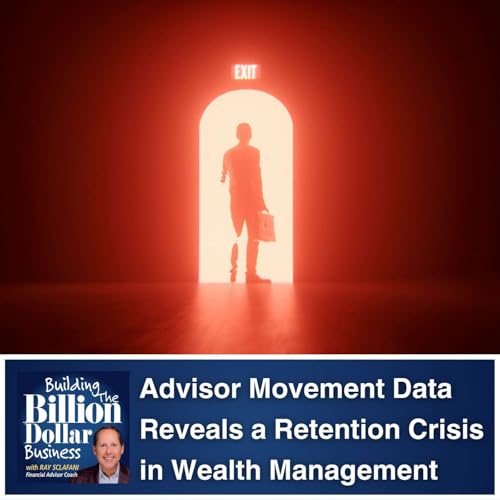
Advisor Movement Data Reveals a Retention Crisis in Wealth Management
Failed to add items
Add to basket failed.
Add to Wish List failed.
Remove from Wish List failed.
Follow podcast failed
Unfollow podcast failed

Advisor Movement Data Reveals a Retention Crisis in Wealth Management
-
Narrated by:
-
By:
About this listen
In this episode of Building the Billion Dollar Business, Ray Sclafani breaks down why advisor movement data should be treated as an early warning system and not industry gossip. While the number of advisors changing firms has remained steady, a more concerning trend is emerging: more advisors are leaving the profession entirely than entering it.
Ray explains that this shift isn’t driven by compensation alone. Instead, advisors are making intentional decisions based on leadership clarity, career path visibility, enterprise value, and control over their future. He outlines four critical decision points for firm leaders in 2026: rethinking retention beyond pay, recruiting for long-term fit, aligning custodian and broker-dealer relationships with strategic purpose, and putting leadership development front and center.
The episode challenges RIA and wealth management leaders to confront strategic ambiguity, leadership bottlenecks, and platform misalignment before retention issues show up in the P&L. The message is clear: firms that provide a credible future will keep top talent and those that don’t won’t.
Key Takeaways
- Advisor movement data is an early warning system that reveals where confidence in leadership and long-term value is eroding.
- More financial advisors are leaving the profession entirely than entering it, signaling a deeper industry challenge beyond firm-to-firm movement.
- The cost of replacing experienced advisors far exceeds the cost of retaining and developing existing talent.
- Firms overly dependent on a single founder or leader create bottlenecks that limit growth and retention.
- Clear leadership pathways and role clarity are essential to sustaining advisor confidence and long-term firm value.
Questions Financial Advisors Often Ask
Q: What does advisor movement data reveal about the wealth management industry?
A: Advisor movement data shows where advisors believe long-term value exists and serves as an early warning system for leadership, retention, and strategic alignment issues.
Q: Why are financial advisors leaving firms if compensation remains competitive?
A: Advisors leave when they lack leadership clarity, role clarity, and a credible long-term career path, not simply because of pay.
Q: Are more advisors leaving the profession entirely?
A: Yes. In 2025, more advisors exited the profession than entered it, indicating a growing talent decline in the industry.
Q: What is the real cost of losing experienced financial advisors?
A: Replacing senior advisors typically costs one-and-a-half to two times their total compensation when factoring in lost productivity, recruiting time, and client disruption.
Q: What role does leadership play in advisor retention?
A: Advisors closely evaluate leadership development, decision-making structure, and whether firms rely too heavily on a single founder or leader.
Q: Why do advisors say they are “voting with their feet”?
A: Advisors move firms to gain more control over their future, their clients, and their long-term career trajectory, not because they want more change.
Find Ray and the ClientWise Team on the ClientWise website or LinkedIn | Twitter | Instagram | Facebook | YouTube
To join one of the largest digital communities of financial advisors, visit exchange.clientwise.com.