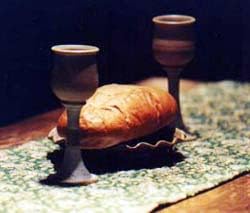
WELCOME Welcome to Above All Love. This is Simply Fellowship — the Good News, quietly told. This is a gentle space. No pressure, no performance. You don't have to have it together to be here. You don't have to be hopeful, or certain, or even feel particularly faithful today. You're welcome exactly as you are, wherever you are reading this. If you need to move, or step away and come back later — that's completely fine. There's no right way to be here. Just be here. HYMN We begin with a hymn verse. Read it slowly. You might want to sit with each line before moving on. Abide with me; fast falls the eventide; The darkness deepens; Lord, with me abide; When other helpers fail and comforts flee, Help of the helpless, oh, abide with me. — Henry Francis Lyte PRAYER Loving God, Thank you that you walk beside us even when we do not know it is you. Thank you that you ask us questions and listen to our answers, and do not tell us off for getting things wrong. Help us today to recognise you — in the breaking of bread, in the kindness of a stranger, in the moment when our hearts feel strangely warm. And may we find, when we look back, that you were with us all along. Amen. SCRIPTURE Our reading today is from Luke chapter twenty-four, verses thirteen to thirty-five, from the Easy English Bible. That same day, two of Jesus' followers were going to a village called Emmaus. It was about eleven kilometres from Jerusalem. They were talking together about everything that had happened. While they were talking, Jesus himself came near and walked along with them. But they did not recognise him. He asked them, "What are you talking about as you walk along?" They stopped. They looked very sad. One of them, whose name was Cleopas, answered, "Are you the only visitor to Jerusalem who does not know the things that happened there recently?" Jesus asked them, "What things?" They told him about Jesus of Nazareth. They told him that the chief priests and rulers had handed him over to be killed. They had hoped that he was the one who would set Israel free. But now it was the third day since these things had happened. Some women of their group had surprised them. The women went to the tomb early in the morning. They did not find his body there. They came and told them that they had seen angels, who said that Jesus was alive. Then Jesus explained to them what was said about himself in all the scriptures. When they came near to the village, Jesus acted as if he was going further on. But they asked him strongly to stay. "Stay with us," they said. "It is nearly evening and the day is almost over." So he went in to stay with them. While he was at the table with them, he took the bread. He gave thanks for it. He broke it and gave it to them. Then their eyes were opened and they recognised him. And he disappeared from their sight. They said to each other, "Our hearts were burning inside us while he talked with us on the road." DEVOTION They are walking away. That is the first thing to notice. Not towards Jerusalem, where the other disciples are gathered. Away from it. Away from the empty tomb, away from the rumours, away from the women's astonishing report that he was alive. They have heard all of it and it has not been enough. They are going home — or somewhere that feels more like home than a city full of confusion and grief. It is hard to blame them. Three days earlier, everything they had hoped for had been nailed to a cross and buried. They had believed he was the one. The one who would change things. The one who would make it all come right. And he hadn't — or so it seemed. Now there was just the long road, the sore feet, and the words they kept turning over between them, trying to make sense of something that refused to make sense. And Jesus falls into step beside them. He doesn't announce himself. He doesn't say: it is I, do not be afraid. He just walks with them, at their pace, in the direction they are going. And then he asks a question — one of the most tender questions in all of scripture. What are you talking about? He knows. Of course he knows. But he asks anyway. He lets them tell it. He listens to the whole sad unravelling of their hopes. He does not interrupt or correct or rush them to the good part. He walks and listens while two heartbroken people explain, to the very person they are heartbroken about, that they had hoped so much and now that hope is gone. Only after they have said it all does he begin to speak. And even then, they do not recognise him. Not on the road. Not through the teaching. It is only later — at the table, in the breaking of the bread, in that one ordinary and familiar gesture — that their eyes are opened. And in the moment they see him, he is gone. But what they are left with is enough. Our hearts were burning, they say. All along the road, something was happening inside them that they couldn't name. They thought it was just a conversation with a stranger. It was something else ...
Show More
Show Less


 Apr 19 202610 mins
 Apr 15 20262 mins
 Apr 10 20268 mins
 Apr 10 20261 min
 Mar 29 20262 mins
 Mar 22 20267 mins
 Mar 16 20267 mins