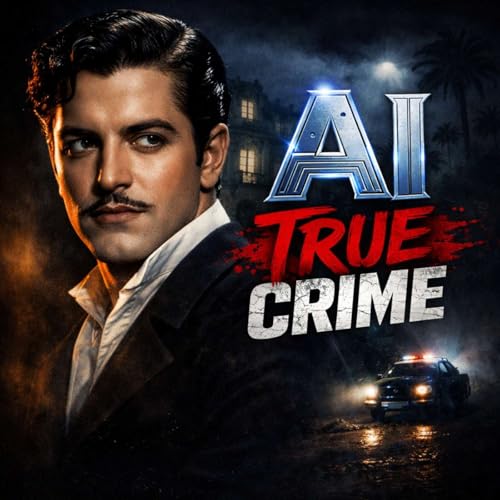
AI True Crime cover art

AI True Crime

AI True Crime

By: Artificial Intelligence
Listen for free

About this listen

Using various programmes, AI True Crime looks at true crime stories using AI text generation (ChatGPT and others) and voice-to-text, with background Music by Bensound. True Crime World
Episodes
  • The Bob's Big Boy Massacre
    Mar 2 2026
    The Bob’s Big Boy Massacre

    Glendale, California – October 22, 1980

    🔗 PRIMARY SOURCES & REPORTING

    Los Angeles Times archive coverage of the murders and arrestshttps://www.latimes.com/archives/la-xpm-1980-10-24-me-6283-story.html

    Follow-up reporting on arrests and confessionshttps://www.latimes.com/archives/la-xpm-1980-10-26-me-6665-story.html

    Coverage of sentencing and courtroom proceedingshttps://www.latimes.com/archives/la-xpm-1981-01-09-me-9017-story.html

    🔗 HISTORICAL & CASE SUMMARIES

    California Department of Corrections inmate records (case defendants)https://inmatelocator.cdcr.ca.gov

    Mass murder documentation and timeline referencehttps://murderpedia.org/male.H/h/harris-darrell.htmhttps://murderpedia.org/male.S/s/streeter-william.htm

    (These pages compile court outcomes, sentencing, and background.)

    🔗 CONTEXTUAL READING

    Discussion of late-1970s and early-1980s restaurant robberies in Southern Californiahttps://www.latimes.com/archives/la-xpm-1981-02-15-me-31303-story.html

    Historical analysis of execution-style robbery killingshttps://www.ncjrs.gov/pdffiles1/Digitization/67622NCJRS.pdf

    🔗 LOCATION HISTORY

    Bob’s Big Boy Glendale history and redevelopment timelinehttps://www.laconservancy.org/learn/historic-places/bobs-big-boy-glendale

    Historical overview of Bob’s Big Boy restaurantshttps://www.bobs.net/history

    🔗 ADDITIONAL ARCHIVAL MATERIAL

    Newspaper scans and contemporaneous reportinghttps://www.newspapers.com/search/?query=Bob%27s%20Big%20Boy%20Glendale%201980

    Court transcript references via California Judicial Archiveshttps://www.courts.ca.gov/archives.htm

    This podcast is powered by Pinecast.

    Show More Show Less
    32 mins
  • Episode 7 - Suspects and the End
    Feb 23 2026
    Episode 6: Other Suspects and the End of the Case Episode Summary In the final chapter of our Black Dahlia series, the investigation widens one last time. With the major theories exhausted, police files and later researchers turn toward a cluster of secondary suspects whose names surfaced briefly, then disappeared. Some were questioned and released. Others were investigated quietly and never revisited. Together, they form the outer perimeter of the case. This episode examines three of the most persistent alternate suspects, the reasons they were considered, and the evidence that ultimately failed to sustain those theories. It also addresses how the investigation finally dissolved, why no official closure ever came, and how the Black Dahlia transformed from an active homicide into one of the most mythologized crimes in American history. The episode concludes with the argument that the case did not remain unsolved because the truth was unknowable, but because the investigation fractured under pressure, politics, and institutional failure. What survived was not resolution, but narrative. Featured Subjects Leslie Dillon A bellhop with an interest in crime who corresponded with LAPD psychiatrist J. Paul De River. Dillon’s detailed letters raised suspicion, but inconsistencies, lack of corroboration, and procedural misconduct ultimately undermined the case against him. Jack Anderson Wilson A former LAPD informant and convicted criminal who claimed responsibility for the murder while hospitalized. His confession failed to match known evidence and was dismissed by investigators. Jeff Connors A bit-part actor who died by suicide in 1947 and was briefly examined due to timing and rumor. No physical or documentary evidence ever linked him to Elizabeth Short. The Collapse of the Investigation By mid-1947, the case was no longer being worked in any coordinated way. Tips continued to arrive, but no suspect remained active. Files were reorganized, leads were deprioritized, and responsibility quietly dispersed. Key Topics Covered Why confessions in high-profile cases often fail verification The role of police psychiatry in 1940s investigations How media pressure reshaped investigative priorities The disappearance of suspects through bureaucratic attrition The moment the case effectively ended without announcement Sources and References Primary and Historical Sources Los Angeles Times Black Dahlia Archivehttps://www.latimes.com/projects/la-me-black-dahlia/ FBI Vault: Black Dahlia Fileshttps://vault.fbi.gov/Black%20Dahlia LAPD Historical Homicide Fileshttps://www.lapdonline.org/history/ Books and Longform Research John Gilmore, _Severed: The True Story of the Black Dahlia Murder_https://www.goodreads.com/book/show/163983.Severed Larry Harnisch, “The Black Dahlia Files”http://www.lmharnisch.com Steve Hodel, _Black Dahlia Avenger_https://www.goodreads.com/book/show/164564.Black_Dahlia_Avenger Janice Knowlton and Michael Newton, _Daddy Was the Black Dahlia Killer_https://www.goodreads.com/book/show/289238.Daddy_Was_the_Black_Dahlia_Killer Academic and Contextual Material FBI Law Enforcement Bulletin Archivehttps://leb.fbi.gov Postwar Los Angeles Policing Historyhttps://www.lapdhistory.org Episode Review Episode 6 closes the Black Dahlia series not with revelation, but with examination. By moving away from dominant theories and toward the structure of failure itself, the episode reframes the case as a study in investigative collapse rather than criminal brilliance. It emphasizes proximity, documentation, and institutional behavior over mythmaking, leaving listeners with a clear understanding of why the case ended the way it did. No culprit is crowned.No certainty is manufactured.The story ends where the investigation actually did. This podcast is powered by Pinecast.
    Show More Show Less
    33 mins
  • The Black Dahlia - Part six: Marvin Margolis
    Feb 16 2026
    AI True Crime — Episode Six: Marvin Margolis

    Episode Six examines Marvin Margolis, a suspect briefly questioned by the LAPD in the weeks following the murder of Elizabeth Short. Unlike figures who later came to dominate public discussion of the case, Margolis was investigated contemporaneously, during the period when detectives were still operating under urgency rather than hindsight.

    The episode traces how Margolis entered the investigation through proximity, circumstance, and behavioral concern rather than theory. His questioning occurred amid a flood of tips, false confessions, and public pressure that defined the earliest phase of the case.

    We explore what investigators sought during his interview, what failed to emerge, and why Margolis did not generate sufficient evidence to justify continued attention. He did not confess, did not contradict verified timelines, and did not produce material leads.

    The episode examines how his name disappeared from the record not through formal clearance or concealment, but through investigative triage as the case shifted toward suspects who produced narrative momentum rather than procedural progress.

    Margolis becomes a control case, illustrating how ordinary suspects are evaluated, abandoned, and forgotten in real investigations. His brief involvement highlights the contrast between early police procedure and later theory-driven reconstructions.

    Episode Six concludes by reframing the Black Dahlia case as one shaped not only by what is unknown, but by how absence becomes misread as meaning once evidence and memory decay.

    Sources and References

    https://www.fbi.gov/history/famous-cases/black-dahlia

    https://www.latimes.com/california/story/2022-01-14/black-dahlia-murder-los-angeles-history

    https://www.smithsonianmag.com/history/black-dahlia-murder-180964709/

    https://www.waterandpower.org/museum/Black_Dahlia_Murder.html

    https://www.laalmanac.com/crime/cr30.php

    https://www.lapdonline.org/history-of-the-lapd/

    https://www.laalmanac.com/history/hi01.php

    https://www.latimes.com/archives/la-xpm-1997-jan-15-me-18740-story.html

    https://daily.jstor.org/the-black-dahlia-and-the-problem-of-victim-blaming/

    This podcast is powered by Pinecast.

    Show More Show Less
    30 mins
No reviews yet
In the spirit of reconciliation, Audible acknowledges the Traditional Custodians of country throughout Australia and their connections to land, sea and community. We pay our respect to their elders past and present and extend that respect to all Aboriginal and Torres Strait Islander peoples today.