

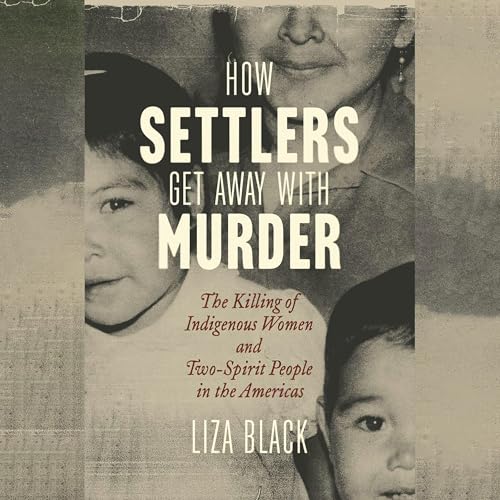
How Settlers Get Away with Murder
The Killing of Indigenous Women and Two-Spirit People in the Americas
Failed to add items
Sorry, we are unable to add the item because your shopping cart is already at capacity.
Add to basket failed.
Please try again later
Add to Wish List failed.
Please try again later
Remove from Wish List failed.
Please try again later
Follow podcast failed
Unfollow podcast failed
1 credit a month to buy any audiobook in our entire collection.
Unlimited access to our all-you-can-listen catalogue of 15K+ audiobooks and podcasts.
Member-only deals & discounts.
Auto-renews at $16.45/mo after 30 days. Cancel anytime.

How Settlers Get Away with Murder
Pre-order for $23.46
-
Narrated by:
-
By:
-
Liza Black
About this listen
“A phenomenal contribution to our understanding of the ongoing violence throughout the Americas against [MMIW2S].” — Professor Randall Akee, Harvard Kennedy School
Since the arrival of Columbus, thousands of perpetrators have gotten away with murder, burying evidence of their crimes in police reports and court testimony. How Settlers Get Away with Murder unearths that hidden evidence to expose the ongoing crisis of missing and murdered Indigenous women and Two-Spirit people (MMIW2S).
Historian and citizen of Cherokee Nation Liza Black examines 5 cases in Canada, the US, and Mexico, from 1908 to 2017. Rejecting narratives that blame victims’ poverty or trauma, Black dissects police files, coroners’ reports, and court records to uncover a harsh historical reality: The evidence of settler violence has been hiding in plain sight.
This landmark work delivers a damning verdict: The same systems of law and policing that have targeted Native people for centuries have also shielded their killers. Through meticulous archival interrogation, Black demonstrates how police, courts, and coroners have functioned not as instruments of justice but as pillars of a system designed to protect settler violence.
No reviews yet
In the spirit of reconciliation, Audible acknowledges the Traditional Custodians of country throughout Australia and their connections to land, sea and community. We pay our respect to their elders past and present and extend that respect to all Aboriginal and Torres Strait Islander peoples today.