

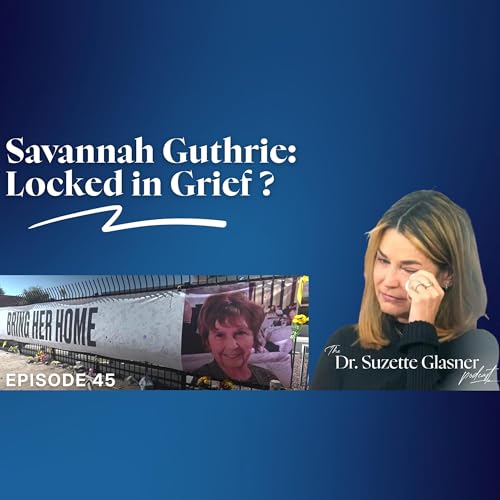
Ambiguous Loss: Why Savannah Guthrie’s Grief Feels Personal
Failed to add items
Add to basket failed.
Add to Wish List failed.
Remove from Wish List failed.
Follow podcast failed
Unfollow podcast failed

Ambiguous Loss: Why Savannah Guthrie’s Grief Feels Personal
-
Narrated by:
-
By:
About this listen
When someone we love disappears, grief becomes trapped between hope and despair. But ambiguous loss also occurs when addiction or illness changes someone we love.
Savannah Guthrie’s mother, Nancy Guthrie, was abducted more than a month ago — a tragedy that has captured national attention and stirred a powerful emotional response from people who have never met the family.
Why do stories like this affect us so deeply?
In this episode, addiction scientist and clinical psychologist Dr. Suzette Glasner explores the psychology of ambiguous loss, a term coined by family therapist Pauline Boss to describe a uniquely painful form of grief that occurs when a loved one is physically absent but psychologically present — such as in cases of missing persons, disappearances, or unresolved tragedies.
But ambiguous loss doesn’t only occur when someone goes missing. It can also happen when someone we love is physically present but psychologically changed by illness. Conditions such as dementia, severe mental illness, and addiction can create a similar experience of grief, as families struggle with the painful feeling that the person they once knew is “here, but not here.”
Drawing on decades of psychological research, Dr. Glasner explains the emotional experience reported by families navigating ambiguous loss — including the constant tension between hope and despair, guilt over moments of happiness, and the profound psychological toll of grief without closure.
The episode also explores why highly publicized tragedies can create a shared emotional experience across society — a phenomenon known as collective ambiguous loss — and how public grief unfolds in the age of social media.
Finally, Dr. Glasner discusses psychological traits and therapeutic approaches that can help people cope with uncertainty and loss when answers may never come.
Ambiguous loss is not limited to missing persons cases. Families coping with addiction, dementia, and severe mental illness often describe a similar experience of grief for someone who is still physically present but psychologically altered. One therapeutic approach that has shown promise in helping people cope with this kind of uncertainty is Acceptance and Commitment Therapy (ACT), which focuses on developing psychological flexibility and learning to live meaningfully even when answers or closure may never come.
Learn More About Acceptance & Commitment Therapy (ACT)• Association for Contextual Behavioral Science – https://contextualscience.org• Get Out of Your Mind and Into Your Life – Steven C. Hayes• The Happiness Trap – Russ Harris
📩 Questions or topic suggestions? Email AskDrGlasner@gmail.com
🔗 Subscribe for evidence-based discussions on addiction, recovery, and mental health:: https://www.YouTube.com/@drglasner
This is a public episode. If you would like to discuss this with other subscribers or get access to bonus episodes, visit drglasner.substack.com