

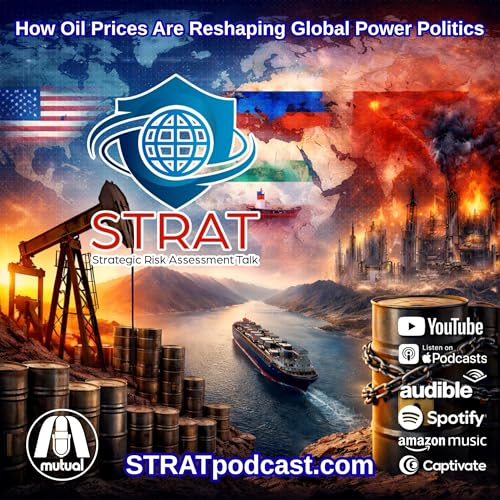
STRAT | 12 FEB 26 | How Oil Prices Are Reshaping Global Power Politics
Failed to add items
Add to basket failed.
Add to Wish List failed.
Remove from Wish List failed.
Follow podcast failed
Unfollow podcast failed

STRAT | 12 FEB 26 | How Oil Prices Are Reshaping Global Power Politics
-
Narrated by:
-
By:
About this listen
Global oil markets are no longer just about supply and demand—they are reshaping geopolitics in real time. In this episode of the STRAT podcast, retired Marine Intelligence Officer LtCol. Hal Kempfer breaks down how oil pricing and access are being used as strategic tools with far-reaching consequences. From pressure on Russia’s war economy to Iran’s vulnerability around the Strait of Hormuz, the ripple effects are global. The discussion explores how sanctions, tariffs, tanker seizures, and discounted crude are squeezing Russia’s revenues, pushing Cuba toward a full-blown energy crisis, and placing China in an increasingly precarious position due to its dependence on cheap oil from sanctioned states. Kempfer also explains key oil benchmarks like Brent and WTI, the importance of U.S. shale production, and why today’s environment differs fundamentally from past oil shocks. The result is a sober look at how energy strategy is quietly reshaping alliances, economies, and global stability.
Takeaways:
- Oil prices are being actively shaped by U.S.-led strategy
- Brent and WTI benchmarks reveal critical geopolitical signals
- Russia’s oil revenues are collapsing under sanctions pressure
- Tanker seizures are disrupting sanctioned oil supply chains
- The Strait of Hormuz remains a major global choke point
- Cuba faces an unprecedented fuel collapse and instability
- China’s reliance on discounted crude is becoming a liability
- Energy pressure may accelerate regime change scenarios
#STRATPodcast #HalKempfer #MutualBroadcastingSystem #StrategicRiskAnalysis #GlobalEnergy #OilMarkets #Geopolitics #EnergySecurity #RussiaUkraine #IranOil #ChinaEnergy #CubaCrisis #SanctionsPolicy #OilPrices #StrategicCompetition #NationalSecurity #EconomicWarfare #EnergyGeopolitics #GlobalStability #RiskAssessment