

Europa's Ice Shell and Planet Nine: Unveiling the Thickness of Frozen Worlds and Cosmic Oddities
Failed to add items
Sorry, we are unable to add the item because your shopping cart is already at capacity.
Add to basket failed.
Please try again later
Add to Wish List failed.
Please try again later
Remove from Wish List failed.
Please try again later
Follow podcast failed
Unfollow podcast failed

Europa's Ice Shell and Planet Nine: Unveiling the Thickness of Frozen Worlds and Cosmic Oddities
-
Narrated by:
-
By:
About this listen
In this episode of SpaceTime, we dive into groundbreaking revelations about Europa's ice shell, explore new evidence for the existence of a potential Planet Nine, and discuss a significant advancement in quantum physics that challenges the Heisenberg Uncertainty Principle.
Europa's Ice Shell Thickness Revealed
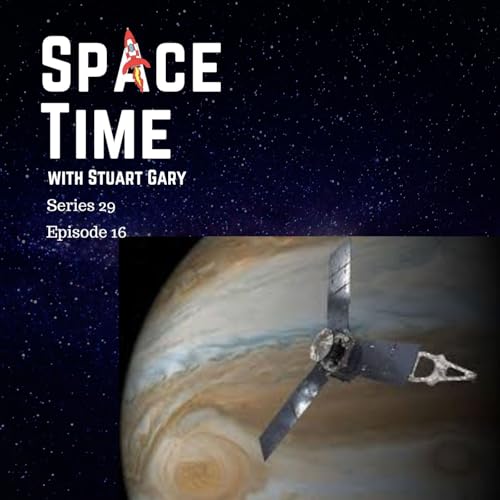
Data from NASA's Juno mission has provided the first insights into the thickness of Europa's icy crust, estimating it to be around 29 kilometers. This measurement comes from Juno's 2022 flyby, where the spacecraft utilized its microwave radiometer to analyze the moon's surface temperature and characteristics. The findings suggest that beneath this thick ice lies a global ocean of liquid water, potentially harboring the ingredients necessary for life. Understanding the ice shell's structure is crucial for future missions, including NASA's Europa Clipper, set to arrive in 2030.
The Case for Planet Nine
A new study published in Nature Astronomy presents fresh simulations suggesting that wide-orbit planets, like the hypothesized Planet Nine, could be a natural outcome of chaotic early planetary systems. Researchers found that during turbulent phases of stellar formation, planets can be flung into distant orbits rather than being ejected entirely. This work offers a 40% chance that a Planet Nine-like object exists, providing a promising avenue for future exploration as telescopes become more capable of surveying the distant solar system.
Advancements in Quantum Physics
In a remarkable breakthrough, physicists have demonstrated a method to sidestep the Heisenberg Uncertainty Principle, allowing for simultaneous precise measurements of a particle's position and momentum. This innovative approach, detailed in Science Advances, could pave the way for ultra-precise sensor technologies across various fields, including navigation and astronomy. The study redefines the boundaries of quantum measurement, offering new possibilities for scientific exploration.
www.spacetimewithstuartgary.com
✍️ Episode References
Nature Astronomy
Science Advances
Become a supporter of this podcast: https://www.spreaker.com/podcast/spacetime-your-guide-to-space-astronomy--2458531/support.
No reviews yet
In the spirit of reconciliation, Audible acknowledges the Traditional Custodians of country throughout Australia and their connections to land, sea and community. We pay our respect to their elders past and present and extend that respect to all Aboriginal and Torres Strait Islander peoples today.