


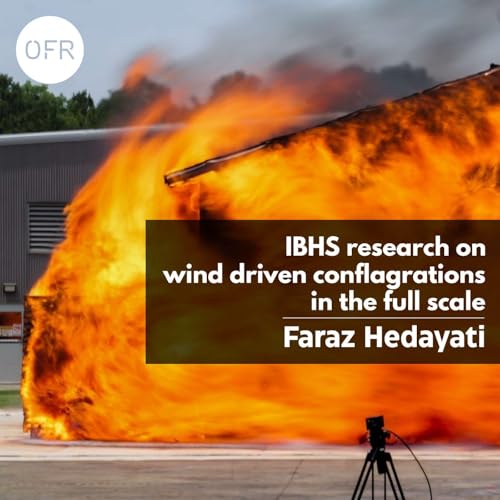
230 - Wind driven conflagration experiments with Faraz Hedayati
Failed to add items
Add to basket failed.
Add to Wish List failed.
Remove from Wish List failed.
Follow podcast failed
Unfollow podcast failed

230 - Wind driven conflagration experiments with Faraz Hedayati
-
Narrated by:
-
By:
About this listen
A facility with 105 synchronized fans pushing hurricane-class wind across a full-size house while a live fire... This is not science fiction - this is a real research capacity that helps us re-shape our knowledge on the full scale building ignition, fire spread, and failure. That’s the stage at IBHS, where we dig into how wind-driven fire behave differently to small-scale and how tiny choices around a building can decide its fate. Together with my guest - dr Faraz Hedayati, we go from embers generation and fire spread studies, to urban conflagration research.
We start with embers, the quiet culprits behind so many structure losses in the WUI. Embers aren’t a single threat but a spectrum of sizes, temperatures, and lifetimes that ride shifting eddies and stall in stagnation zones. We talk through what full-scale tests reveal: glowing ember lines at the base of walls, roof reattachment zones where deposits spike, and the hard truth that counting particles matters less than controlling where they land. The guidance is clear and actionable—noncombustible vertical clearance, hardened vents, defensible space within the first five feet—because under wind, any component can become the first domino.
Then we tackle conflagration: how a spot fire becomes a neighborhood problem. IBHS’s shed-to-structure and fully furnished burns show exposure arriving in pulses, not a smooth curve. Collapse chokes flames and then reinvigorates them, creating multiple peaks where materials succeed or fail on a timer. We compare 30 mph to 60 mph winds and see how plumes lose buoyancy, flatten into the target, soften vinyl frames, and push glazing inward. Separation distance emerges as a decisive lever: around 10 feet, continuous flame contact dominates; at 20 feet and beyond, exposure becomes intermittent and materials can win—unless “connected fuels” like vehicles, fences, and decks bridge the gap.
The takeaway isn’t a silver bullet. It’s a layered defense: control embers, clean the near-wall zone, harden openings, choose noncombustible claddings, and increase spacing where possible. Small-scale testing and modeling still matter, but wind-driven fire demands validation at full scale to catch the peaks, the collapses, and the failure modes no bench setup can mimic. If you care about wildfire resilience, urban design, or building safety, this conversation offers a rare, data-rich look at how communities ignite—and how we can change the odds.
Learn more about IBHS research at https://ibhs.org/risk-research/wildfire/
Cover picture courtesy of dr Faraz Hedayati.
----
The Fire Science Show is produced by the Fire Science Media in collaboration with OFR Consultants. Thank you to the podcast sponsor for their continuous support towards our mission.